 MineArchive
Trefrane Cliff Colliery
| Also known as | Trefrane Colliery, Trefran Cliff Colliery, Trevane |
|---|---|
| Location | Nolton, St Brides Bay, Pembrokeshire — 51.8347, -5.1118 (approximate) |
| Commodity | Coal |
| Type | Coal |
| Worked | In the first List of Mines, 1854; reopened 1888–1906 or 1907; idle until 1913 |
| Maximum depth | 100 yards (each inclining shaft) |
| Operators | Walters and Canton (1888–1906), Thomas and Clayton (1854–1874) |
Overview
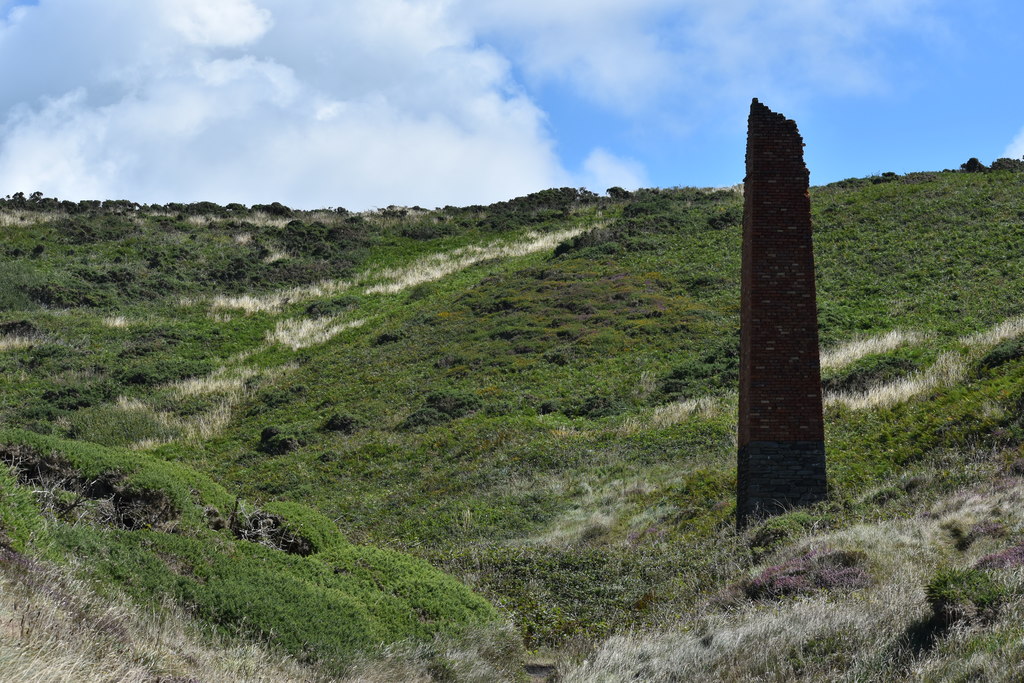
The largest colliery of the little Nolton and Newgale coalfield on St Brides Bay, and the westernmost coal worked in Wales. Opened in the 1850s by Thomas and Canton, its inclining shafts went down 100 yards under the cliff; coal went to Nolton Haven to be loaded into small ships that beached on the sand. It employed 36 people in 1896 under Walters and Canton, ceased production in 1906 and was gone from the Lists of Mines by 1913. Its engine-house chimney still stands above the coast path, a listed landmark at the southern end of Newgale Beach.
History
The Pembrokeshire coalfield's western arm ran out to the sea at St Brides Bay, and its accessibility from the coast produced a string of small collieries around Little Haven, Broad Haven and Nolton Haven. Trefrane, the largest of them, appears in the first List of Mines in 1854 as 'Trevane' and may be older; it was opened by Thomas and Canton, held by Thomas and Clayton until 1870 and then by David Clayton alone, and had dropped out of the lists by 1874. Coflein's account gives Thomas and Canton as the original owners and David Canton as sole owner by 1870. The colliery was reopened in 1888 as Trefrane Cliff under Walters and Canton. The Inspector of Mines list of 1896 records 36 people employed, eight of them on the surface, working what the lists call the Goutts seam; the Cliff seam is recorded as abandoned. Its inclining shafts were each 100 yards deep. Trefrane was worked as part of the wider Nolton undertaking, and its coal was carried to Nolton Haven to be loaded at low tide into small coasting vessels that floated off on the following tide. Production ceased in 1906 or 1907, after which the colliery was returned as idle until it disappeared from the lists in 1913.
Geology
The westernmost coal of the Pembrokeshire coalfield, an anthracite field whose measures reach the sea at St Brides Bay. The lists record Trefrane working the Goutts seam, with the Cliff seam abandoned.
Geological setting: Sedimentary Beds and Seams (historical documentary reference)
Workings
Inclining shafts, each 100 yards deep, driven from a small valley just in from the shore. The surviving remains are a stone and brick chimney, the foundations of the engine house beside it and a spoil tip to the west; the chimney is square, just over two metres at the base and rises to fourteen metres.
Closure
Production ceased in 1906 or 1907 and the colliery was classed as idle in the Lists of Mines until it disappeared from them in 1913. Welsh Coal Mines gives the closure as 1906 and Coflein as 1906 or 1907.
What remains
The site is on the Pembrokeshire Coast Path at the southern end of Newgale Beach. The chimney survives substantially intact and is listed Grade II; the engine-house foundations and spoil tip remain, and the former shafts are fenced off.
A substantially intact stone and brick chimney, fourteen metres high, with the foundations of the engine house alongside and a spoil tip to the west. The Royal Commission recorded the site by photogrammetry in 2022.
Redevelopment
None; the site is open coastal grassland within the Pembrokeshire Coast National Park.
People
- David Canton · owner, from 1870 — Sole owner of Trefrane by 1870 in Coflein's account; the Cantons of Nolton Haven farm were long connected with the coal trade of this coast.
Recorded claims
Individual factual claims, each attached to the source(s) that support it below. Where sources disagree, both are kept.
- Trefrane appears in the first List of Mines in 1854 as 'Trevane' and was opened by Thomas and Canton; it was held by Thomas and Clayton until 1870, then by David Clayton alone, and had left the lists by 1874. 1,2
- The colliery was reopened in 1888 as Trefrane Cliff under Walters and Canton, and the Inspector of Mines list of 1896 records 36 people employed, eight of them on the surface. 1,2
- Its inclining shafts were each 100 yards deep, and the colliery worked the Goutts seam, the Cliff seam being recorded as abandoned. 1
- Trefrane was worked as part of the wider Nolton undertaking and its coal was taken to Nolton Haven to be loaded at low tide into small ships that beached on the sand. 1,2
- The surviving remains are a substantially intact stone and brick chimney, listed Grade II and standing fourteen metres high, the foundations of the engine house and a spoil tip to the west. 2
- Production ceased in 1906 or 1907, after which the colliery was returned as idle until it disappeared from the Lists of Mines in 1913. 1,2
Photographs & further reading
The national monuments record entry: the chronology of the workings, the listed chimney and engine-house foundations, and the 2022 photogrammetric survey.
View sourceSources
- (secondary) Trefrane (Welsh Coal Mines, via the Internet Archive) — Welsh Coal Mines
- (primary) Trefran Cliff Colliery; Trefrane Cliff Colliery — Coflein, Royal Commission on the Ancient and Historical Monuments of Wales
Record created: 20 September 2026 · Last researched: 20 September 2026