 MineArchive
Tanyrallt Mine
| Location | Tanyrallt, north of Talybont, Ceredigion |
|---|---|
| Commodities | Lead, Silver |
| Type | Metal |
| Worked | Before 1869–1891 |
A silver-lead mine on the ridge above Talybont, north of Alltycrib, worked from adits and then by a Cornish pumping engine from the early 1870s until 1891; its boiler survives.
History
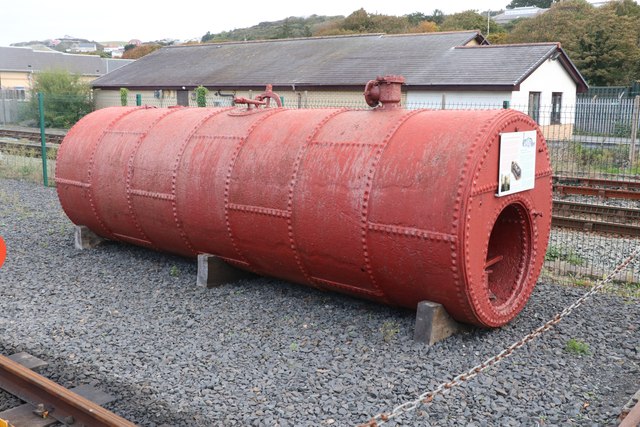
Tanyrallt Mine worked lead on the ridge above Talybont, about half a mile north of Alltycrib, between that old mine and the Penpontbren and Erglodd workings. It was first worked from adit levels, which yielded a considerable quantity of lead ore. In 1870 a correspondent reported that Tan'rallt mine, on the property of J. M. Davies, looked very promising and that good ground had been cut. A new company then gave it a trial and put up a Cornish pumping engine in a new engine house. The display beside its surviving boiler dates the engine to 1870 and the boiler to 1875, when a larger one was needed to raise the engine's power to 30 horsepower; a 2013 study put the installation at about 1873 or 1874, since reports of 1869 and 1870 do not mention an engine and Absalom Francis did in 1874.
Francis was not impressed. He had been over the mine many times and doubted that enough ore could be raised to pay its costs, calling it one of those concerns he would not consider a desirable investment. Its employer, C. Herbert Stokes, was more hopeful: in September 1874 he gave the thirty or so men at the mine a dinner, toasted the success of the Tanyrallt Mine and hoped a recent discovery there would prove lasting. Separate returns were made from 1869 to 1871 and from 1874 to 1886, and over those years the mine sent away about 750 tons of lead ore, yielding 554 tons of lead and 3,966 ounces of silver. It was abandoned in 1891.
Geology
Lodes which Francis described as caunter lodes, running about 40 to 50 degrees south of east and north of west into the old Alltycrib workings, rather than the district's usual east-west veins. The main lode has a southerly dip and was worked for galena; it may be the continuation of the north lode at Penpontbren. The ore was argentiferous, at about 5.5 ounces of silver to the ton of ore.
Workings
Adit levels, followed in the early 1870s by a shaft pumped by a Cornish engine in a stone engine house with a square chimney and an external boiler house. The lode was worked about 150 yards west of Tanyrallt farm.
Closure
Abandoned in 1891. The engine was removed but the boiler was left in its house and gradually buried by the collapsing masonry.
What remains
The engine house is gone: it was razed in 1968 by one account and its remains demolished in 2006 by another. The boiler was lifted out in 2006 and is now displayed at Aberystwyth.
None of the engine house survives. Its Cornish boiler, 15 feet 6 inches long and 5 feet across, is on display at the Vale of Rheidol Railway in Aberystwyth.
Related mines
- Alltycrib Mine — On the same ridge above Talybont: Tanyrallt's lodes run into the old Alltycrib workings, and some Talybont returns may include Tanyrallt ore.
- Penpontbren Mine — Tanyrallt's lode may be the westward continuation of the north lode at Penpontbren.
Further reading
The Geological Survey's 1922 memoir on the north Cardiganshire mines, with the Tanyrallt lode and the mine's output of lead ore and silver.
View sourceFrancis's 1874 account of the mines from Ynystudor to Alltycrib, including his opinion of Tanyrallt and its new steam engine.
View sourceThe trust's account of the mine's Cornish boiler: its history, rescue in 2006 and description.
View sourceA newspaper report of C. Herbert Stokes's dinner for the men of the mine.
View sourceSources
- (primary) Lead and Zinc: The Mining District of North Cardiganshire and West Montgomeryshire (Special Reports on the Mineral Resources of Great Britain, vol. XX), O. T. Jones, 1922 — Memoirs of the Geological Survey
- (secondary) A site visit to Cwmbyr Mine in 2012, by Nigel Chapman (Welsh Mines Preservation Trust Newsletter, May 2013) — Welsh Mines Preservation Trust
- (secondary) History of the Cardiganshire Mines, from the Earliest Ages to A.D. 1874, by Absalom Francis (extract for the Llangynfelyn district) — Llangynfelyn community website
- (observational) Vale of Rheidol Railway - Cornish boiler (Geograph 8428245, Chris Allen) — Geograph
- (secondary) Festivities at the Tanyrallt Mine (Aberystwith Observer, 26 September 1874) — National Library of Wales (Welsh Newspapers Online)
- (secondary) Mining intelligence (Aberystwyth Times, 5 February 1870) — National Library of Wales (Welsh Newspapers Online)
Record created: 19 November 2026 · Last researched: 19 November 2026