 MineArchive
Plashetts Colliery
| Location | Plashetts, north-west of Falstone in the North Tyne valley, Northumberland; the site is under Kielder Water, Northumberland — 55.1992, -2.5003 (approximate) |
|---|---|
| Commodity | Coal |
| Type | Coal |
| Worked | 1850s–1964 |
| Maximum depth | About 130 ft (40 m) to the Plashetts seam |
| Operators | Duke of Northumberland, J. F. Tone and Co., Plashetts Coal Company |
Overview
A colliery high in the North Tyne valley north-west of Falstone, opened in the 1850s on the Duke of Northumberland's land and served by its own waggonway and a station on the Border Counties Railway. Its pit village of four terraces grew up in the 1890s; the colliery dwindled after the 1920s and closed in the 1960s, and its site now lies under Kielder Water.
History
Plashetts Colliery lay in the North Tyne valley about four miles north-west of Falstone, working the Plashetts seam, a coal of the Limestone measures, which its shafts reached at about 130 feet. It was opened in the 1850s under the Duke of Northumberland; in the 1860s James Furness Tone's J. F. Tone and Co. took it over. Plashetts station opened on the Border Counties Railway near the colliery in 1861, and a waggonway climbed from it up Slater's Incline and across the moor to the Seldom Seen Pit, sunk on higher ground east of Plashetts. Seldom Seen was worked from 1862 until 1889, when it was worked out and replaced by two new pits, around which grew the hamlets of Far Colliery and Bank Top.
C. U. Laws held the colliery in the 1880s and the Plashetts Coal Company from the 1890s. A brickworks was set up in 1886, and in the 1890s Plashetts village, four rows of terraced houses with a chapel, was built for the miners. The colliery raised steam coal, employing 74 people in 1894 and 106 in 1910, and 126 were recorded in 1914. The brickworks closed that year, and after the 1920s only a handful of miners worked on: 13 in 1930. The Plashetts seam was abandoned in 1935, but W. A. Nixon worked the colliery again from the 1940s with five to sixteen men; its last workings were abandoned in February 1964. The colliery, the station and Plashetts Farm now lie under Kielder Water, completed in 1982; the foundations of the village terraces survive in Kielder Forest above the shore.
Geology
Northumberland's Carboniferous Limestone measures: the Plashetts seam, about 3 ft 9 in thick.
Workings
Shafts to the Plashetts seam, an air shaft and the Doctor Drift; the Seldom Seen Pit (1862-1889) and two later pits, joined to Plashetts station by a waggonway up Slater's Incline.
Closure
Its last Plashetts seam workings were abandoned on 7 February 1964; one account gives 1962. The seam had been abandoned once before, in 1935, before small-scale reworking.
What remains
The colliery and station sites are under Kielder Water; the foundations of the village terraces survive in Kielder Forest.
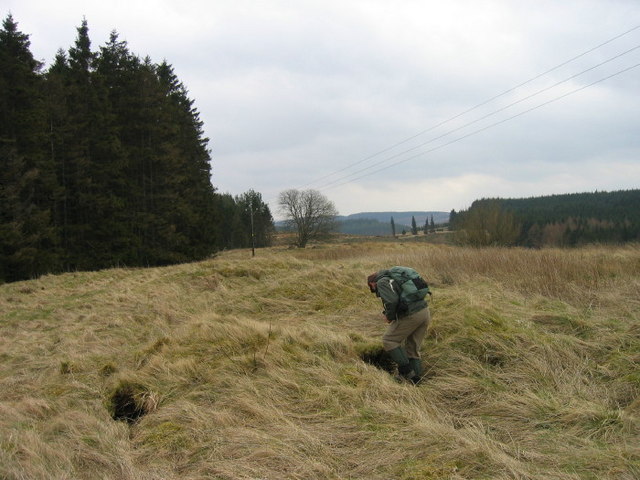
The foundations of the miners' terraces in Kielder Forest.
Redevelopment
Flooded by Kielder Water, completed in 1982, and planted as Kielder Forest.
Related mines
- Brownrigg Colliery — Both were worked under the Duke of Northumberland's estate.
What's uncertain
Points where sources disagree or the record could not be settled; both accounts are kept. All open questions in the archive.
- The colliery finally closed in 1962. (disputed) 1
- The Plashetts seam was abandoned on 1 June 1935; the colliery was still listed, with five men, in 1964. (disputed) 4
Recorded claims
Individual factual claims, each attached to the source(s) that support it below. Where sources disagree, both are kept.
- Plashetts Colliery was opened in the 1850s, and Plashetts station opened near it in 1861. 1,2
- J. F. Tone and Co. took over from the Duke of Northumberland in the 1860s and sank the Seldom Seen Pit, reached by a waggonway up Slater's Incline; it was worked out by 1889 and replaced by two new pits. 3
- Plashetts village, four rows of terraced houses, was built for the miners in the 1890s; a brickworks opened in 1886 and closed in 1914. 1
- The colliery employed 74 people in 1894, 106 in 1910 and 13 in 1930, and was worked again from the 1940s with five to sixteen men. 4
- The colliery finally closed in 1962. (disputed) 1
- The Plashetts seam was abandoned on 1 June 1935; the colliery was still listed, with five men, in 1964. (disputed) 4
- The site of the colliery, the station and Plashetts Farm now lie under Kielder Water, and the foundations of the pit village can still be seen near its shore. 1,2,5
- The Plashetts seam workings were abandoned on 7 February 1964; plans of Plashetts Nos 1, 3 and 4 are dated 1928, and of the Doctor and Slaters No. 2 workings 1 June 1935. 6
Photographs & further reading
Owners, employment from 1894 to 1964, the shaft section and the men killed at the colliery.
View sourceSources
- (secondary) Plashetts — Co-Curate (Newcastle University)
- (secondary) Plashetts railway station — Wikipedia
- (secondary) Seldom Seen Pit (Plashetts Colliery) — RailScot
- (primary) Plashetts Colliery — Durham Mining Museum
- (observational) Part of village was submerged — Hexham Courant
- (primary) BGS mine plan: Plashetts, Plashetts seam, abandoned 7 February 1964 — BGS / Mining Remediation Authority mine plans
Record created: 5 October 2026 · Last researched: 5 October 2026