 MineArchive
Niddrie Colliery
| Also known as | Niddrie and Benhar Collieries |
|---|---|
| Location | Niddrie, Liberton parish, Edinburgh, Midlothian — 55.9330, -3.1050 (approximate) |
| Commodity | Coal |
| Type | Coal |
| Worked | By 1874–by 1968 |
| Maximum depth | Unknown. |
| Operators | Niddrie and Benhar Coal Company (1874–1947), National Coal Board (1947–1968) |
Overview
Coal workings at Niddrie, on the eastern edge of Edinburgh between Craigmillar and Newcraighall, run under a single company from 1874, when the Niddrie Coal Company Limited was formed to acquire the mineral rights of the Niddrie, Woolmet and Edmonstone areas from George Simpson of Benhar. It was a subsidiary of the Benhar Coal Company, and the two names ran together as the Niddrie and Benhar Coal Company. The official list of collieries at work in 1880 returns Niddrie under the Benhar Coal Co., Limited. Shafts numbered up to thirteen were sunk at Niddrie; a large new colliery began sinking at Newcraighall in 1897 and another came into production at Woolmet in 1898. The company built 168 houses for its men in what became the Jewel village, and a brickworks in 1924 to supply bricks for its own housebuilding.
History
The Niddrie Coal Company Limited was formed in 1874 to acquire the mineral rights in the Niddrie, Woolmet and Edmonstone areas of Edinburgh from George Simpson of Benhar, and was a subsidiary of the Benhar Coal Company Limited. The official list of collieries at work in 1880 returns the pit as "Niddrie, Liberton, Benhar Coal Co., Limited" — Liberton being the parish. Shafts numbered eleven to thirteen were added at Niddrie; in 1897 a large new colliery began sinking nearby at Newcraighall, often called the Klondyke, and in 1898 another came into production at Woolmet.
The company housed its men itself. The Jewel Cottages were built between 1880 and 1900 by the Niddrie and Benhar Coal Company as miners’ housing for the pits in this part of Edinburgh, and grew into a company village of 168 houses known as the Jewel. A private mineral railway ran from Niddrie Yard, serving Woolmet Colliery, the various Niddrie mines and Newcraighall, running generally southward parallel to the Edinburgh and Dalkeith Railway. In 1924 the company built the Niddrie Brickworks to supply bricks for its own housebuilding, with three large Hoffman continuous kilns and, latterly, a modern shuttle kiln.
The Niddrie pits themselves gave out before their neighbours. Woolmet closed in 1967 and Newcraighall — the nearest pit to the Jewel by the end — in 1968; National Coal Board locomotives were still drawing loaded trains out of the Niddrie exchange sidings to the landsale yard in 1971, and the connection to the landsale yard was lifted only shortly before April 1982. The brickworks closed in 1991 and was demolished. The Jewel village went in the early 1980s, and the relief road built across its site in 1983 took its name.
Geology
The Midlothian coalfield, running south-east from Edinburgh in a deep basin whose seams dip steeply on its western limb. The Niddrie, Woolmet and Edmonstone royalties acquired in 1874 lie together on the northern edge of that field, and the sequence of workings across them — Niddrie first, then Newcraighall from 1897 and Woolmet from 1898 — is a company following one coalfield deeper and further out from a single base.
Geological setting: Sedimentary Beds and Seams (well documented example)
Workings
A group of shafts numbered up to thirteen at Niddrie, worked with the company’s other pits at Woolmet and Newcraighall and served by its own private mineral railway from Niddrie Yard, which ran south parallel to the Edinburgh and Dalkeith line. The yard and its exchange sidings outlived the pits by more than a decade as a landsale depot. A brickworks was added in 1924.
Closure
The Niddrie pits closed before their neighbours; Woolmet followed in 1967 and Newcraighall in 1968, ending deep mining on the company’s ground. The Niddrie yard continued as a National Coal Board landsale depot into the 1970s, the brickworks until 1991.
What remains
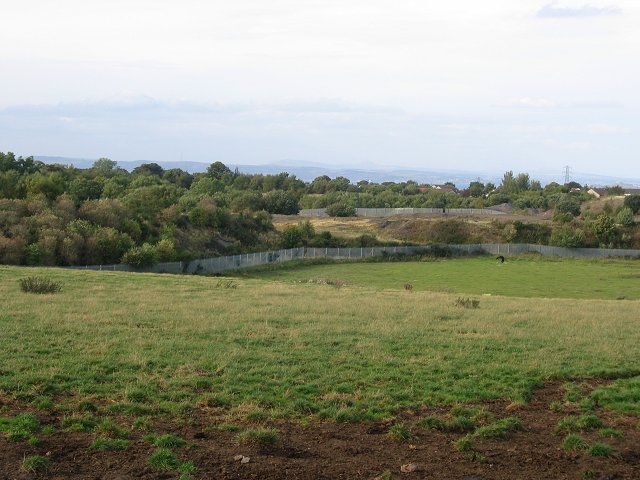
Housing and open ground. The Jewel village was cleared in the early 1980s and the Niddrie-Bingham relief road driven across the site in 1983, taking the village’s name; the brickworks was demolished after 1991. Colliery waste is still visible on the ground north of Cauldcoats, photographed from the Niddrie side.
Colliery waste north of Cauldcoats, and the street names of the 1980s estate — The Jewel, Corbieshot, North Greens, Parrotshot, Vexhim Park, Hosie Rigg — which preserve the field and village names of the mining ground beneath.
Redevelopment
Housing, a superstore and the Jewel relief road of 1983.
Nearby mines
- Newcraighall Colliery — 0.4 miles (0.6 km) E
- Edmonstone Colliery — 1.1 miles (1.7 km) SW
- Monktonhall Colliery — 1.1 miles (1.8 km) SE
- Woolmet Colliery — 1.3 miles (2.1 km) S
- Gilmerton Colliery — 2.3 miles (3.7 km) S
Straight-line distance, within 9 miles (15 km). Show on the map.
Disasters & major incidents
-
Niddrie Colliery No. 7 Pit fire, 1884
1884 · Fire · 7 fatalities
Early on 24 May 1884 the timber beside the pump rods in the No. 7 incline of Niddrie Colliery, near Portobello, caught fire. The flames destroyed the headgear and smoke filled the workings; most men escaped by No. 12 pit, but sixteen went to the rise workings instead, and seven of them were found dead ten hours later. -
Niddrie Colliery incline accident, 1901
1 September 1901 · Haulage / Transport · 2 fatalities
Two roadsmen testing a carriage incline at Niddrie on 1 September 1901 were killed when the rope came off the drum and the carriage ran away to the bottom. -
Niddrie Colliery incline shaft accident, 1908
29 August 1908 · Winding / Shaft Accident · 2 fatalities
Two inclinemen inspecting a 109-degree pipe shaft at Niddrie on 29 August 1908 died when their carriage left the rails: one fell to the bottom, and the other collapsed from heat and exhaustion trying to climb out.
What's uncertain
Points where sources disagree or the record could not be settled; both accounts are kept. All open questions in the archive.
- The BGS mine-plans catalogue holds a Mining Remediation Authority abandonment plan titled 'Niddrie' (catalogue 9070, Peacocktail, dated 1926); the catalogue gives no location and the plan's details do not clearly tie it to this working, so it may belong to another of the same name. (uncertain) 5
Recorded claims
Individual factual claims, each attached to the source(s) that support it below. Where sources disagree, both are kept.
- The official list of collieries at work in 1880 returns the pit as "Niddrie, Liberton, Benhar Coal Co., Limited". 1
- The Niddrie Coal Company Limited was formed in 1874 to acquire the mineral rights in the Niddrie, Woolmet and Edmonstone areas of Edinburgh from George Simpson of Benhar, and was a subsidiary of the Benhar Coal Company Limited. 2
- Shafts numbered eleven to thirteen were added at Niddrie; in 1897 a large new colliery commenced sinking nearby at Newcraighall, often called the Klondyke, and in 1898 another commenced production at Woolmet. 2
- The Jewel Cottages were built between 1880 and 1900 by the Niddrie and Benhar Coal Company as miners’ housing for the pits in this area, constituting a company village known as the Jewel and totalling eventually 168 houses. 2
- A private mineral railway ran from Niddrie Yard serving Woolmet Colliery, the various Niddrie mines and Newcraighall Colliery, its main portion running generally southward parallel to the Edinburgh and Dalkeith Railway; National Coal Board locomotives were still working loaded trains out of the Niddrie exchange sidings in 1971, and the connection to the landsale yard was lifted shortly before April 1982. 3
- The Niddrie Brickworks was built in 1924 to supply bricks for housebuilding by the Niddrie & Benhar Coal Co., with three large Hoffman continuous kilns and latterly a modern shuttle kiln; it closed in 1991 and was demolished. 2,4
- Newcraighall closed in 1968 and Woolmet in 1967. 2
- The BGS mine-plans catalogue holds a Mining Remediation Authority abandonment plan titled 'Niddrie' (catalogue 9070, Peacocktail, dated 1926); the catalogue gives no location and the plan's details do not clearly tie it to this working, so it may belong to another of the same name. (uncertain) 5
Photographs & further reading
The company’s private mineral railway traced location by location, with dated photographs from 1971 to 1982 of the exchange sidings, the landsale yard and the NCB Andrew Barclay locomotives still working them after the pits had closed.
View sourceSources
- (secondary) List of coal mines UK 1880 — Coalmining History Resource Centre
- (secondary) The thread about the little suburban 'Jewel Carriageway' — Threadinburgh
- (observational) Niddrie and Benhar Coal Company — RAILSCOT
- (secondary) Niddrie and Benhar Coal Company — Scotland’s Brick and Tile Manufacturing Industry — Scottish Brick History
- (primary) BGS / Mining Remediation Authority mine plans: NIDDRIE — British Geological Survey / Mining Remediation Authority
Record created: 6 September 2026 · Last researched: 6 September 2026