 MineArchive
New Bowson Colliery
| Also known as | Bowson Colliery |
|---|---|
| Location | Cinderford, Forest of Dean — 51.8338, -2.5173 (approximate) |
| Commodity | Coal |
| Type | Coal |
| Worked | 1864 (sinking began)–1925 (abandoned) |
| Maximum depth | 865 feet |
| Operators | Cornelius Walding (1843–?, owner) — Galee of the Bowson gale from 1843 Great Western Deep Coal Co. (1863–1868) New Bowson Deep Coal Co. Ltd (1868–1870) New Bowson Coal Co. Ltd (?–1907, owner) — Held the pits after the 1871 abandonment Lydney and Crump Meadow Collieries Co. Ltd (1907–1932, owner) — As part of the Northern United gale |
The Forest of Dean's first attempt at deep mining, two shafts near Cinderford sunk from 1864 to about 865 feet but beaten by water; little or no coal was won and the site was abandoned in 1925.
Location
Approximate location. The large pin is this mine; the small round markers are the nearest mines on record. Click one for its page. View on full map
History
The Bowson gale near Cinderford was granted in June 1843 to Cornelius Walding of Ruardean Hill, for the Coleford High Delf and the veins between it and the Churchway High Delf. As one of the Forest's deep gales it sat untouched until somebody could raise the money to sink that far. That came in January 1863, when the Great Western Deep Coal Co. was formed with £50,000 of capital, most of its shareholders from the Pontefract area of Yorkshire, among them members of the Holden family. It added the northern part of the unworked East Dean Deep gale. Early in 1864 it began sinking two shafts beside the Winning Pits of Goold and Heyworth, owners of Bilson and Crump Meadow, who went to law to stop it; in June 1864 the court found for the newcomers. It was the first attempt at deep mining in the Forest.
The sinking went badly. In October 1866 a labourer was killed by stone falling from the shaft lining at about 200 yards, and the inspector found the brickwork crushed and out of true, the winding engine too weak and the rope too thin. At about 280 yards water broke in so fast that the sinkers were lucky to escape. For a while the water was wound out in containers, until a chain snapped in September 1867. The company bought a Cornish beam pumping engine for £700 from the closed Poldice copper mine, built in 1821 to William Sims's design, and had it rebuilt at Perran Foundry as a double-acting engine with an 85-inch cylinder. In January 1868 Edward Hooper was killed when the tub he was riding was wound over the pulley at the Land Pit. That March the company went into liquidation.
The New Bowson Deep Coal Co. Ltd took over in June 1868 and had the engine working by July 1869, but in April 1870 the Mining Journal called the venture a partial failure: the shafts were about 284 yards deep and the engine could not keep the water out. The company was wound up in December 1870 and the work abandoned in 1871, after about £80,000 had been spent. The Holden and Illingworth families' New Bowson Coal Co., which worked neighbouring East Slade, held the pits afterwards, while the great engine stood unused in its house for over fifty years. Under the Dean Forest (Mines) Act of 1904 New Bowson and East Dean Deep were joined with the Holly Hill United and Richard Whites gales as the Northern United gale, which the Lydney and Crump Meadow Collieries Co. Ltd acquired in 1907. A new steel headframe went up in 1921, but by 1925 hope of winning coal here was given up and the engine house and pump were demolished. Henry Crawshay & Co. bought the gale in 1932 and sank Northern United Colliery a short way to the north-west.
Geology
The shafts went down through the Supra-Pennant Group, with the Churchway High Delf seam, to below the Yorkley seam of the Pennant Group in the Upper Coal Measures. The gale's target was the Coleford High Delf. The sinkers met heavy feeders of water at about 240 and 280 yards in porous ground.
Workings
Two shafts, the deep pit and the Land Pit, the deeper reaching 865 feet. The pit was 11 feet in diameter, lined in dressed stone, brick and iron tubing. A second-hand 85-inch Cornish beam engine, rebuilt as double-acting, pumped from the main shaft and a staple pit inside the engine house from 1869. Sidings connected the site to the Churchway branch of the Great Western Railway's Forest of Dean branch.
Closure
Work was abandoned in 1871 after the second company failed, and a dam was put in the shaft in 1874. The pits were revived on paper as part of the Northern United gale in 1904, but the site was finally given up in 1925, when the engine house and the Cornish engine were demolished.
What remains
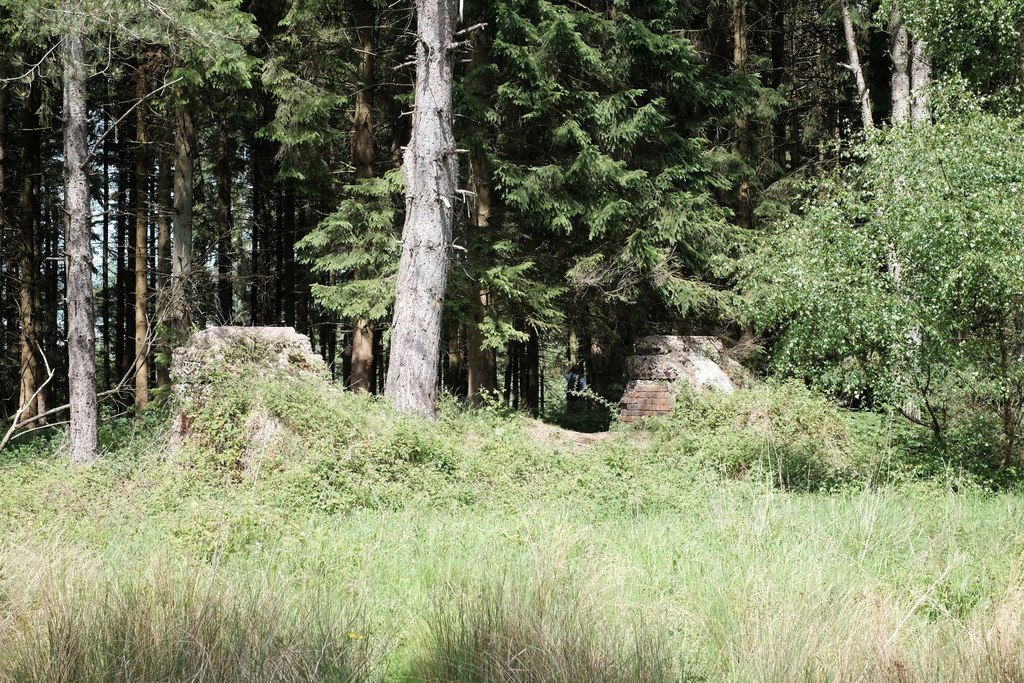
Concrete and brick foundations survive. A circular stone and steel structure, probably a shaft collar, and the lower part of a stone building, possibly the engine house, have been restored, and an information board stands on the site as part of the Cinderford Linear Park.
Foundations, a restored circular shaft collar and the base of a stone building, probably the engine house.
Redevelopment
The site lies within the Cinderford Linear Park, with an information board.
Related mines
- Bilson Colliery — The New Bowson shafts were sunk beside Bilson's Winning Pits in 1864, and the Bilson and Crump Meadow owners went to law to stop them.
- Crump Meadow Colliery — The New Bowson shafts were sunk beside the Winning Pits of the Bilson and Crump Meadow owners, who went to law to stop them in 1864.
- East Slade Colliery — Both were held by the Holden and Illingworth families' New Bowson Coal Co., which bought East Slade in 1871 and kept the New Bowson pits.
- Meadow Cliff Colliery — Neighbours north of Cinderford, both recorded on the Northern United abandonment plan.
- Northern United Colliery — New Bowson became part of the Northern United gale in 1904, and Henry Crawshay & Co. sank Northern United Colliery a short way to the north-west after 1932.
Nearby mines
- Bilson Colliery — 0.1 miles (0.2 km) S
- All Profit Colliery — 0.2 miles (0.4 km) N, Gloucestershire
- Churchway Colliery — 0.3 miles (0.4 km) NW
- Duck Colliery — 0.2 miles (0.4 km) SE
- Whimsey Colliery — 0.2 miles (0.4 km) E
Straight-line distance, within 9 miles (15 km). Show on the map.
Further reading
The society's heritage-site note on the colliery, with its grid reference, seams, dates and the state of the site.
View sourceA dated chronology of the gale drawn from Crown records, company files and newspaper reports.
View sourceSources
- (secondary) New Bowson Colliery — Forest of Dean Local History Society
- (secondary) Bowson (New) (Forest Coal) — Forest of Dean Local History Society / Lightmoor
- (primary) BGS mine plans: Northern United / Hawkwell / Meadow Cliff / Bowson / Crumpmeadow (Coleford High Delf) — British Geological Survey / Mining Remediation Authority
Record created: 12 November 2026 · Last researched: 12 November 2026