 MineArchive
Nab Gill Mine
| Also known as | Boot Mine, Whitehaven Iron Mine, Eskdale and Miterdale Mine |
|---|---|
| Location | Boot, Eskdale, Cumbria (north side of the old Boot station), Cumbria — 54.3989, -3.2711 (approximate) |
| Commodity | Iron |
| Type | Iron |
| Worked | By 1842 (ore shipped); c. 1870 as the Whitehaven Iron Mine–July 1918 |
| Maximum depth | Five day-levels between about 200 and 700 ft above sea level, with a dip-drift below the valley floor; the vein appeared to die out at about 50 fathoms. |
| Operators | Whitehaven Iron Mines Ltd (1870–1877) |
Overview
A haematite mine on the fellside above Boot in Eskdale, working a thin iron vein in the Eskdale Granite through five levels stacked up the hill. Ore was being shipped from it by the 1840s, and in the 1870s the Whitehaven Iron Mines company built a three-foot-gauge railway down the valley to Ravenglass to carry its output: the line that survives today as the Ravenglass and Eskdale Railway. The ore never matched the promotion, and after revivals in 1907-12 and 1917-18 the mine closed for good.
History
Haematite outcrops in near-vertical veins across Eskdale, and in the 19th century they were thought to be the 'mother lode' of the great Cleator Moor and Millom orebodies. Mining proper began in 1837 with a lease of the ground north of the Esk, and by 1842 ore from Nab Gill at Boot was being shipped from Ravenglass to South Wales, fetching 10s 6d a ton against 6s for carriage and royalty. Lessees came and went: John Oxnam and Thomas Brown from 1844, then the Lindow brothers of Cleator, who worked mainly at the Ban Garth opencast in 1845-53 and drove only two short barren levels at Nab Gill. In 1866 the Whitehaven businessman Joseph Fearon sold the lease to Faithful Cookson, a London iron master, who with the Devon miner W.H. Hoskings floated the Whitehaven Iron Mines company on the steel boom of the early 1870s. Hoskings reported veins forty feet wide, which was true, but the ore in them was often a few inches thick. The shareholders were almost all outsiders. In about 1873 Cookson was found out and left the company, having made about £25,000. The new board kept mining and built a three-foot railway to Ravenglass, opened in May 1875, but by the time it reached Boot the levels had shown how little ore there was. The company was in liquidation by 1877, and receivers let the mine to a series of Bristol consortia until about 1883. The Geological Survey records 9,135 tons from the Eskdale and Miterdale mine in 1876 and a closure in 1882. A few men and the railway manager worked on a small scale to about 1885. The mine reopened in 1907-12, driving below the valley floor, but the vein grew thinner and poorer. Wartime prices brought one last attempt: in 1917 a handful of men worked the lowest level, No. 5, for 30 to 50 tons a week, and the mine was abandoned in July 1918. The whole valley produced perhaps 100,000 tons of ore in all, the tonnage the railway had been built to carry in a single year.
Geology
A haematite vein in the Eskdale Granite, trending about N 18° W and hading steeply north-east, worked for 200 to 240 fathoms. Up to 20 ft wide near the surface, including 11 ft of barren 'horse', but averaging 2½ to 3½ ft and only 6 to 8 in by 1917. The ore was red earthy haematite and purplish kidney ore with manganese oxide, clay and granite quartz.
Geological setting: Veins and Lodes (well documented example)
Workings
Five day-levels up the fellside, the lowest (No. 5) near Boot station, served by three inclined planes; No. 3 had a concreted water-box, and a dip-drift followed the vein below the valley floor to three water-logged lower levels. Ore went down the Ravenglass and Eskdale Railway to Ravenglass and on to the Whitehaven district.
Closure
Worked intermittently: largely abandoned by the mid-1880s (1882 per the Geological Survey; small-scale work to about 1885 per Austin), reopened 1907-12, and finally abandoned in July 1918 after a wartime revival in 1917.
What remains
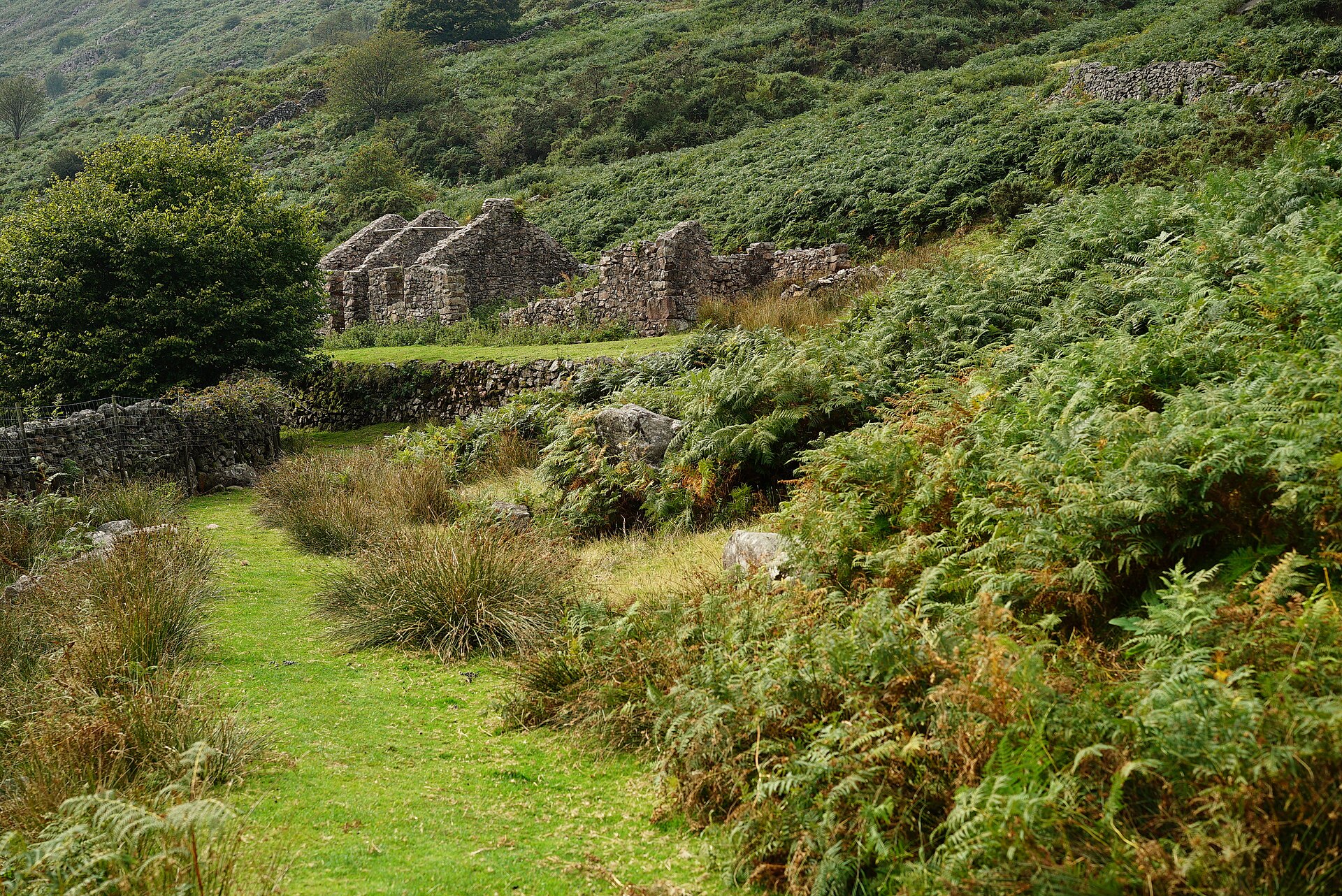
Ruins of the mine offices and works stand on a loading platform above the overgrown site of the old Boot station; the fellside above is under bracken.
Ruined office and works buildings, spoil heaps, five adits, three inclined planes and tracks, prospecting trenches, two ventilation shafts and collapsed ground over the workings at the top of the slope.
Redevelopment
None; the site is open fellside in the Lake District National Park.
Related mines
- Birker Moor Mine — Both worked haematite veins in the Eskdale Granite in the 1870s-80s.
- Gill Force Mine — Across the valley on the same vein; both served by the Ravenglass and Eskdale Railway.
Nearby mines
- Gill Force Mine — 1.4 km S
- Cove Quarries, Coniston — 10.7 km E
- Greenburn Mine — 10.8 km E
- Coniston Copper Mines — 11.6 km E
- Tilberthwaite — 12.9 km E
Straight-line distance, within 15 km. Show on the map.
People
- Faithful Cookson · lessee, 1866–1873 — Bought the lease in 1866 and floated the Whitehaven Iron Mines company, leaving it in about 1873 with about £25,000.
- Joseph Fearon · lessee, 1860–1866 — Whitehaven businessman who held the Eskdale lease in 1860-66, proposed a tramway down the valley, and sold to Cookson.
- W.H. Hoskings · partner, 1866–1873 — Devon miner and Cookson's partner, whose reports of forty-foot veins were used to promote the company.
- William Lazarus · owner, 1917–1918 — Named as the mine's owner or occupier in the Geological Survey's 1917 survey.
- John Oxnam · lessee, 1844–1845 — Took the Nab Gill lease with Thomas Brown in July 1844.
What's uncertain
Points where sources disagree or the record could not be settled; both accounts are kept. All open questions in the archive.
- By 1842 ore from Nab Gill mine at Boot was being shipped from Ravenglass to South Wales. (disputed) 1,2,3
- The Geological Survey says the mine was first opened as the 'Whitehaven (or Eskdale and Miterdale) Iron Mine' about 1870. (disputed) 4
- The mines closed down in 1882, but reopened later. (disputed) 4
- Bristol consortia leased the mine from the receiver until about 1883, and a few miners and the railway manager worked it on a small scale to about 1885. (disputed) 2,3
- The 20th-century reopening is dated 1909 (National Trust HER, as cited) rather than 1907. (uncertain) 6
Recorded claims
Individual factual claims, each attached to the source(s) that support it below. Where sources disagree, both are kept.
- By 1842 ore from Nab Gill mine at Boot was being shipped from Ravenglass to South Wales. (disputed) 1,2,3
- The Geological Survey says the mine was first opened as the 'Whitehaven (or Eskdale and Miterdale) Iron Mine' about 1870. (disputed) 4
- Faithful Cookson, a London iron master, bought the lease in 1866 and floated the Whitehaven Iron Mines company; he left it in about 1873 having made about £25,000. 1,2,3
- The three-foot-gauge Ravenglass and Eskdale Railway opened on 24 May 1875 to carry haematite from the mines around Boot to the Furness Railway at Ravenglass. 3,5
- The Eskdale and Miterdale mine produced 9,135 tons of ore in 1876. 4
- The mines closed down in 1882, but reopened later. (disputed) 4
- Bristol consortia leased the mine from the receiver until about 1883, and a few miners and the railway manager worked it on a small scale to about 1885. (disputed) 2,3
- The mine was reopened in 1907-12, taking the workings below the valley floor, but the vein grew thinner and poorer. 2,3
- The 20th-century reopening is dated 1909 (National Trust HER, as cited) rather than 1907. (uncertain) 6
- Reopened in 1917 at 30-50 tons a week from No. 5 level, and abandoned in July 1918. 4,3
- The vein trends about N 18° W in the Eskdale Granite, was up to 20 ft wide near the surface and averaged 2½-3½ ft, dying out at about 50 fathoms. 4
- Ruined offices and works stand above the old Boot station, with spoil heaps, five adits, three inclined planes and two ventilation shafts on the fellside. 6
- Plans survive of the Nab Gill mine and a section of the Nab Gill vein drawn for the Whitehaven Iron Mines in June 1873. 7,8
Photographs & further reading
A walker's account of the ruins, adits and inclines at Boot today.
View sourceAlbyn Austin's history of the Eskdale iron mines, from the first leases to the final closure in 1918.
View sourceTranscription of the 1919 survey entry for Nab Gill: the vein, the five levels and the 1917 working.
View sourceSources
- (secondary) The mines of Eskdale (from an article by Albyn Austin, CIHS Newsletter, May 1990) — Industrial History of Cumbria
- (secondary) Boot Iron Mines, Eskdale — Northern Mine Research Society (Albyn Austin)
- (secondary) Austin, A. 1991, 'The Mines of Eskdale', British Mining No. 43, pp. 133-137 — Northern Mine Research Society
- (primary) The Geological Survey on Eskdale's iron ore (Special Reports on the Mineral Resources of Great Britain, vol. VIII: Iron Ores — Haematites of West Cumberland, Lancashire and the Lake District, Bernard Smith, HMSO 1919, with 1924 amendments) — Memoirs of the Geological Survey, transcribed by Past Presented
- (secondary) Ravenglass and Eskdale Railway — Wikipedia
- (observational) Nab Gill: The Lost Industry of Eskdale — Fhithich, Out & About (blog, citing National Trust HER MNA115506)
- (primary) BGS / Mining Remediation Authority mine plans: NAB GILL MINE ESKDALE — British Geological Survey / Mining Remediation Authority
- (primary) BGS / Mining Remediation Authority mine plans: THE WHITEHAVEN IRON MINES. SECTION OF NAB GILL VEIN. JUNE 1873 — British Geological Survey / Mining Remediation Authority
Record created: 18 September 2026 · Last researched: 18 September 2026