 MineArchive
Kidney Ore
| Category | Commodities |
|---|
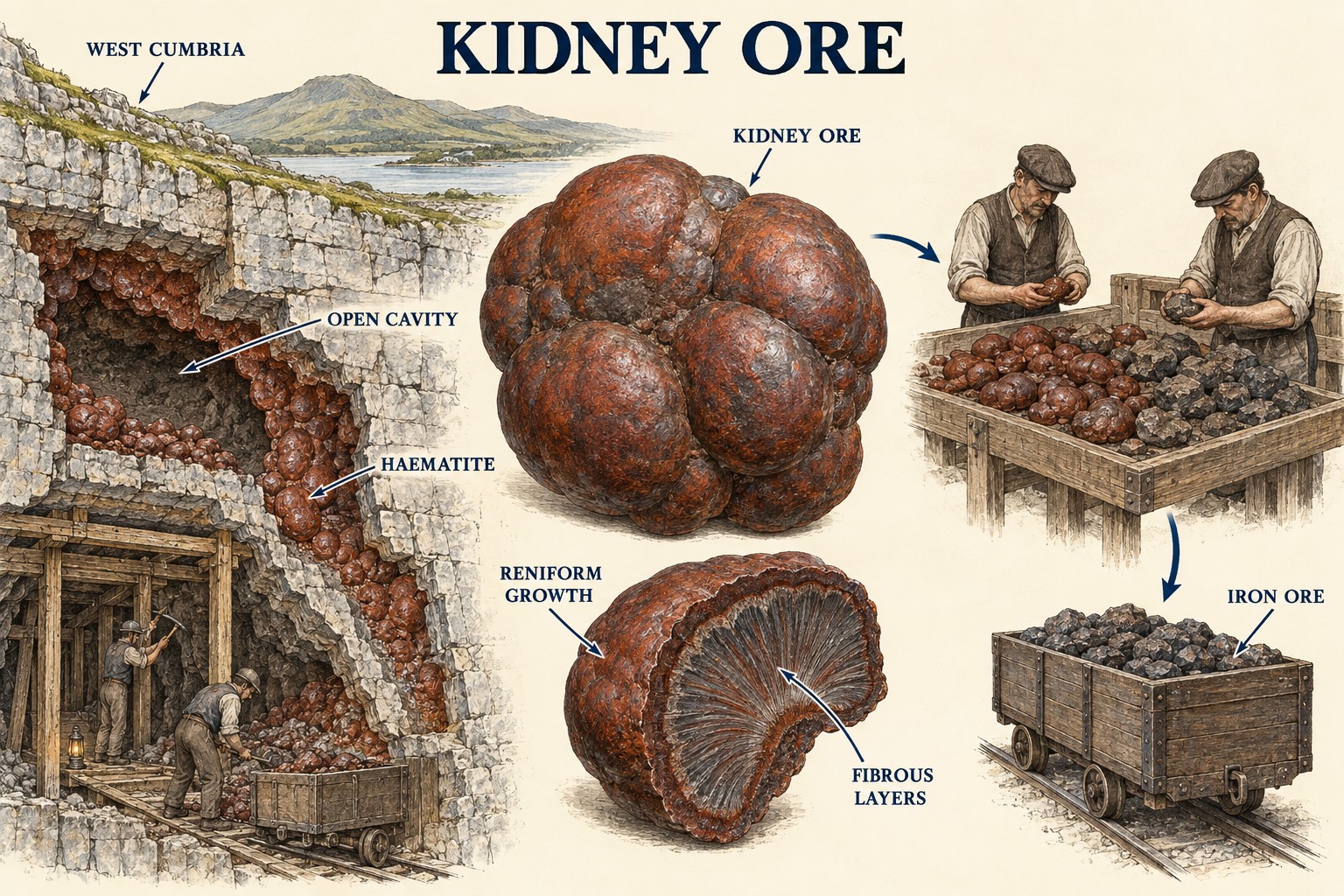
The mammillated, kidney-shaped variety of haematite, formed where the mineral precipitates freely inside open cavities.
Historical usage
Kidney ore takes its name from its reniform, kidney-like outline, which developed as haematite precipitated inside open cavities in the rock rather than being confined by surrounding material. It is particularly associated with the West Cumbrian haematite orefield, where fibrous, mammillated kidney ore — alongside conical broken fragments known to miners as 'pencil ore' — became one of the district's most recognisable mineral forms.
How it worked
Its distinctive rounded, layered form let miners recognise it easily among ordinary massive haematite; because chemically precipitated kidney ore tends to be relatively pure, fine specimens were prized by collectors even as most of the material raised was simply smelted for iron.
Why it was used
As a form of haematite it was worked for iron exactly like the ore's other varieties, though its purity made it a particularly valued specimen material among mineral collectors, distinct from its purely industrial value.
Risks & limitations
Not a distinct commercial grade in its own right so much as a recognisable form of haematite; its economic value tracked that of haematite generally rather than commanding a premium of its own, aside from the specimen trade.
Regional variation
Most strongly associated with the West Cumbrian haematite orefield, though the same botryoidal/reniform habit occurs wherever haematite forms freely in open cavities.
Related terminology
Mines associated with this term
5 examples chosen from 8 linked records — the term page is not an index.
- Ullcoats Mine — Cumbria (well documented example)
Named in this record’s geology: “…the fibrous, mammillated variety long prized by collectors as 'kidney ore'. The accepted formation model has hot, hypersaline brines — heated…” - Birker Moor Mine — Cumbria (well documented example)
Named in this record’s workings: “…to the gap, carrying haematite of the finest quality with much kidney ore and contents estimated in millions of tons — and at 2,500 feet above…” - Sharkham Point Iron Mine — Devon (well documented example)
Named in this record’s history: “…-- reported as early as 1790 as yielding 'considerable quantities of kidney ore' -- that ran from Sharkham Point to Upton, extensively worked from…” - Dalzell's Moor Row Mine — Cumbria (well documented example)
Named in this record’s geology: “…irregular masses. The ore includes the mammillated variety known as kidney ore. The returns for 1924 and 1925 specify red haematite, and the…” - Eskett Pit — Cumbria (well documented example)
Named in this record’s geology: “…irregular masses. The ore includes the mammillated variety known as kidney ore, and the returns from 1900 onwards specify red haematite. It is the…”
Sources
- (primary) Haematite deposits of Cumbria — BGS Earthwise
- (secondary) Hematite — Geology.com
Record created: 27 August 2026 · Last researched: 27 August 2026