 MineArchive
Gill Force Mine
| Also known as | South Cumberland Mine, Ghyll Force Mine |
|---|---|
| Location | Gill Force, near St Catherine's Church, Eskdale, Cumbria — 54.3872, -3.2653 (approximate) |
| Commodity | Iron |
| Type | Iron |
| Worked | 1880–By 1884 |
| Maximum depth | Unknown; the ore 'did not go as deep as hoped'. |
| Operators | South Cumberland Iron Mining Company (1880–1884) |
Overview
A haematite mine on the south side of Eskdale near St Catherine's Church, opposite the Nab Gill mine at Boot. A group led by the civil engineer William Donaldson leased it in 1880 as the South Cumberland Iron Mining Company, and the Ravenglass and Eskdale Railway built a branch across the Esk to serve it. The ore ran out within a few years, and the company had folded by 1884. The branch's route later became the railway's extension to its present terminus at Dalegarth.
History
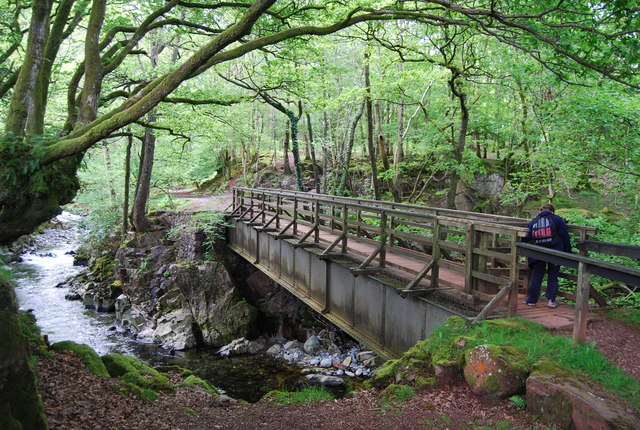
The iron veins of Eskdale cut the granite on both sides of the valley. After the Whitehaven Iron Mines company failed at Nab Gill in 1877, the Bristol mining engineers Owen, father and son, who were leasing the Eskdale mines from the receiver, noticed an iron vein at Gill Force, near St Catherine's Church on the south bank of the Esk. In 1880 it was leased by a group led by William Donaldson, a civil engineer who had worked on the Midland Railway around Bristol, and financed by James and Howard Allport, sons of the Midland Railway's general manager. For a time the group called itself the South Cumberland Iron Mining Company. In 1880 a tramway branch was built from the Ravenglass and Eskdale Railway near Beckfoot, across the river, to the new mines, and extensive work was carried out in 1880-81. John Postlethwaite, writing from 1877, recorded 'a considerable quantity of ore' raised at the South Cumberland Mine, on the southern side of the valley opposite Nab Gill and on the direct course of its vein. But the ore did not go as deep as hoped. Trials on other veins on both sides of the Esk found nothing better, and with ore down to 8s 6d a ton the company had folded by 1884. Many of the miners, West Country men, moved on to Millom. The branch outlived the mine. When Sir Aubrey Brocklebank took over the rebuilt 15-inch railway in the 1920s, it was extended along the route of the former Gill Force tramway to a new terminus at Dalegarth, which it still uses, and the girder bridge built for the line now carries the bridleway over the Esk.
Geology
A haematite vein in the Eskdale Granite, on the course of the Nab Gill vein across the valley (Postlethwaite).
Geological setting: Veins and Lodes (historical documentary reference)
Workings
Mine workings reached by a tramway branch from the Ravenglass and Eskdale Railway near Beckfoot, crossing the Esk on a girder bridge.
Closure
Worked extensively in 1880-81; the ore soon ran out and the company had folded by 1884. There were brief later spells of activity, especially in the First World War (Eskdale.info).
What remains
The branch trackbed is a footpath and its girder bridge carries a bridleway over the Esk; the mine workings themselves are not described in the sources read.
The branch trackbed and the girder bridge over the Esk. OpenStreetMap marks the abandoned mine; no survey of its remains was read.
Redevelopment
The northern part of the branch route was reused in the 1920s for the railway's extension to Dalegarth station.
Related mines
- Birker Moor Mine — Another Eskdale Granite haematite venture of the same boom.
- Nab Gill Mine — Across the valley on the same vein; both served by the Ravenglass and Eskdale Railway.
Nearby mines
- Nab Gill Mine — 1.4 km N
- Cove Quarries, Coniston — 10.0 km E
- Greenburn Mine — 10.4 km E
- Coniston Copper Mines — 11.1 km E
- Tilberthwaite — 12.6 km E
Straight-line distance, within 15 km. Show on the map.
People
- William Donaldson · lessee, 1880–1884 — Civil engineer who led the group that leased Gill Force in 1880.
What's uncertain
Points where sources disagree or the record could not be settled; both accounts are kept. All open questions in the archive.
- Postlethwaite records a considerable quantity of ore raised at the South Cumberland Mine, opposite Nab Gill on the course of its vein, and implies it was working before the railway opened in 1875. (disputed) 5
- A plan of the South Cumberland Iron Company's workings on Eskdale Moor, dated June 1882, carries William Donaldson's name. (uncertain) 6
Recorded claims
Individual factual claims, each attached to the source(s) that support it below. Where sources disagree, both are kept.
- In 1880 the Gill Force vein was leased by a group led by the civil engineer William Donaldson and financed by James and Howard Allport; it called itself the South Cumberland Iron Mining Co. 1,2
- In 1880 a tramway was built from the railway near Beckfoot across the Esk to the newly opened mines at Gill Force. 2,3,4
- Extensive mining was carried out in 1880-81, but the ore soon ran out and the company had folded by 1884. 1,2,4
- Postlethwaite records a considerable quantity of ore raised at the South Cumberland Mine, opposite Nab Gill on the course of its vein, and implies it was working before the railway opened in 1875. (disputed) 5
- By 1926 the railway had been extended along the route of the former Gill Force tramway to its present terminus at Dalegarth. 3
- A plan of the South Cumberland Iron Company's workings on Eskdale Moor, dated June 1882, carries William Donaldson's name. (uncertain) 6
Photographs & further reading
The Gill Force branch and the girder bridge that now carries the bridleway.
View sourceAlbyn Austin's history of the Eskdale mines, including the Gill Force venture of 1880-84.
View sourceSources
- (secondary) Boot Iron Mines, Eskdale — Northern Mine Research Society (Albyn Austin)
- (secondary) Austin, A. 1991, 'The Mines of Eskdale', British Mining No. 43, pp. 133-137 — Northern Mine Research Society
- (secondary) Ravenglass and Eskdale Railway — Wikipedia
- (observational) Boot and Esk Riverside Trails: history — Boot Riverside Access Group (eskdale.info)
- (primary) Postlethwaite on Eskdale mining (transcribing J. Postlethwaite, Mines and Mining in the Lake District, 1877/1913) — Past Presented (transcription)
- (primary) BGS / Mining Remediation Authority mine plans: SOUTH CUMBERLAND IRON COS. WORKINGS. ESKDALE MOOR. JUNE 1882. WILLIAM DONALDSON — British Geological Survey / Mining Remediation Authority
Record created: 18 September 2026 · Last researched: 18 September 2026