 MineArchive
Lakes Pit, Dukinfield
| Also known as | Dukinfield Colliery, Victoria Pit, Dukinfield |
|---|---|
| Location | Dukinfield, Tameside, Greater Manchester |
| Commodity | Coal |
| Type | Coal |
| Maximum depth | 340 yards (downcast to the Black Mine) |
| Operators | Francis Dukinfield Palmer Astley |
Overview
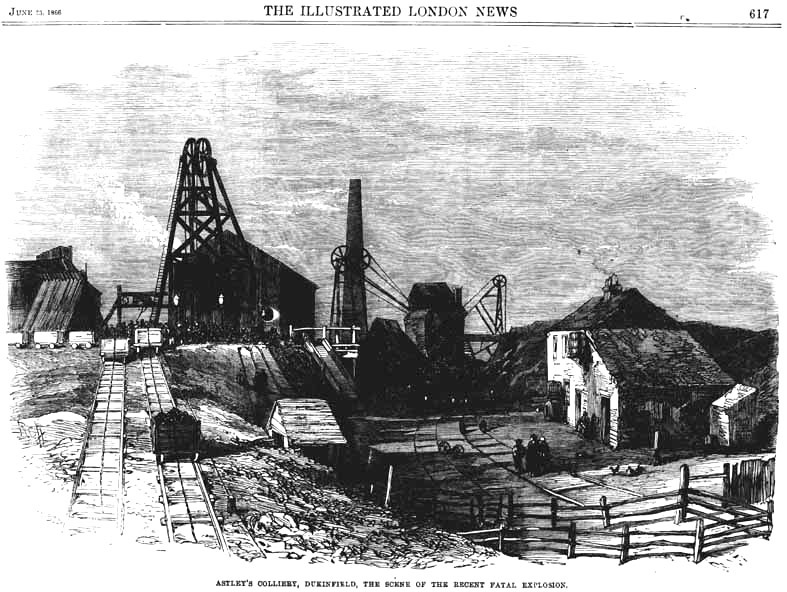
The Astley family's colliery at Dukinfield, also called the Victoria Colliery, whose 340-yard downcast reached the Black Mine. An explosion in June 1866 killed 38 men and boys.
History
Francis Dukinfield Astley began developing collieries at Dukinfield around 1820, and his son Francis Dukinfield Palmer Astley, lord of the manor from 1825, carried on the two most notable: this pit, known as the Lakes Pit, the Victoria Colliery or simply Dukinfield Colliery, and the deeper Astley Deep Pit. The Lakes Pit was worked by the Dukinfield Colliery Company, with Astley its sole proprietor; Isaac Whelden managed it in the 1860s.
Water met in the sinking was raised by plunger pumps worked by a Cornish engine with a 17-foot cylinder, fed by three boilers. The winding engine's drums were over 24 feet across and drew the load at 21 miles an hour. The downcast, 340 yards deep, reached the Black Mine and was linked to the upcast for ventilation, with a furnace added in 1866. The workings ran 600 yards south along the level, 350 yards north to a fault where they had been abandoned, and 150 yards west on a steep dip.
The mine was regarded as fiery and the men had lamps, but the boys worked with naked lights. In June 1866 an explosion killed 38 of about seventy-three below, leaving sixteen widows and thirty-four fatherless children.
Geology
Middle Coal Measures beneath Tameside: the Black Mine, reached at 340 yards, cut off to the north by a fault.
Workings
Two shafts, a 340-yard downcast to the Black Mine and an upcast with a ventilating furnace from 1866; a Cornish pumping engine with plunger pumps; a horse road along the level with up-brows and a jig brow.
Closure
Unknown.
What remains
Unknown.
Redevelopment
Unknown.
Related mines
- Astley Deep Pit — Both developed by the Astleys of Dukinfield; the two most notable pits of the town.
Disasters & major incidents
-
Lakes Pit explosion, Dukinfield, 1848
23 February 1848 · Explosion · 7 fatalities
Shortly after the midday meal on 23 February 1848 gas fired in the Victoria Pit at Dukinfield, the deepest in the district, where Swire and Lees' men were cutting through into old workings. Seven died; the owners had long tried, and failed, to stop the men using candles. -
Lakes Pit explosion, Dukinfield, 1866
June 1866 · Explosion · 38 fatalities
At about 8 a.m. one June morning an explosion of firedamp in the Black Mine at F. D. P. Astley's Lakes Pit, or Victoria Colliery, Dukinfield, killed 38 of the seventy-odd men and boys below. The pit was worked with safety lamps, but the boys carried naked lights against the colliery's rules.
What's uncertain
Points where sources disagree or the record could not be settled; both accounts are kept. All open questions in the archive.
Recorded claims
Individual factual claims, each attached to the source(s) that support it below. Where sources disagree, both are kept.
- Dukinfield Colliery was also known as the Lakes Pit and the Victoria Colliery, owned by Astley's Dukinfield Colliery Company. 1,2
- Francis Dukinfield Astley began developing collieries around 1820, and his son continued the Dukinfield and Astley Deep pits after 1825. 1
- The downcast was 340 yards (1,020 feet) deep to the Black Mine and was connected to the upcast for ventilation. 1,2
- An explosion of firedamp at the Victoria Pit killed 38 on 14 June 1866. 3
- The explosion that killed 38 was on 4 June 1867. (disputed) 1,2
Photographs & further reading
The colliery's engines, shafts and workings, and the explosion.
View sourceThe town's history, including the Astleys' two collieries.
View sourceSources
- (secondary) Dukinfield — Wikipedia
- (secondary) Dukinfield Colliery Explosion - Ashton-under-Lyne - 1867 — Northern Mine Research Society
- (primary) Colliery Disaster: Dukinfield, Victoria Pit, 14 June 1866 — Durham Mining Museum
Record created: 3 October 2026 · Last researched: 3 October 2026