 MineArchive
Kelton Fell Mine
| Also known as | Kelton Mine, Kelton Iron Ore Mine |
|---|---|
| Location | Kelton Fell, east of Lamplugh, Cumbria — 54.5521, -3.4154 (approximate) |
| Commodity | Iron |
| Type | Iron |
| Worked | 1869–June 1914 |
| Maximum depth | About 56 fathoms (102 m), the greatest depth given for the Kelton and Knockmurton mines together in 1877. |
| Operators | William Baird & Company (1869–1914) |
Overview
William Baird & Co.'s haematite mine on Kelton Fell near Lamplugh, partner to Knockmurton, opened in 1869, served by the Rowrah and Kelton Fell Railway from 1877 and abandoned in June 1914.
History
Kelton Fell mine worked veins of red haematite in the Skiddaw Slate on Kelton Fell, east of Lamplugh, on the western edge of the Lake District fells. Prospecting for iron ore around Kelton was first recorded in 1853, and by 1869 William Baird & Co. of Glasgow had established mines with three shafts, two of them on Kelton Fell and one at Knockmurton. John Postlethwaite, writing in 1877, said the Kelton Fell mines were opened more recently than Knockmurton, which was the older, and that both were worked by levels driven into the hill at various heights.
To carry the ore Baird built the Rowrah and Kelton Fell Railway, authorised in July 1874 and opened in January 1877, with sidings at Kelton Fell. Output from Kelton and Knockmurton together was 14,435 tons in 1872, about 30,000 tons in 1877, 46,100 tons in 1888 and 27,160 tons in 1909. Kelton employed 127 men in 1894, 104 of them underground, and 116 in 1896; 89 in 1900 and 141 in 1902 are figures for Kelton and Knockmurton together, and 97 men worked there in 1910. Six deaths are recorded at the mine between 1881 and 1905, each of a single man or boy, from falls of roof and stone and from haulage. The mine was abandoned in June 1914; the system was later described as worked out by then, though it was reworked in the 1920s. The railway was out of use by 1927 and lifted in 1934.
Geology
Veins of haematite in the Skiddaw Slate, bearing north-west to south-east and hading to the north-east, with the ore in lenticular masses or bunches from a few inches to 23 feet wide.
Workings
Levels driven into the hill at several heights and two shafts, the longest level of the Kelton and Knockmurton system about 240 fathoms.
Closure
Abandoned in June 1914; the haematite system was reworked in the 1920s, and its railway was disused by 1927.
What remains
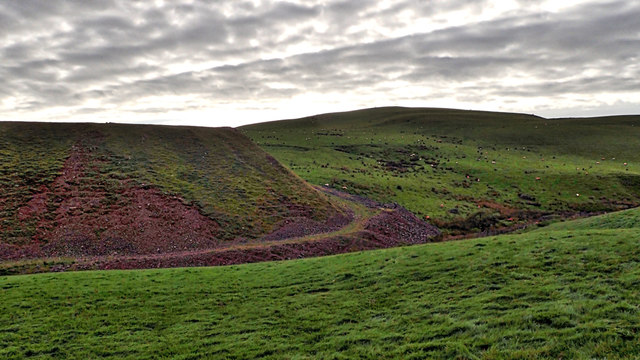
Red haematite spoil tips (the pit bing at Kelton Fell Top) and embankments of the mineral railway survive on the fell.
Spoil tips and the embankments and bridges of the Rowrah and Kelton Fell Railway.
Redevelopment
Rough grazing on the open fell.
Related mines
- Knockmurton Mine — Partner haematite mines of William Baird & Co., served by the Rowrah and Kelton Fell Railway.
Nearby mines
- Knockmurton Mine — 0.4 miles (0.7 km) E
- Barbara Pit, Kirkland — 0.8 miles (1.2 km) W
- Frizington Iron Mines — 2.4 miles (3.9 km) W
- Eskett Pit — 2.5 miles (4.1 km) SW
- Mowbray Mine — 3.2 miles (5.1 km) SW
Straight-line distance, within 9 miles (15 km). Show on the map.
What's uncertain
Points where sources disagree or the record could not be settled; both accounts are kept. All open questions in the archive.
- The Rowrah and Kelton Fell Railway closed in 1926. (disputed) 3
- The Rowrah and Kelton Fell Railway was out of use by 1927 and lifted in 1934. (disputed) 4
Recorded claims
Individual factual claims, each attached to the source(s) that support it below. Where sources disagree, both are kept.
- By 1869 William Baird & Co. had established mines with three shafts, two at Kelton Fell and one at Knockmurton. 1,2
- The Rowrah and Kelton Fell mineral railway opened in January 1877 to carry ore from the mines on Kelton Fell and Murton Fell. 2,3,4
- The Kelton Fell and Knockmurton haematite veins in the Skiddaw Slate bear north-west to south-east, with the ore in lenticular bunches up to 23 feet wide. 1
- Kelton and Knockmurton mines together produced 14,435 tons of ore in 1872, about 30,000 tons in 1877, 46,100 tons in 1888 and 27,160 tons in 1909. 1
- Kelton employed 127 men in 1894 (104 below ground) and 89 in 1900, the 1900 figure including Knockmurton. 2,5
- Kelton mine was abandoned in June 1914. 1,2,5
- The Rowrah and Kelton Fell Railway closed in 1926. (disputed) 3
- The Rowrah and Kelton Fell Railway was out of use by 1927 and lifted in 1934. (disputed) 4
Sources
- (secondary) Kelton and Knockmurton Mines, Lamplugh — Old Cumbria Gazetteer (Lakes Guides)
- (secondary) Kelton Iron Ore Mine — Co-Curate, Newcastle University
- (secondary) Rowrah and Kelton Fell Railway — Wikipedia
- (secondary) Rowrah and Kelton Fell Railway — Old Cumbria Gazetteer (Lakes Guides)
- (primary) Kelton (Iron Ore) — Durham Mining Museum
Record created: 19 October 2026 · Last researched: 20 October 2026