 MineArchive
Hewlett Colliery
| Location | Hart Common, Westhoughton, Greater Manchester — 53.5444, -2.5530 (approximate) |
|---|---|
| Commodity | Coal |
| Type | Coal |
| Worked | 1871 (sinking)–1 January 1931 |
| Maximum depth | 450 yards (Arley mine, No. 1 shaft) |
| Operators | Wigan Coal & Iron Co. (1871–1930), Wigan Coal Corporation Ltd (1930–1931) |
Overview
The Wigan Coal and Iron Company's two-shaft colliery at Hart Common, Westhoughton, sunk in 1871 to the Arley mine at 450 yards and closed on 1 January 1931.
History
Hewlett Colliery, the Hewlett Pits, stood at Hart Common on the west side of Westhoughton, in the triangle of railway lines between Hindley, Bolton and Dobbs Brow. The Wigan Coal and Iron Company sank its two shafts in 1871 and production began about 1875. In preparation the vicar, Kinton Jacques, decided to build a school and church at Hart Common, and rows of cottages went up for the colliers, with better terraces either side of Patterson Street for the managers. Labour was short, and the newcomers came from Somerset, Cornwall, County Mayo, Glamorgan and further afield; local people said they had 'arrived at Crows Nest Siding under a tar sheet'.
In 1894 the two pits employed 1,180 people, 1,039 of them underground, working the Arley and Yard mines; in 1896 the company returned 981 underground and 182 on the surface. Electric power came in 1908. In 1912, during the minimum wage dispute, soldiers and police were brought in to guard the colliery.
By 1919 the pits were working the Trencherbone, Hindley Green Four Feet and Haigh Yard mines, raising 101,156 tons with almost half of it cut by machine. The Wigan Coal Corporation took over in 1930, and the last coal was raised on 1 January 1931; the colliery was abandoned in March and the main buildings were demolished in 1933.
Geology
Lancashire Coal Measures. The No. 1 shaft reached the Arley mine at 450 yards and worked the Haigh Yard at 322 yards; the Hindley Green Five Feet, or Trencherbone, lay 153 yards below the surface. The Wigan Four Feet, Hindley Green Four Feet and Yard were also worked, with fireclay and some pyrites.
Workings
Two shafts of 16 feet diameter sunk in 1871: No. 1, the upcast, to the Arley, and No. 2, the downcast, to the Haigh Yard, each with a twin-cylinder steam winding engine and double-deck cages. The workings were first ventilated by furnaces in the Haigh Yard and Arley mines. A Bull pumping engine at No. 1 was later replaced by electric pumps, and a 250 h.p. Mather & Platt pump installed in 1925 lifted all the water, about 66,000 gallons a day. In 1919 nearly 50,000 tons were cut by disc, chain, bar and percussion machines.
Closure
The last coal was raised on 1 January 1931, a year after the colliery passed to the Wigan Coal Corporation, and it was abandoned in March 1931. Both shafts were later filled to below the Hindley Green Five Feet horizon.
What remains
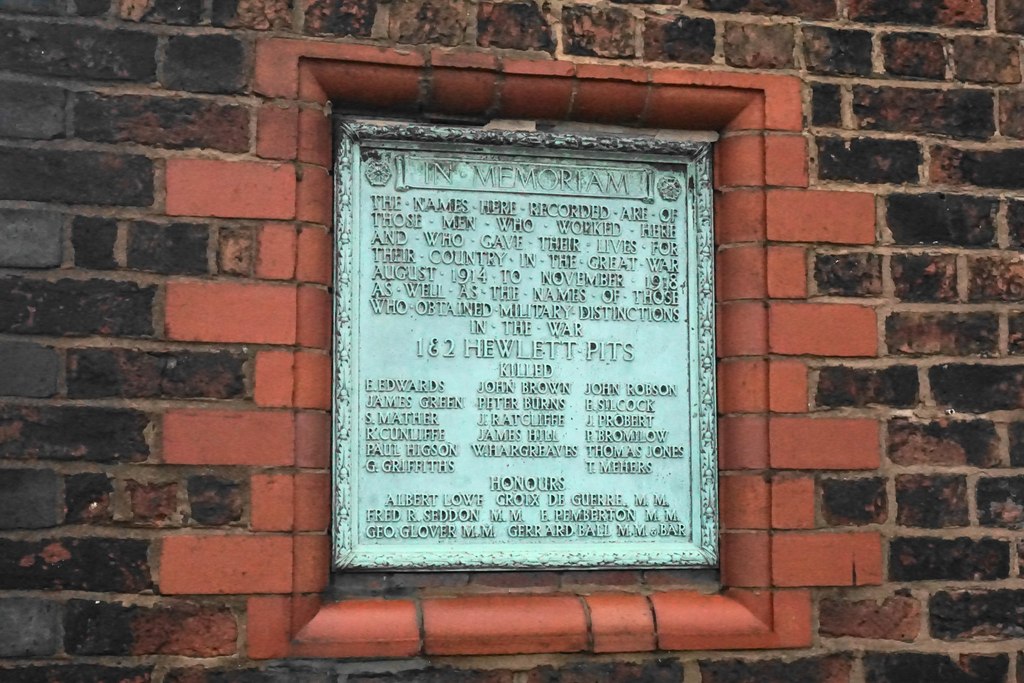
The colliery ground was landscaped and returned to pasture in the early 1980s. 552 Wigan Road, once the colliery superintendent's house and now a day nursery, carries the company's bronze war memorial plaque to the Hewlett Pits men; the Hewlett Lodge, where miners once bathed, is a fishing pond.
The colliery building at 552 Wigan Road, with its First World War plaque, and the colliery cottages of Hart Common.
Redevelopment
The colliery land was returned to pasture in the early 1980s.
Nearby mines
- Abram Colliery — 2.2 miles (3.5 km) S
- Gibfield Colliery — 2.3 miles (3.6 km) SE
- Rose Bridge Colliery — 2.3 miles (3.6 km) W
- Ince Hall Arley Pit — 2.4 miles (3.9 km) W
- Wigan Junction Colliery — 2.5 miles (4.1 km) SW
Straight-line distance, within 9 miles (15 km). Show on the map.
What's uncertain
Points where sources disagree or the record could not be settled; both accounts are kept. All open questions in the archive.
- Hewlett Colliery opened in 1880 and closed in December 1930. (disputed) 3
Recorded claims
Individual factual claims, each attached to the source(s) that support it below. Where sources disagree, both are kept.
- Both shafts were sunk in 1871, 16 feet in diameter; No. 1 reached the Arley mine at 450 yards and production commenced about 1875. 1,2
- Hewlett Colliery opened in 1880 and closed in December 1930. (disputed) 3
- The Wigan Coal & Iron Co. Ltd owned the colliery from 1871 to 1930, and the Wigan Coal Corporation from 1930 to 1931. 1
- In 1894 the No. 1 Pit employed 358 and the No. 2 Pit 822. 3
- In 1896 the Hewlett Pits employed 981 men underground and 182 surface workers. 2
- In 1919 the colliery raised 101,156 tons of coal and 2,334 tons of fireclay, 49,715 tons of it machine cut. 1
- In 1912, during the minimum wage dispute, soldiers and police were called in to defend the colliery. 2
- The last coal was raised on 1 January 1931 and the colliery was abandoned in March 1931; the main buildings were demolished in 1933. 1,2
- The company's bronze plaque to the Hewlett Pits men killed in the First World War is the only one of its nineteen such plaques still where it was first installed. 4
- Plans of the Trencherbone, Haigh Yard and Hindley Green Four Feet at Hewlett Nos. 1 and 2 record abandonment in 1931. 5
Photographs & further reading
The G. Hayes collection record of the shafts, winding and pumping engines, ventilation, seams and 1919 output.
View sourceThe history of the Westhoughton hamlet built around the Hewlett Pits, with its church, school and colliery cottages.
View sourceThe record of the Hewlett Pits war memorial plaque, its inscription and the names on it.
View sourceSources
- (secondary) Hewlett Colliery - Northern Mine Research Society — Northern Mine Research Society
- (secondary) Hart Common — Wikipedia
- (primary) Durham Mining Museum - Hewlett Colliery (UK) — Durham Mining Museum
- (secondary) Wigan Coal and Iron Co. Hewlett Pits WW1 - War Memorials Online — War Memorials Online
- (primary) BGS mine plans: Hewlett Nos. 1, 2 (Trencherbone, abandoned 1931) — British Geological Survey / Mining Remediation Authority
Record created: 1 October 2026 · Last researched: 1 October 2026