 MineArchive
Hamsterley Colliery
| Location | Hamsterley Colliery, near Consett, in the Derwent valley, County Durham — 54.9035, -1.8183 (approximate) |
|---|---|
| Commodity | Coal |
| Type | Coal |
| Worked | 1864–2 February 1968 |
| Maximum depth | Unknown. |
| Operators | H. W. Watson (1864–?), Hamsterley Colliery Ltd (?–1947), National Coal Board (1947–1968) |
Overview
A Derwent valley colliery near Consett, opened in 1864 and worked with its drifts until 2 February 1968, which gave its name to the pit village beside it.
History
Hamsterley Colliery lay on the south bank of the River Derwent in north-west County Durham, about nine and a half miles west-south-west of Newcastle, between Hamsterley and High Westwood. It opened in 1864, and the pit village that grew up beside it took the name Hamsterley Colliery. In the 1860s it belonged to H. W. Watson, given by Wikipedia as W. H. Watson, and by the 1910s to Hamsterley Colliery Ltd, one of whose directors, Sir Cecil Harcourt-Smith, had married Watson's daughter Alice Edith.
The colliery raised coal for coking, gas, household and manufacturing use, and fireclay. It employed 410 in 1894 and 547 in 1902. The Towneley Drift was added by 1915 and the Long Close and Forge drifts by 1930 and 1940; with them the colliery's employment reached 605 in 1925. William Allen was manager in the 1880s and 1890s, Frederick Berkley from 1896 and J. Cummings from 1909. A. T. Watson was agent in 1909. Major Arthur T. Watson, of the family that ran the colliery, was killed at Passchendaele on 5 August 1917, and the colliery's war memorial marks his death above the names of 58 other men; the workmen's inscription calls him their friend and employer.
The National Coal Board took over in 1947, when 306 men raised 52,000 tons. The reserves were known to be running out, and the county development plan of the early 1950s put the village in category D, where no new building was allowed. The colliery closed on 2 February 1968 with 220 men, only 60 of whom lived in the village.
The village outlived its pit. In April 1969 the MP for Consett raised in the Commons the refusal of permission to replace 50 prefabricated bungalows there, after an inquiry at which every piece of evidence had favoured building.
Geology
Durham Coal Measures. The colliery worked the Brockwell, Three Quarter, Tilley, Top and Bottom Busty and Victoria seams, and the drifts the Towneley, also called the Harvey. Fireclay was worked with the coal. The Top and Bottom Busty were given up in 1948, though abandonment plans of the Bottom Busty date from February 1968.
Workings
A shaft colliery, one of whose shafts was the John Shaft, with drifts added in the twentieth century: the Towneley Drift (by 1915 to 1950), the Long Close Drift (1930s) and the Forge Drift (1940). The workings extended up the hillside into the woods above the colliery buildings.
Closure
The reserves were known to be approaching their end by the early 1950s. The colliery closed on 2 February 1968, employing 220 men.
What remains
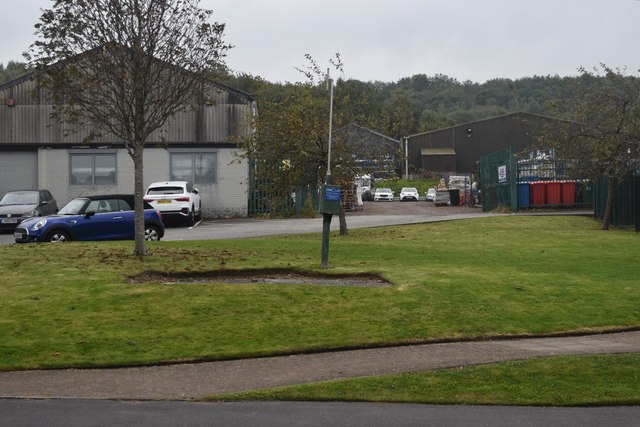
The colliery buildings' site is an industrial estate, and the hillside above, where the workings ran, is woodland. The site of the John Shaft is marked. The colliery's war memorial, a Grade II listed wheel-head cross designed by Walter Brierley, stands in a garden on the main road through Hamsterley; the names of 24 men of the Second World War were added to it, and it was restored and rededicated in 2000.
Redevelopment
An industrial estate occupies the site of the colliery buildings.
Nearby mines
- Chopwell Colliery — 1.2 miles (2.0 km) N, Tyne and Wear
- Medomsley Colliery — 1.8 miles (3.0 km) S
- Garesfield Colliery — 2.4 miles (3.9 km) NE, Tyne and Wear
- South Garesfield Colliery — 2.5 miles (4.1 km) E, Tyne and Wear
- Lintz Colliery — 2.6 miles (4.2 km) E
Straight-line distance, within 9 miles (15 km). Show on the map.
What's uncertain
Points where sources disagree or the record could not be settled; both accounts are kept. All open questions in the archive.
- The Top Busty and Bottom Busty seams were discontinued in 1948. (disputed) 1
- Plans of the Bottom Busty seam at Hamsterley record its abandonment on 8 February 1968. (disputed) 4
Recorded claims
Individual factual claims, each attached to the source(s) that support it below. Where sources disagree, both are kept.
- Hamsterley Colliery opened in 1864 and closed on 2 February 1968. 1,2
- The colliery was owned by H. W. Watson in the 1860s, by Hamsterley Colliery Ltd by the 1910s, and by the National Coal Board from 1947. 1
- Sir Cecil Harcourt-Smith, a director of Hamsterley Colliery Ltd, married Alice Edith Watson, daughter of W. H. Watson, owner of the mine in the 1860s. 2
- Employment was 410 in 1894 and 605 in 1925, including 205 at the Towneley Drift. 1
- In 1947 the colliery produced 52,000 tons. 1
- When the pit closed early in 1968 only 60 of the 220 men employed lived in the village. 3
- Under the County Durham development plan of the early 1950s Hamsterley Colliery was in category D, where a decline in population was expected and no development was permitted. 3
- The Top Busty and Bottom Busty seams were discontinued in 1948. (disputed) 1
- Plans of the Bottom Busty seam at Hamsterley record its abandonment on 8 February 1968. (disputed) 4
- William Allen was manager in 1882, F. Berkley from 1896 to 1905 and J. Cummings from 1909 to 1921. 5
- The site of the colliery buildings is now an industrial estate (2024 photograph). 6
- The site of the John Shaft of Hamsterley Colliery is identifiable (2009 photograph). 7
- The Watson family ran Hamsterley Colliery; Major Arthur T. Watson was killed at Passchendaele on 5 August 1917. 8
- The colliery's First World War memorial, by Walter Brierley and built by Emley and Sons Ltd, names Arthur T. Watson and 58 other men; 24 Second World War names were added, and it was restored in 2000. 8
- A. T. Watson was agent at Hamsterley Colliery in 1909. 5
Photographs & further reading
A 2009 photograph of the site of the John Shaft of Hamsterley Colliery.
View sourceOwners, output, employment for the colliery and its drifts from 1882 to 1964, seams worked and the names of those killed.
View sourceThe Commons adjournment debate on housing at Hamsterley Colliery a year after the pit closed, with the village's planning history.
View sourceThe Grade II list entry for the colliery's war memorial cross, with its history, inscriptions and the Watson family's connection.
View sourceSources
- (primary) Durham Mining Museum - Hamsterley Colliery — Durham Mining Museum
- (secondary) Hamsterley, Consett — Wikipedia
- (primary) Housing, Hamsterley Colliery (Hansard, 2 April 1969) — UK Parliament (Hansard)
- (primary) BGS mine plans: Hamsterley (Bottom Busty seam, abandoned 8 Feb 1968) — British Geological Survey / Mining Remediation Authority
- (primary) Durham Mining Museum - Hamsterley Colliery: colliery management — Durham Mining Museum
- (observational) Industrial estate, Hamsterley Colliery (Geograph, David Martin, 2024) — Geograph
- (observational) John Shaft (Geograph, Helen Wilkinson, 2009) — Geograph
- (primary) Hamsterley Colliery War Memorial, Non Civil Parish - 1447357 (Historic England list entry) — Historic England
Record created: 1 October 2026 · Last researched: 1 October 2026