 MineArchive
Gresford Colliery
| Location | Gresford, Wrexham — 53.0727, -2.9910 (exact) |
|---|---|
| Commodity | Coal |
| Type | Coal |
| Worked | 1908 (sinking)–1973 |
| Operators | United Westminster and Wrexham Collieries Company (1908–1973) |
Overview
Gresford Colliery, just north of Wrexham, was a major North Wales coal mine whose 1934 explosion killed 266 men — one of the worst disasters in British mining history — yet the pit itself continued working for almost forty years afterwards before closing on ordinary economic grounds in 1973.
History
Shaft sinking at Gresford began in 1908, and commercial coal production started in June 1911, worked by the United Westminster and Wrexham Collieries Company across three seams: Main, Crank and Brassey. By 1934 only the Main and Crank seams remained active, and the colliery employed around 2,200 people, roughly 1,850 of them underground. In the early hours of 22 September 1934 an explosion tore through the Dennis section of the Main seam, around three-quarters of a mile from the bottom of the shaft, igniting a fire that made the affected workings impossible to enter safely; 261 miners in the section were killed, along with three men from the rescue team and, in a further explosion on 25 September, a surface worker. The section was sealed off within days, entombing the great majority of the dead, who were never recovered. The disaster did not end the colliery: after a lengthy inquiry and a six-month closure, Gresford reopened, with coal production resuming in January 1936, and the mine continued working for a further 37 years before finally closing in November 1973 for ordinary economic reasons unrelated to the disaster; the site was later redeveloped as an industrial estate.
Geology
The colliery worked Carboniferous Coal Measures of the Denbighshire Coalfield, extracting from the Main, Crank and Brassey seams, of which only Main and Crank remained active by the time of the 1934 disaster.
Geological setting: Sedimentary Beds and Seams (well documented example)
Workings
The mine was reached via twin shafts, with underground workings extending over a mile from the shaft bottom in the Dennis section where the 1934 explosion occurred. Following the disaster, the affected section was permanently sealed with sand, cement and iron girders across both shafts, entombing it while the rest of the colliery continued in production elsewhere in the mine.
Closure
Gresford closed in November 1973 on ordinary economic grounds, unconnected to the 1934 disaster, and the site was subsequently redeveloped as an industrial estate.
What remains
No significant physical remains of the colliery survive above ground at the former site, now an industrial estate, though the sealed Dennis section survives below ground as the resting place of the great majority of the disaster's victims.
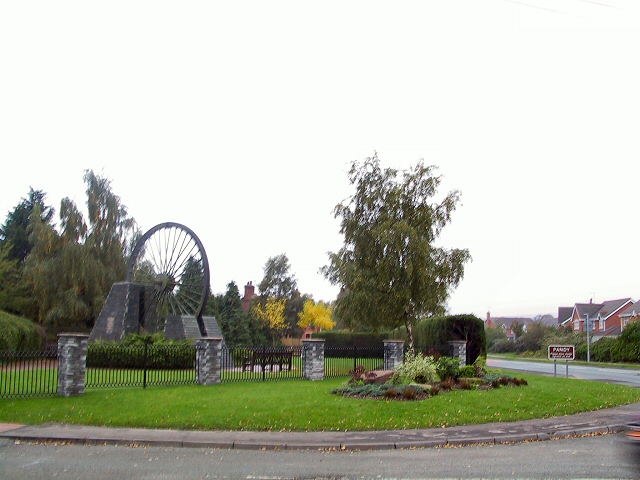
A public memorial to the 266 who died in 1934 stands near the site of the former colliery.
Nearby mines
- Gwersyllt Colliery — 1.3 miles (2.1 km) W
- Llay Main Colliery — 1.4 miles (2.3 km) N
- Gatewen Colliery — 1.7 miles (2.8 km) SW
- Borras Quarry — 1.8 miles (2.9 km) E
- Westminster Colliery — 1.8 miles (2.9 km) W
Straight-line distance, within 9 miles (15 km). Show on the map.
Disasters & major incidents
-
Gresford Colliery explosion, 1934
22 September 1934 · Explosion · 266 fatalities
An explosion in the Dennis section of Gresford Colliery's Main seam killed 261 miners in the early hours of 22 September 1934, with three more men dying in the rescue effort and a further worker killed in a subsequent explosion — 266 deaths in total, making it one of the worst disasters in British mining history. A subsequent government inquiry found widespread falsification of ventilation records and serious management failings, though prosecutions resulted only in a conviction for inadequate record-keeping.
Culture
- Gresford (Robert Saint's Miners' Hymn) (Music)
'Gresford' was written in response to the 1934 explosion at Gresford Colliery. - Gresford Disaster Memorial, Pandy (Art)
The memorial at Pandy, near the colliery site, is built around one of Gresford's winding wheels, for the 266 men killed in 1934. - The Gresford Disaster (Music)
The colliery the disaster, and this song, describes.
Recorded claims
Individual factual claims, each attached to the source(s) that support it below. Where sources disagree, both are kept.
- By 1934 the colliery employed around 2,200 people, roughly 1,850 of them underground, working the Main and Crank seams. 1
- Gresford Colliery finally closed in November 1973 on ordinary economic grounds, and the site was later redeveloped as an industrial estate. 1
- A memorial was erected in 1982 in the grounds of Gresford Colliery Club, comprising two tapering stone piers supporting one of the colliery's own winding sheaves; the names of all 266 men who died were added to it in 2000. 2
Sources
- (secondary) Gresford Colliery Explosion - Wrexham - 1934 — Northern Mine Research Society
- (primary) Gresford Colliery Mining Disaster Monument (NPRN 407803) — Coflein / RCAHMW (Royal Commission on the Ancient and Historical Monuments of Wales)
- (primary) Emily Capper and the 1934 Gresford Colliery disaster — The National Archives
- (primary) Gresford Mine Plans (BGS Mine Plans Catalogue, NW715) — British Geological Survey / The Coal Authority
Record created: 22 August 2026 · Last researched: 28 August 2026