 MineArchive
Gresford Colliery explosion, 1934
An explosion in the Dennis section of Gresford Colliery's Main seam killed 261 miners in the early hours of 22 September 1934, with three more men dying in the rescue effort and a further worker killed in a subsequent explosion — 266 deaths in total, making it one of the worst disasters in British mining history. A subsequent government inquiry found widespread falsification of ventilation records and serious management failings, though prosecutions resulted only in a conviction for inadequate record-keeping.
| Date | 22 September 1934 |
|---|---|
| Mine | Gresford Colliery |
| Region | Wrexham |
| Primary type | Explosion |
| Associated types | Fire, Gas / Asphyxiation |
| Fatalities | 266 (261 miners killed in the initial explosion and fire, three rescue workers killed during the recovery effort, and one surface worker killed by a further explosion on 25 September 1934; 254 of the dead were never recovered from the sealed section.) |
| Context | During active mining |
Cause
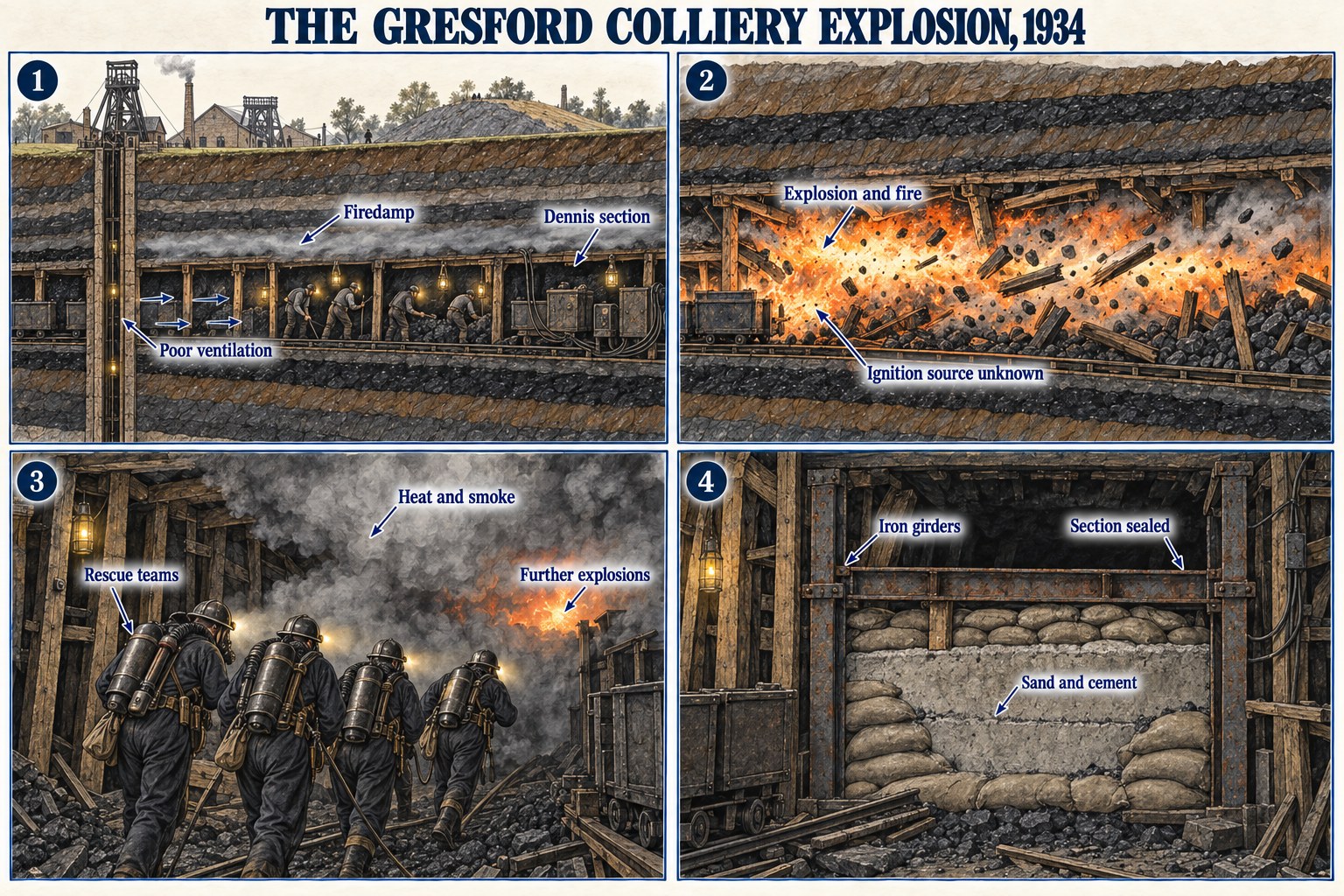
An explosion, most likely caused by an ignition of firedamp gas, tore through the Dennis section of the Main seam at around 2:08am on 22 September 1934, roughly three-quarters of a mile from the shaft bottom, and started a fire that made the section impossible to enter safely.
Contributing factors
The subsequent inquiry, led by Chief Inspector of Mines Sir Henry Walker, found that ventilation measurement records for July and August 1934 had been substantially fabricated by the colliery surveyor, that the mine's manager had spent most of his time overseeing a surface conveyor-belt installation rather than inspecting the working districts, that deputies' books recording gas checks from earlier in 1934 had gone missing, and that some electrical equipment and magneto telephones in use underground were not certified as flameproof or intrinsically safe — any of which could have provided the ignition source in a gas-laden atmosphere.
What happened
The explosion struck during a shift changeover in the early hours of the morning, with around 480 men in or near the affected workings. Rescue teams, including reinforcements from the neighbouring Llay Main Colliery, descended within hours wearing breathing apparatus, but intense heat, thick smoke and repeated further explosions made conditions increasingly dangerous. By the Sunday morning after the disaster, conditions had deteriorated to the point that rescuers were withdrawn, with officials stating that no one could possibly still be alive in the affected workings.
Rescue & recovery
Three members of the rescue team — Dan Hughes, William Hughes and John Lewis — were killed during the recovery effort, and a further explosion on 25 September killed surface worker George Brown. The Dennis section was sealed on the Monday after the disaster with sand, cement and iron girders across both shafts; the great majority of the dead, 254 of the 266, were never recovered and remain entombed in the sealed section.
Investigation & inquiry
Sir Henry Walker's official inquiry opened on 25 October 1934 and exposed systemic safety failures at the colliery, including fabricated ventilation records, inadequate management oversight of the Dennis section, missing safety records, and non-flameproof electrical equipment underground — though the inquiry could not conclusively establish the precise ignition source.
Legal & regulatory aftermath
Legal proceedings brought against the colliery's manager, under-manager and owning company in 1937 resulted only in a conviction for inadequate record-keeping, a outcome widely seen at the time as disproportionate to the scale of the failures the inquiry had exposed.
Memorials & commemoration
A memorial to the 266 victims stands near the site of the former colliery, and the disaster is marked with annual commemorations in Wrexham; it was also the subject of the folk song 'The Gresford Disaster'.
Recorded claims
Individual factual claims, each attached to the source(s) that support it below. Where sources disagree, both are kept.
- The colliery surveyor admitted fabricating ventilation measurement records for July and August 1934; the inspector concluded he had been given more work than he could realistically complete.
- 1937 legal proceedings against the pit manager, under-manager and owning company resulted only in a conviction for inadequate record-keeping.
Related terminology
Mining terms this disaster is structurally linked to, with the nature of the relationship.
- Afterdamp (contributing factor)
Toxic afterdamp (carbon monoxide) generated by the explosion and fire was a major cause of death among those trapped. - Breathing Apparatus (contextual relationship)
Rescue teams, with reinforcements from neighbouring Llay Main, went down in breathing apparatus within hours, but heat and smoke defeated them and the section was sealed. - Deputy (contextual relationship)
Named in this record’s contributing factors: “…installation rather than inspecting the working districts, that deputies' books recording gas checks from earlier in 1934 had gone missing,…” - Firedamp (direct cause)
The explosion is understood to have been caused by an ignition of firedamp gas in the Dennis section. - HM Chief Inspector of Mines (contextual relationship)
Named in this record’s contributing factors: “The subsequent inquiry, led by Chief Inspector of Mines Sir Henry Walker, found that ventilation measurement records for…”
Sources
- (primary) Emily Capper and the 1934 Gresford Colliery disaster — The National Archives
- (secondary) Gresford Colliery Explosion - Wrexham - 1934 — Northern Mine Research Society
Record created: 22 August 2026 · Last researched: 22 August 2026