 MineArchive
Greenside Colliery
| Location | Greenside, near Ryton, Gateshead, Tyne and Wear — 54.9520, -1.7837 (approximate) |
|---|---|
| Commodity | Coal |
| Type | Coal |
| Worked | 1795–1796 (A Pit sunk)–23 July 1966 |
| Maximum depth | 564 feet (A Pit, including boring) |
| Operators | J. B. Simpson (1880–1906), Stella Coal Company (1907–1946), National Coal Board (1947–1966) |
Overview
The colliery of the Gateshead village of Greenside, first sunk in 1795-96, which the Stella Coal Company made into the largest pit in the district, employing over 1,200 in 1925; it closed in July 1966.
History
Greenside Colliery was the pit of the village of Greenside, about seven miles west of Newcastle. Its A Pit was sunk in 1795-96 from a surface about 497 feet above sea level, passing the Main Coal (six and a half feet thick at 61 feet), the Craw, Candle, Old Five-Quarter, Ruler, Towneley, Tilley, Stone Coal, Five-Quarter and Three-Quarter seams to the Brockwell at 463 feet. The B Pit stood a little to the north-east.
In the late 19th century it was a small landsale colliery: R. Simpson and then J. B. Simpson worked it with between ten and twenty men from the 1880s to 1905. The Stella Coal Company took it over in 1907 and developed it into a large colliery, employing 749 by 1910 and 1,241 in 1925, its peak, working the Brockwell, Five Quarter, Stone Coal, Three Quarter, Tilley, Towneley and Victoria seams for coking, gas, household and steam coal. William Rochester was manager for most of the years from 1888 to 1935, with Sir F. R. Simpson as agent. By the early 20th century it was the largest colliery in the district.
The National Coal Board took it over in 1947, when it employed 934 and raised 185,000 tons. Its seams were given up one by one from 1951, and on 15 May 1963 a fall of stone killed three men. The last shift was worked on Saturday 23 July 1966. The Greenside Miners' Lodge banner is still marched through the village each year at the Greenside Banner Festival before going on to the Durham Miners' Gala.
Geology
The A Pit section passes the Main Coal (61 feet), Craw, Candle, Old Five-Quarter, Ruler, Towneley, Tilley, Stone Coal, Five-Quarter (386 feet), Three-Quarter and Brockwell (463 feet) seams, with fireclay worked from the 1920s.
Workings
The A Pit and B Pit, working up to ten seams at once by 1950, including the Victoria, Crow and Ruler or Plessey.
Closure
Seams were abandoned one by one from 1951; the last shift was worked on 23 July 1966.
What remains
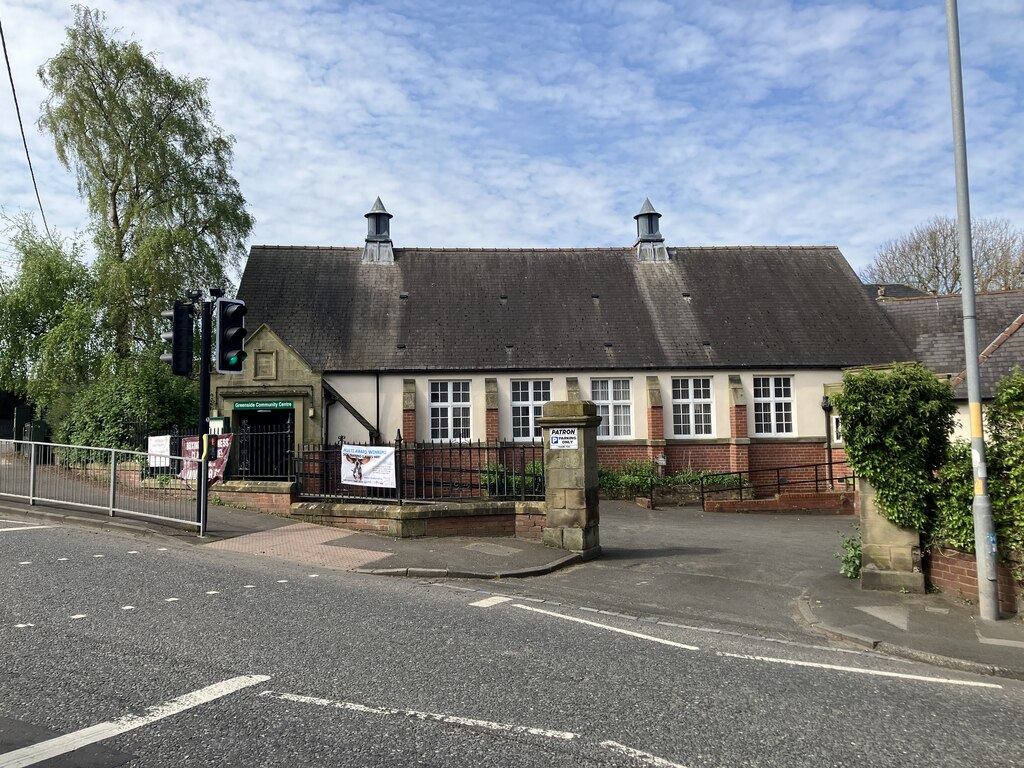
The former colliery welfare hall is now Greenside Community Centre.
The former welfare hall.
Redevelopment
Unknown.
Nearby mines
- Phoenix Drift — 0.6 miles (0.9 km) N
- Emma Colliery — 1.3 miles (2.0 km) N
- Garesfield Colliery — 1.3 miles (2.2 km) S
- Stargate Colliery — 1.7 miles (2.7 km) NE
- Blaydon Burn Colliery — 1.7 miles (2.8 km) E
Straight-line distance, within 9 miles (15 km). Show on the map.
Recorded claims
Individual factual claims, each attached to the source(s) that support it below. Where sources disagree, both are kept.
- The A Pit was sunk in 1795-96 and reached the Brockwell seam at 463 feet. 1
- The Stella Coal Company took it over in 1907. 2
- Employed 1,241 people in 1925. 2
- By the early 20th century Greenside had the largest colliery in the district. 3
- William Rochester was manager in 1888-96 and 1910-35. 4
- A fall of stone killed three men on 15 May 1963. 2
- The last shift was worked on Saturday 23 July 1966. 5,2,3
- The Crow Coal or Bottom Brass Thill workings were abandoned in 1962-66. 6,7
Photographs & further reading
Owners, employment, managers, seams and recorded deaths.
View sourceSources
- (primary) Account of Strata sunk through in the A Pit, Greenside, 1795-1796 (An Account of the strata of Northumberland & Durham as proved by Borings & Sinkings) — North of England Institute of Mining & Mechanical Engineers, via the Durham Mining Museum
- (primary) Greenside Colliery — Durham Mining Museum
- (secondary) Greenside, Tyne and Wear — Wikipedia
- (primary) Greenside Colliery: Colliery Management (prior to 1970) — Durham Mining Museum
- (secondary) NCB Collieries - England (Northern Mine Research Society) — Northern Mine Research Society
- (primary) Catalogue of Plans of Abandoned Mines: Greenside Colliery — Durham Mining Museum
- (primary) Greenside Mine Plans (Mining Remediation Authority plan D911, Crow Coal or Bottom Brass Thill, 1966) — British Geological Survey / Mining Remediation Authority
Record created: 9 October 2026 · Last researched: 9 October 2026