 MineArchive
Foxfield Colliery
| Location | Dilhorne, Cheadle Coalfield, Staffordshire — 52.9536, -2.0403 (approximate) |
|---|---|
| Commodity | Coal |
| Type | Coal |
| Worked | Early 1880s (company formed 1893)–1965 |
| Maximum depth | 725 feet |
| Operators | John and Enoch Mann (?–1893), Foxfield Colliery Co. Ltd (1893–1927), Parkhall Colliery Co. Ltd (1927–1965) |
Overview
The last working deep mine in the Cheadle Coalfield, developed at Dilhorne from the early 1880s and heavily modernised in the 1930s to concentrate the district's production, before closing in 1965 — its site preserved ever since as the Foxfield Railway, whose two original headgears still stand today.
History
Mining had gone on around Dilhorne and Godley Brook for years before John and Enoch Mann began formal operations at Foxfield in the early 1880s, sinking a shaft that reached 725 feet; a second shaft was sunk to access the Woodhead Seam, which became the mine's principal working level throughout its life. The Manns incorporated the business as Foxfield Colliery Co. Ltd on 12 May 1893, capitalised at £25,000. The company went into voluntary liquidation on 23 August 1927, and Parkhall Colliery Co. Ltd of Cheadle acquired both Foxfield and its mining rights — though the two pits, despite being connected underground and under common ownership, continued to operate as independent units. Under the Coal Mines Act of 1930, the combined Parkhall and Foxfield output was confirmed at 160,000 tons a year; a planned expansion of the combined operation was reluctantly abandoned, and it was Parkhall rather than Foxfield that lost out, closing down and surviving only as a pumping station until it was abandoned entirely around the Second World War. Production was concentrated at Foxfield instead, which was heavily modernised through the 1930s, helped by its direct rail connection to the North Staffordshire Railway's Stoke-Derby line at Blythe Bridge. By the late 1930s Foxfield and New Haden Colliery were the only two deep mines left working the Cheadle Coalfield, and Foxfield went on to outlast New Haden too, becoming the coalfield's last working deep mine. Persistently uneconomic owing to its modest output and high development costs, Foxfield Colliery was finally closed by the National Coal Board in 1965, with its workforce transferred to Florence Colliery.
Geology
Coal of the Cheadle coalfield: the Woodhead Seam, reached by a second shaft and the mine's principal working level throughout its life.
Workings
Two shafts, the first reaching 725 feet, working principally the Woodhead Seam; connected underground to the neighbouring Parkhall Colliery from 1927, though the two continued to operate as separate units.
Closure
Closed by the National Coal Board in 1965, the last working deep mine in the Cheadle Coalfield, its limited output and high development costs having made it persistently uneconomic; the workforce was transferred to Florence Colliery.
What remains
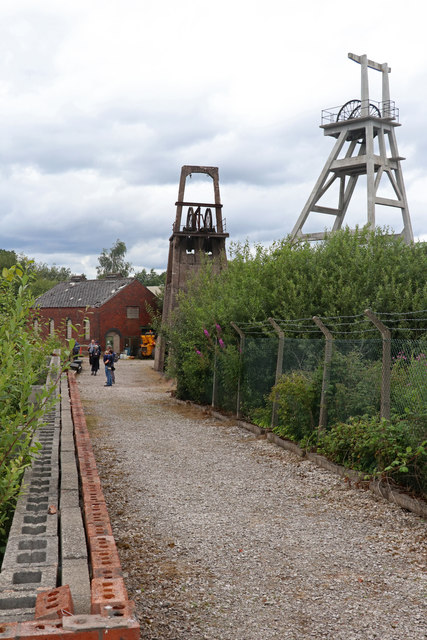
The colliery's branch line, built in 1893 to join the North Staffordshire Railway at Blythe Bridge, was preserved by volunteers as the Foxfield Railway from the year of closure. Both of the mine's original headgears still stand on the site today — the enclosed one marking the former upcast shaft — and are the subject of an ongoing restoration appeal by the railway.
Both original pit headgears survive in situ, along with the colliery's winding house and a few smaller buildings, now maintained by the Foxfield Railway; most of the rest of the original colliery site has been redeveloped as a modern industrial estate.
Nearby mines
- New Haden Colliery — 3.3 miles (5.3 km) NE
- Florence Colliery — 3.6 miles (5.8 km) NW
- Parkhall Colliery — 4.1 miles (6.6 km) NW
- Hem Heath Colliery — 5.1 miles (8.2 km) W
- Kemball Colliery — 5.2 miles (8.4 km) NW
Straight-line distance, within 9 miles (15 km). Show on the map.
Recorded claims
Individual factual claims, each attached to the source(s) that support it below. Where sources disagree, both are kept.
- John and Enoch Mann began formal mining at Foxfield in the early 1880s, sinking a shaft to 725 feet; a second shaft accessed the Woodhead Seam, the mine's principal working level. 1
- Parkhall Colliery Co. Ltd acquired Foxfield after the original company's 1927 liquidation; although connected underground, the two collieries continued to operate as independent units, and it was Parkhall that closed (surviving only as a pumping station) once a planned joint expansion was abandoned. 1
- By the late 1930s, Foxfield and New Haden Colliery were the only two deep mines left in the Cheadle Coalfield; Foxfield outlasted New Haden to become the coalfield's last working deep mine before its own 1965 closure. 1
- Both of the mine's original headgears survive on site, along with its winding house; the branch railway that served the colliery has been preserved and operated as the Foxfield Railway since the year of closure, 1965. 2
Photographs & further reading
The heritage railway's own account of the colliery and its preservation, including the ongoing headgear restoration appeal.
View sourceSources
- (secondary) A history of Foxfield Colliery — Newcastle-under-Lyme/Apedale local heritage research
- (secondary) Our History — Foxfield Railway — Foxfield Railway
Record created: 2 September 2026 · Last researched: 2 September 2026