 MineArchive
Clitherbeck Colliery
| Also known as | Danby Low Moor Colliery, Clitherbecks pits, Castleton Colliery |
|---|---|
| Location | Clitherbeck, Danby Low Moor, north of Castleton in Eskdale, North Yorkshire |
| Commodity | Coal |
| Type | Coal |
| Worked | 16th century–1860s |
| Maximum depth | About 150-160 feet |
| Operators | Michael Smith (1749–1784), Viscount Downe (1749–?) |
Overview
Moorland coal pits on Danby Low Moor at Clitherbeck, north of Castleton in Eskdale, worked by horse gins from at least the eighteenth century and probably the sixteenth. Lord Downe's lessee Michael Smith fought him for eight years over a drainage adit, and mining went on into the 1860s, leaving bell-pit mounds across the moor.
History
Coal was worked on the moor at Clitherbeck, near the meeting of Black and Clither Becks above Castleton in Danby, from the outcrop below what is now Clitherbecks Farm, historically Doubting Castle; the first documentary mention is from the sixteenth century. In 1749 Henry Dawnay, Lord Downe, let his Low Moor Colliery at Clitherbeck to Michael Smith, a local man who had risen from labourer to colliery owner. An estate report of 1768 describes pits about 150 feet deep and six feet by eight, the coal drawn by a horse gin in corves holding six pecks, with four or five men underground working one pit at a time; the workings were drained by soughs and troubled by black damp. Once a seam was reached, headings were driven until they grew unsafe and a new shaft was sunk nearby, leaving the bell-pit mounds that still dot the moor.
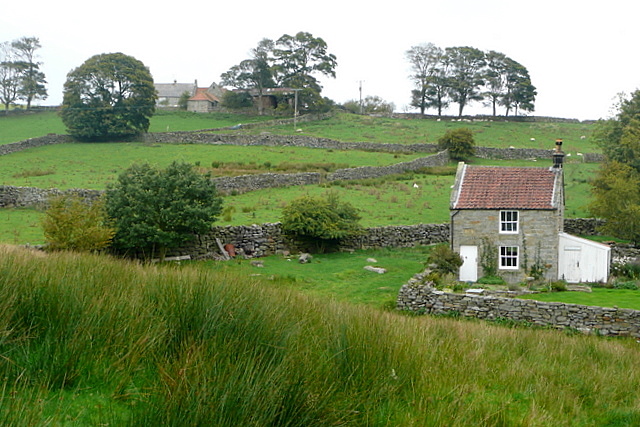
Smith renewed his lease in 1769 at £70 a year and bought a freehold intake at Clitherbeck. In 1775 he began driving an adit to drain the coal under his land, running it under the common where Lord Downe owned the minerals without permission; the dispute lasted eight years and two trials at York, until Lord Downe bought him out in 1784 for £1,000. The seam was worked on both sides of the valley, most extensively along the east side at Danby Low Moor, also called Castleton Colliery, and mining went on until about the mid-1860s, when the railway came through Eskdale. In 1849-51 an eighteenth-century sheep house, now Rose Cottage, was converted to house pit workers, and cottages were built nearby. Shafts up to 160 feet deep, capped with large stones, survive among the mounds between Clitherbeck Farm and Poverty Hill, and ochreous mine water rises in a well beside Rose Cottage.
Geology
A thin moorland coal worked on both sides of the Clitherbeck valley, drained by soughs; the workings were troubled by black damp (carbon dioxide) but not firedamp.
Workings
Small shafts about 150 feet deep worked by horse gin as bell pits, each abandoned for a new shaft nearby once its headings became unsafe; drained by soughs and, from 1775, a drainage adit.
Closure
Mining around Clitherbeck continued until about the mid-1860s, coinciding with the opening of the railway through Eskdale; Hidden Teesside gives working until the 1890s.
What remains
Many pit mounds and some stone-capped shafts survive on the moor between Clitherbeck Farm and Poverty Hill, with ruined pit workers' cottages and ochreous mine water in a well by Rose Cottage.
Bell-pit mounds, stone-capped shafts up to 160 feet deep, and the ruins of cottages built for the pit workers.
Redevelopment
Moorland; Rose Cottage, converted for pit workers in 1849-51, is a private house.
What's uncertain
Points where sources disagree or the record could not be settled; both accounts are kept. All open questions in the archive.
- Mining around Clitherbeck continued until the mid-1860s. (disputed) 1
- Coal was worked here until the 1890s. (disputed) 3
Recorded claims
Individual factual claims, each attached to the source(s) that support it below. Where sources disagree, both are kept.
- In 1749 Lord Downe let his Low Moor Colliery at Clitherbeck to Michael Smith. 1
- In 1768 the pits were about 150 feet deep and worked by horse gin. 1,2
- Smith's adit, begun in 1775 under Lord Downe's common, led to an eight-year dispute ended by a £1,000 buy-out in 1784. 1
- The first documentary mention of coal at Clitherbeck is from the sixteenth century. 3,2
- Mining around Clitherbeck continued until the mid-1860s. (disputed) 1
- Coal was worked here until the 1890s. (disputed) 3
- Pit mounds and stone-capped shafts up to 160 feet deep survive between Clitherbeck Farm and Poverty Hill. 3
Photographs & further reading
The Clitherbeck and Danby Low Moor collieries, from estate papers of 1749 to the 1860s.
View sourceA local history of the pits, the bell-pit method and the pit workers' cottages.
View sourceSources
- (secondary) NMRS: Clitherbeck Colliery — Northern Mine Research Society
- (secondary) Clitherbecks: Coal, Cottages and Calamity (fhithich.uk) — fhithich.uk
- (observational) Hidden Teesside: Clitherbeck Coal Mines — Hidden Teesside
- (observational) Geograph: Rose Cottage, Clitherbeck — Geograph Britain and Ireland
Record created: 11 October 2026 · Last researched: 11 October 2026