 MineArchive
Torbanite
| Also known as | Torbanehill mineral (The name used in the 1850s litigation and by Bennett (1854).), Kerosene shale (The historical Australian name.) |
|---|---|
| Category | Commodities |
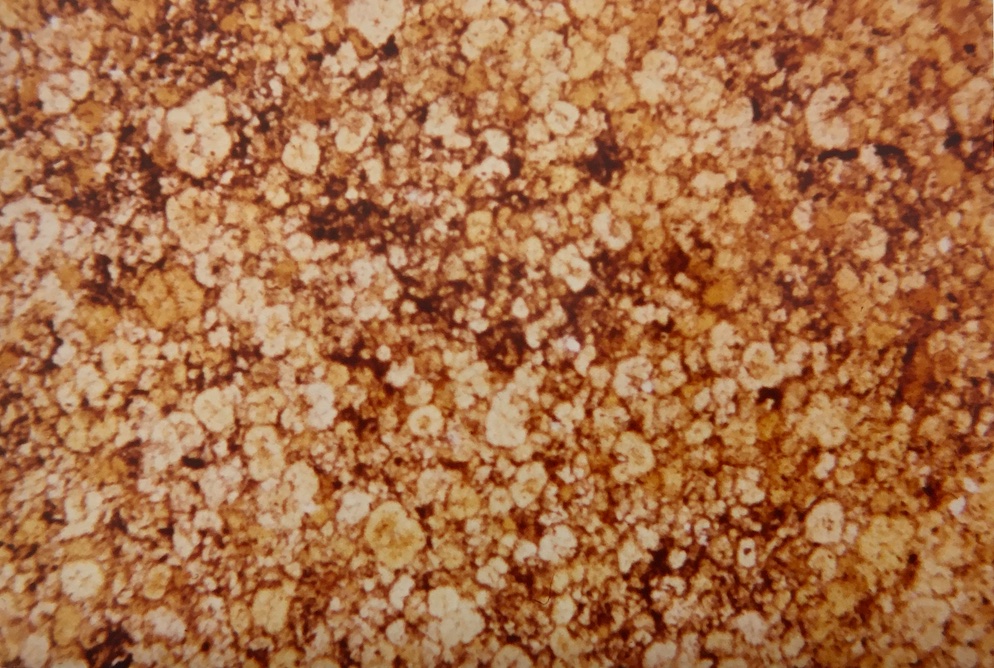
Torbanite is a fine-grained black oil shale, formed in lakes from the remains of microscopic algae, that occurs as lens-shaped masses with coal. In Scotland it was the Boghead coal of the Bathgate district, a cannel so rich in gas and oil that in the 1850s its landlord went to law to argue it was not coal at all. It takes its name from Torbane Hill (Torbanehill), south-west of Bathgate in West Lothian.
Historical usage
An unusually rich cannel was found on the Boghead estate south-west of Bathgate in about 1846. Bores showed that the seam extended over about three square miles, westward towards Armadale and south to Torbanehill; it was seldom more than eighteen inches thick at the centre of this basin and thinned to a few inches at its margins. It proved richer than any other cannel found in Britain, and for a time it was exported to gasworks across Britain and Europe and as far as the east coast of the United States. James Young's patent of 17 October 1850 for distilling paraffin oil from coal made it more valuable still: the works he and his partners completed at Bathgate in 1851, the first truly commercial oil works in the world, ran on locally mined torbanite.
Under William Gillespie's Torbanehill estate, whose minerals had been leased to the Falkirk coalmasters James Russel and Son in 1850, the value of the seam led to a decade of litigation. Gillespie argued that the 'Torbane mineral' was not coal but a new kind of mineral, and so outside the lease. At the jury trial in Edinburgh in 1853 microscopists, botanists and chemists gave evidence on both sides: one group held that the yellow bodies in the mineral were vegetable cells, so that it was a fossil plant, and the other that they were not. Examining thin sections for the Royal Society of Edinburgh the next year, John Hughes Bennett concluded that every coal had a woody basis and that the Torbanehill mineral had none, being bituminous matter set in clay. When the second action reached the House of Lords in 1859, their lordships ruled only on whether the first action barred it. After all the microscopes, the question that started the whole business went unanswered in the highest court in the land.
The seam did not last long. By one account the torbanite was completely exhausted by 1862; at Torbanehill most of it was worked out by about 1870, and the last Boghead gas workings there were abandoned in 1888. The search for something like it led to the discovery of the Broxburn oil shales in 1858, and to the West Lothian shale-oil industry that outlived it by sixty years.
How it worked
Torbanite is classed as a lacustrine oil shale. Its organic matter, telalginite, comes from lipid-rich microscopic plant remains like those of the freshwater colonial green alga Botryococcus braunii, with lesser amounts of vitrinite and inertinite. That separates it from ordinary cannel coal, which is classed as a terrestrial oil shale. It typically comprises 88 per cent carbon and 11 per cent hydrogen, and it occurs as lenticular masses alongside coal seams.
In 1853 the difference was argued through the microscope. Bennett's thin sections showed coal to be altered wood, the cannel coals to carry rounded bituminoid masses within that woody structure, and the Torbanehill mineral to consist of the bituminoid masses in clay, with no woody texture at all. Underground at Torbanehill the seam formed a solid slab of fine-grained material, broken into cubic blocks in workings little more than four feet high before it was hauled to the surface. Thomas Stewart Traill, who visited No. 2 pit in 1853, described the blocks piled at the pithead as from 1 foot 4 inches to 1 foot 11 inches thick.
Why it was used
Gas first, then oil. Cannel coals had been used for town gas since the 1820s because they yielded far more gas in the retort than common coal, and the Boghead coal yielded more than any of them, so gasworks at home and abroad paid a high price for it. From 1851 it was also the raw material of Young's paraffin oil: torbanite yielded 537 litres of petroleum spirit per tonne, against 150 to 180 litres from the oil shales that took its place.
Risks & limitations
It was scarce. The Bathgate basin covered about three square miles and the seam was seldom more than eighteen inches thick, so a coal famous across Europe was worked out within a generation. A contemporary account of the field counted thirty-three pits and more than fifty steam engines at work on it, many also raising ironstone, and called it the most expensive coal to work that its author knew, though one that could be worked at a profit. Underground it had a hazard of its own: miners at Torbanehill said its intense gas-like smell, in confined workings, gave them headaches and sometimes made them vomit.
Its classification has never been tidy. The same material has been called coal, cannel, oil shale and a mineral in its own right, so older records that speak of cannel, gas coal or Boghead coal need reading with care over which is meant.
Regional variation
In Scotland it was Boghead coal, after the Boghead estate where it was first found, and also Boghead cannel, Boghead gas coal and the Torbanehill or Torbane mineral; torbanite is the name the scientific literature settled on. In Australia it was called kerosene shale. Major deposits outside Scotland lie in Pennsylvania and Illinois, in Mpumalanga in South Africa, in the Sydney Basin of New South Wales, where the largest is at Glen Davis, and in Nova Scotia. Bathvillite, a related substance, occurs within the Bathgate torbanite.
Mines associated with this term
Included only where MineArchive's own research gives a reasonable evidential basis — not every mine where this might plausibly apply.
- Boghead Colliery — West Lothian (well documented example)
Named 4 times in this record, first in the summary: “…Boghead estate south-west of Bathgate where the Boghead gas coal, or torbanite, was first worked: James Russel and Son sank more than fifteen from…” - Torbanehill Pits — West Lothian (well documented example)
Named twice in this record, first in the summary: “…James Russel and Son from 1850 into the Boghead coal, the oil-rich 'Torbanehill mineral' whose nature was fought over in the courts for a decade. The seam…”
Sources
- (primary) Gillespie et al. v Russel et al. and Russel et al. v Gillespie et al. (House of Lords, 1859), law report reprinted by LawCare Nigeria — LawCare Nigeria (reprint of the House of Lords report)
- (primary) J. H. Bennett, An Investigation into the Structure of the Torbanehill Mineral, and of Various Kinds of Coal (Transactions of the Royal Society of Edinburgh, vol. 21, 1854) — Royal Society of Edinburgh (copy held by GeoSphere Austria library)
- (secondary) James Young (chemist) — Wikipedia
- (secondary) Scottish Shale: Beyond the Garden Wall (the great fire of Torbanehill, part one) — Scottish Shale
- (secondary) Scottish Shale: Boghead Gas Coal mining in West Lothian — Scottish Shale (Museum of the Scottish Shale Oil Industry, Almond Valley Heritage Trust)
- (secondary) Scottish Shale: The Remarkable Torbanehill Mineral — Scottish Shale (Museum of the Scottish Shale Oil Industry, Almond Valley Heritage Trust)
- (secondary) Torbanite (Wikipedia) — Wikipedia
Record created: 24 October 2026 · Last researched: 24 November 2026