 MineArchive
Yeolands Quarry
| Location | East of Easton, south of the Grove, above the east cliffs of Portland, Dorset — 50.5462, -2.4239 (approximate) |
|---|---|
| Commodity | Limestone |
| Type | Quarry |
| Worked | to 2000s (largely redundant) |
| Maximum depth | About 120 feet (37 metres) |
| Operators | Portland Stone Firms Ltd, Portland Stone Limited |
Overview
A large, deep Portland stone quarry above the east cliffs of Portland, south of the old prison, worked by Portland Stone Firms until it became largely redundant in the twenty-first century. It is joined to Broadcroft Quarry and was the intended site of the never-built Jurassica attraction.
History
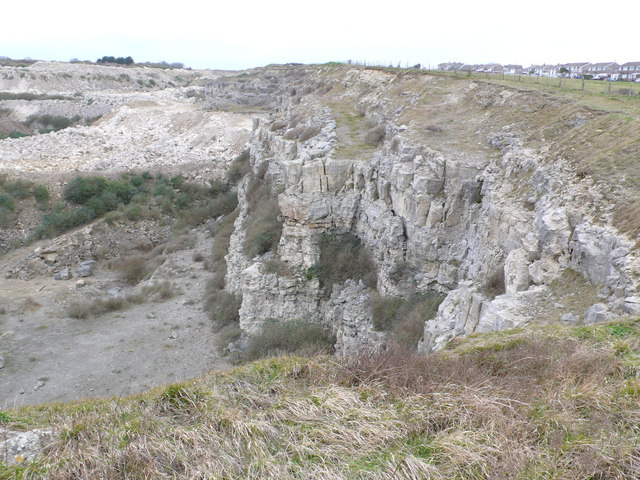
Yeolands Quarry lies on the eastern side of the Isle of Portland, east of Easton and south of the Grove, above the east cliffs just south of the old prison, now a Young Offenders Institution, and near Durdle Pier. It is one of the largest quarries on the island, 120 feet deep and 300 feet wide, and its north-north-eastern face shows a clean sequence of the Portland Stone, both the Cherty Series and the Freestone, below degraded Purbeck beds. Portland Stone Firms Ltd worked it fully until it became redundant for stone in the twenty-first century; it connects with Broadcroft Quarry to the west, which is still worked, and Portland Stone Limited has used it with Broadcroft, Perryfield and Coombefield for crushed stone.
By the late 1980s the bottom of the quarry held a small wetland of ponds fed by rivulets, with reeds, grasses and newts, but in the twenty-first century it was used to dump overburden and the ecosystem was buried under rubble. Large blocks of stromatolitic limestone from the Purbeck Caps were set along its eastern edge near the cliff top as a barrier. In 2013 plans were announced for Jurassica, an £85-90 million underground geological park inspired by the Eden Project, to be built in Yeolands, but it was never built there. In April 1999 a man fell 60 feet from the cliff top into the quarry and survived after ten hours.
Geology
Portland Stone, both Cherty Series and Freestone, with Purbeck beds up to about the Hard Slatt at the top; Purbeck Cap stromatolites in boulders along the eastern edge.
Workings
A large open quarry about 120 feet deep and 300 feet wide, linked to Broadcroft Quarry on the west.
Closure
Largely redundant for stone extraction in the twenty-first century; the north and north-west parts are still used with Broadcroft.
What remains
Mostly disused and partly filled with overburden; the parts next to Broadcroft are still used.
The deep quarry faces, with a sequence of Portland Stone exposed on the north-north-eastern face.
Redevelopment
Proposed in 2013 as the site of the Jurassica attraction, which was not built there.
Related mines
- Broadcroft Quarry — Adjoining quarries, linked on Yeolands' western side.
- Coombefield Quarry — Both worked by Portland Stone Firms Ltd.
- Perryfield Quarry — Both worked by Portland Stone Firms Ltd, and by Portland Stone Limited for crushed stone.
Nearby mines
- Broadcroft Quarry — 0.2 miles (0.4 km) W
- Perryfield Quarry — 0.7 miles (1.1 km) SW
- Jordans Mine — 0.8 miles (1.2 km) W
- King Barrow Quarry — 0.8 miles (1.3 km) NW
- Coombefield Quarry — 1.1 miles (1.7 km) SW
Straight-line distance, within 9 miles (15 km). Show on the map.
Recorded claims
Individual factual claims, each attached to the source(s) that support it below. Where sources disagree, both are kept.
- Yeolands is one of the largest quarries on Portland, 120 feet deep and 300 feet wide. 1
- The quarry was worked by Portland Stone Firms Ltd before becoming redundant for stone in the twenty-first century. 2,1
- Yeolands adjoins and links with Broadcroft Quarry to the west, which is still in use. 2,1
- A wetland of small ponds on the quarry floor in the late 1980s was later buried under dumped rubble. 1,3
- Yeolands was the planned site of the Jurassica attraction, announced in 2013 and not built there. 1,3
Photographs & further reading
The quarry, its lost wetland and the Jurassica plans.
View sourceThe geology exposed at Yeolands and the stromatolite blocks on its edge.
View sourcePhotographs of the quarry from 1989 to 2015.
View sourceSources
- (secondary) Yeolands Quarry — Wikipedia
- (secondary) Isle of Portland Quarries — Geology by Ian West (University of Southampton)
- (observational) Yeolands Quarry and Jurassica — Portland Museum Picture Archive
Record created: 4 October 2026 · Last researched: 4 October 2026