 MineArchive
Perryfield Quarry
| Location | Middle of the Isle of Portland, east of Weston and south of Wakeham, Dorset — 50.5389, -2.4338 (approximate) |
|---|---|
| Commodity | Limestone |
| Type | Quarry |
| Worked | 1890s–Still active |
| Maximum depth | Unknown. |
| Operators | Portland Stone Firms Ltd, Portland Stone Limited |
Overview
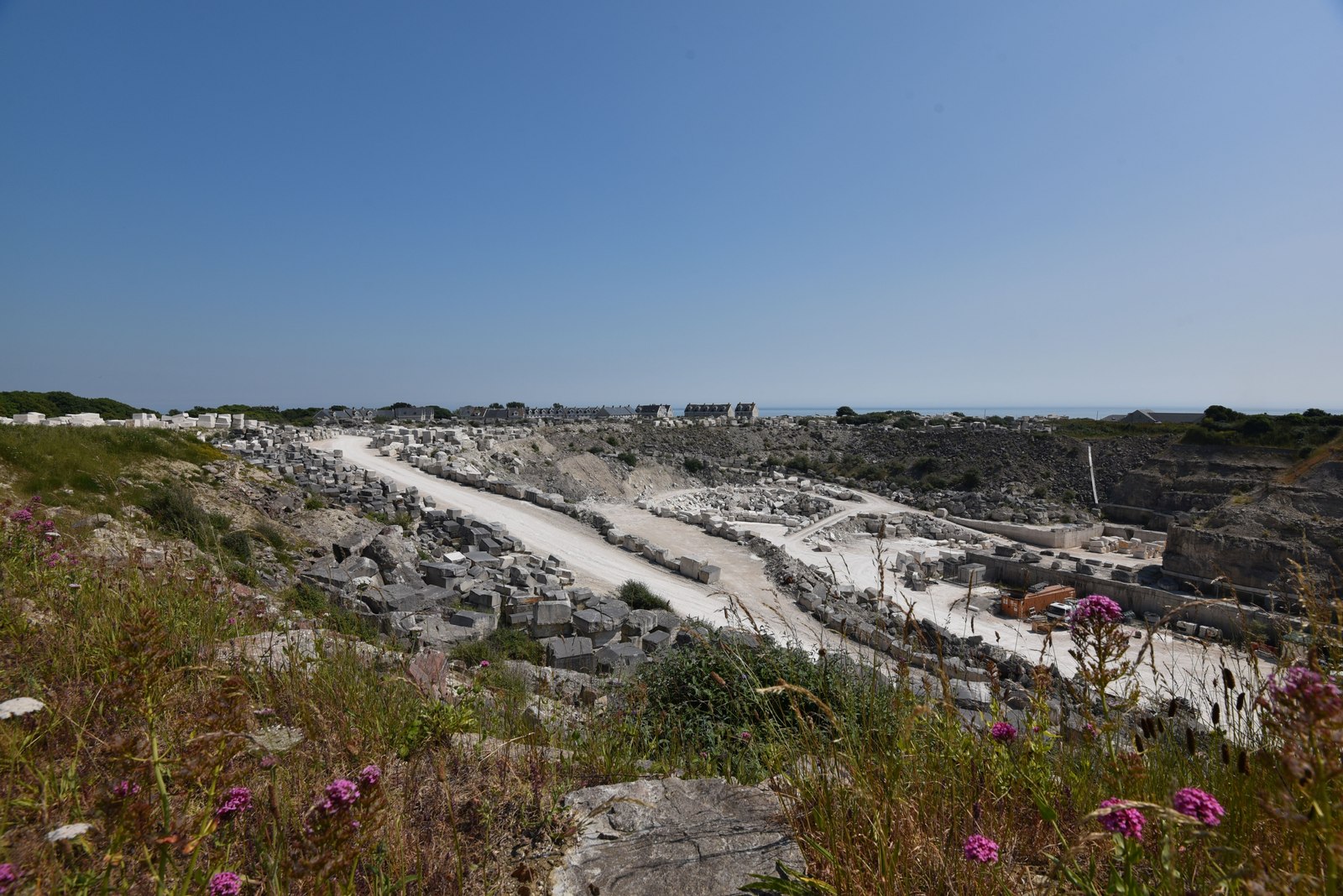
A Portland stone quarry in the middle of the Isle of Portland, first worked in the 1890s and now Portland Stone Firms' main production site, worked westward for Basebed, Roach, Shelly and Whitbed stone. An infilled corner has been a butterfly reserve since 1998.
History
Perryfield Quarry lies towards the middle of the Isle of Portland, east of Weston and south of Wakeham, and was first quarried in the 1890s. It has had periods out of work but was reopened for the demand for its particular stone. Under the 1951 planning consent for modern quarrying on Portland, which covered 324 hectares, Portland Stone Firms Ltd, the island's largest landholder, holds Perryfield with Broadcroft and Coombefield, and Perryfield is now the firm's main production site, an open-cast working being driven westward. Its reserves of dimension stone run beyond the present consent, which ends in 2042. It is known for the quality and bed heights of its stone and is quarried for Perryfield Basebed, Roach, Shelly and Whitbed; the Whitbed was used in restoring Westminster Abbey in 1993 and for Waterloo Bridge, and in 2012 the firm's masons carved panels and lintels from selected Perryfield blocks for the Sixty London development at Holborn Viaduct. Portland Stone Limited, a separate firm, also takes crushed stone from it.
The quarry is also known for its geology: a giant Titanites ammonite stands at the gate, the Basal Shell Bed yields bivalves, gastropods and burrows, and the Perryfield Stromatolite Bed in the Lower Purbeck above is named from it. Windmill Quarry, or Perryfield North, is a partly separate northern extension. In 2009 the small Perryfield Works was demolished for flats, and the Pennsylvania Heights estate has been built on a former part of the quarry. An abandoned, infilled 1.2-hectare area has been leased to Butterfly Conservation as a reserve since 1998, within the Portland SSSI.
Geology
Portland Stone (Basebed, Roach, Shelly and Whitbed), with the Basal Shell Bed, and Lower Purbeck strata above including the Hard Slatt and the Perryfield Stromatolite Bed.
Workings
An open-cast quarry for block dimension stone, worked westward, with a northern extension (Windmill Quarry or Perryfield North); crushed stone also produced.
Closure
Working; planning consent runs to 2042.
What remains
A working quarry; the infilled reserve is limestone grassland and scrub managed for butterflies.
Perryfield House, derelict, survives from the former Perryfield Works.
Redevelopment
Flats on the Perryfield Works site (from 2009), the Pennsylvania Heights housing estate on part of the quarry, and a butterfly reserve since 1998.
Related mines
- Broadcroft Quarry — Both held by Portland Stone Firms Ltd, each with a Butterfly Conservation reserve.
- Coombefield Quarry — Both held by Portland Stone Firms Ltd under the 1951 planning consent.
- Yeolands Quarry — Both worked by Portland Stone Firms Ltd, and by Portland Stone Limited for crushed stone.
Nearby mines
- Coombefield Quarry — 0.4 miles (0.6 km) SW
- Broadcroft Quarry — 0.6 miles (0.9 km) N
- Jordans Mine — 0.7 miles (1.1 km) NW
- Yeolands Quarry — 0.7 miles (1.1 km) NE
- Portland Stone Quarries — 0.8 miles (1.2 km) NW
Straight-line distance, within 9 miles (15 km). Show on the map.
Recorded claims
Individual factual claims, each attached to the source(s) that support it below. Where sources disagree, both are kept.
- Perryfield Quarry was first quarried in the 1890s. 1
- Portland Stone Firms Ltd holds Perryfield under the 1951 planning consent, and it is the firm's main production site. 1
- The quarry is worked for Perryfield Basebed, Roach, Shelly and Whitbed; the Whitbed was used to restore Westminster Abbey in 1993. 1
- The Perryfield Stromatolite Bed of the Lower Purbeck is well known in Perryfield Quarry. 2
- An infilled 1.2-hectare area has been leased to Butterfly Conservation as a reserve since 1998. 1
Photographs & further reading
History, ownership, stones, the housing and the butterfly reserve.
View sourceGeology of Perryfield and Windmill quarries, including the stromatolite bed.
View sourceSources
- (secondary) Perryfield Quarry — Wikipedia
- (secondary) Isle of Portland Quarries — Geology by Ian West (University of Southampton)
Record created: 4 October 2026 · Last researched: 4 October 2026