 MineArchive
Jordans Mine
| Location | Inmosthay, centre of the Isle of Portland, Dorset — 50.5479, -2.4411 (approximate) |
|---|---|
| Commodity | Limestone |
| Type | Stone |
| Worked | 2008 (mine–Still active |
| Maximum depth | More than 20 metres below the surface; workings up to 9 metres high |
| Operators | Albion Stone plc (2008–?) |
Overview
Albion Stone's underground Portland stone mine in the centre of the Isle of Portland, on the site of Jordans quarry, part of Inmosthay Quarry and worked from the late 1800s. Mining began in 2008 and the working was wholly underground by 2016, when it was the largest Portland stone mine. It was joined to the Bowers workings in 2019.
History
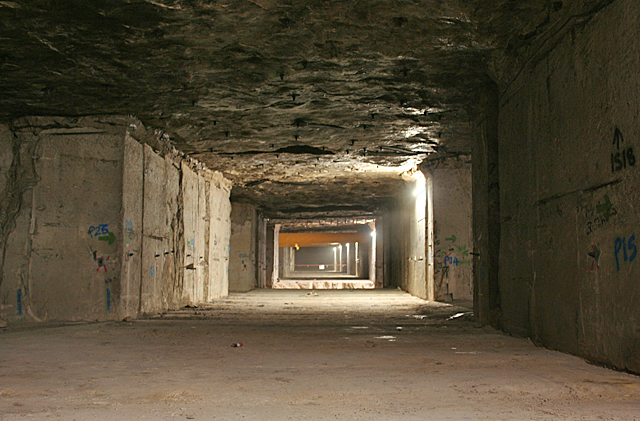
Jordans was a quarry, part of Inmosthay Quarry in the centre of the Isle of Portland together with Fancy Beach, worked consistently from the late 1800s. Albion Stone, a family business in the Portland stone trade for more than a century, began trial mining at its neighbouring Bowers Quarry in 2002 and high-wall mining there in 2006. After planning permission and a unilateral undertaking it moved underground at Jordans in 2008, starting beneath the Red Triangle Cricket Club and later extending under nearby roads, schools and community areas. The portal was cut in the floor of the existing quarry, out of sight of the listed buildings and conservation area above. The last stones were taken from the open quarry in 2015, and by early 2016 the working was wholly underground, in places 9 metres high, and the largest mine for Portland stone.
In 2014 the mine had about six miles of roadways, each 6 metres wide, laid out in a grid with 6-metre square blocks of stone left standing between them, more than 20 metres below the surface. The Bowers workings, which had continued under the school playing field and churchyard, were joined to Jordans in November 2019. The complex produces Jordans Basebed, Jordans Whitbed, Fancy Beach Whitbed, Grove Whitbed, Ostrea Patch Reef Whitbed and Jordans Roach; Bowers Whitbed and Basebed are now sold under the Jordans names because the stone is identical. Albion expects extraction to continue until the early 2040s. The northern reserves of the old quarry are part of a Site of Special Scientific Interest and are to be restored in the final site scheme.
Geology
Portland stone, worked in the Basebed, Whitbed and Roach beds, with the Ostrea patch-reef whitbed.
Workings
A grid of roadways 6 metres wide with 6-metre square pillars of stone left between them, entered from a portal in the floor of the former quarry; joined underground to the Bowers workings in 2019.
Closure
Working; Albion Stone expects extraction to continue into the early 2040s.
What remains
A working mine operated by Albion Stone.
The former Jordans quarry, in whose floor the portal lies.
Redevelopment
The northern reserves of the old quarry are part of a Site of Special Scientific Interest and are to be restored.
Related mines
- Portland Stone Quarries — Albion Stone's Bowers workings, covered there, were joined to Jordans Mine underground in 2019.
Nearby mines
- Portland Stone Quarries — 0.3 miles (0.5 km) SW
- Tout Quarry — 0.4 miles (0.6 km) NW
- Broadcroft Quarry — 0.5 miles (0.9 km) E
- King Barrow Quarry — 0.5 miles (0.9 km) NE
- Perryfield Quarry — 0.7 miles (1.1 km) SE
Straight-line distance, within 9 miles (15 km). Show on the map.
Recorded claims
Individual factual claims, each attached to the source(s) that support it below. Where sources disagree, both are kept.
- Jordans, part of Inmosthay Quarry, was worked as a quarry from the late 1800s until the last stones were extracted in 2015. 1,2
- Mining at Jordans began in 2008 and the working was wholly underground by early 2016. 1,2
- In 2016 Jordans was the largest Portland stone mine, in places 9 metres high. 2
- In 2014 the roadways were 6 metres wide in a grid with 6-metre square blocks of stone left between them. 3
- The Bowers workings were joined to Jordans Mine in November 2019. 1
Photographs & further reading
The operator's history of the Jordans and Bowers workings, their stones and reserves.
View sourceThe move from quarrying to mining, the portal and the stones produced.
View sourceSources
- (secondary) Our Mines: Jordans/Bowers & Stonehills — Albion Stone plc
- (secondary) Jordans Mine — Wikipedia
- (observational) Jordans Mine (Geograph 4187091) — Geograph
Record created: 4 October 2026 · Last researched: 4 October 2026