 MineArchive
Tout Quarry
| Location | Tophill, north-west Isle of Portland, Dorset — 50.5531, -2.4446 (approximate) |
|---|---|
| Commodity | Limestone |
| Type | Quarry |
| Worked | c. 1780–1982 |
| Maximum depth | Unknown. |
Overview
A Portland stone quarry on Tophill, worked commercially from about 1780 until 1982, when its last job was 30,000 tons of boulders for sea defences. Since 1983 it has been a sculpture park of the Portland Sculpture and Quarry Trust, with sixty to seventy carvings in the old workings, and it is now also a nature reserve.
History
Tout Quarry lies in the north-west corner of Tophill on the Isle of Portland and was one of some eighty quarry sites on the island. It was worked commercially from about 1780, chiefly through the eighteenth and nineteenth centuries. Tramways ran through it, carrying waste to the cliff edge to be tipped and block stone to Priory Corner, where it went down the Merchant's Railway to Castletown to be shipped. Lano's Bridge, now listed at Grade II, was built in the mid-1800s to carry a high-level tramway taking waste to the cliff edge. The quarry was last worked in 1982, for a contract that took 30,000 tons of boulders for sea defences.
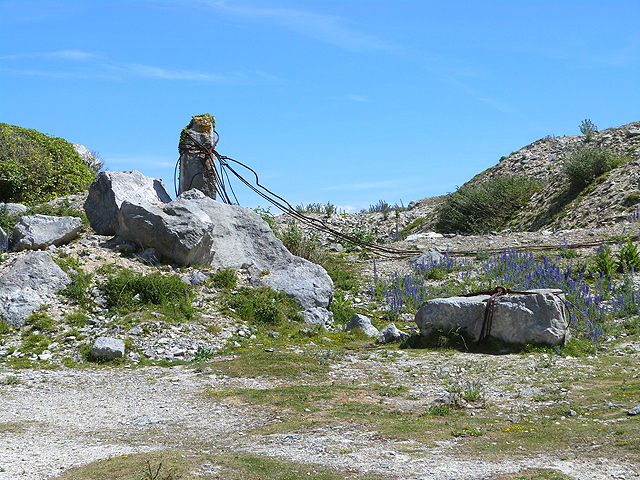
In 1983 the Portland Sculpture and Quarry Trust began a sculpture park in the quarry, which also saved it from further extraction. Artists' residencies left both temporary and permanent works among the gullies and ledges of the old workings, among them Antony Gormley's 'Still Falling', a figure cut into the rock face; sixty to seventy survive. The Trust teaches stone carving in an outdoor workshop in the quarry. The site became a nature reserve around 2004 and is part of Portland's Site of Special Scientific Interest, managed by Dorset Wildlife Trust; rock stonecrop, Portland spurge and rare lichens grow on the bare stone, and clearing invasive scrub brought the first colony of silver-studded blue butterflies to the area.
Geology
Portland and Purbeck limestones.
Workings
An open quarry with ravines and gullies running to the cliff edge; tramways to the cliff-edge tips and to Priory Corner for the Merchant's Railway; Lano's Bridge carrying a high-level waste tramway.
Closure
Last worked in 1982 for a contract of 30,000 tons of sea-defence boulders.
What remains
A sculpture park and nature reserve of open grassland and bare stone, kept clear of invasive scrub.
Lano's Bridge, listed Grade II, and the old workings, gullies and waste tips survive among the sculptures.
Redevelopment
Tout Quarry Sculpture Park since 1983, with an outdoor carving workshop, and a nature reserve since about 2004.
Related mines
- King Barrow Quarry — Together they make up Dorset Wildlife Trust's Portland Quarries Nature Park.
Nearby mines
- Jordans Mine — 0.4 miles (0.6 km) SE
- King Barrow Quarry — 0.4 miles (0.7 km) E
- Portland Stone Quarries — 0.5 miles (0.8 km) S
- Broadcroft Quarry — 0.8 miles (1.3 km) SE
- Yeolands Quarry — 1.0 miles (1.7 km) SE
Straight-line distance, within 9 miles (15 km). Show on the map.
Recorded claims
Individual factual claims, each attached to the source(s) that support it below. Where sources disagree, both are kept.
- Tout Quarry was worked commercially from about 1780 until 1982. 1,2
- The quarry was last worked in 1982 for a boulder contract of 30,000 tons for sea defences. 1
- The Portland Sculpture and Quarry Trust began a sculpture park in the quarry in 1983, the year after quarrying ended. 1,3
- Tramways took waste to the cliff edge and block stone to Priory Corner for the Merchant's Railway; Lano's Bridge carried a high-level waste tramway. 1
- The quarry is a nature reserve and part of the Isle of Portland SSSI, managed by Dorset Wildlife Trust. 1,2
Photographs & further reading
The reserve, its working dates, plants and butterflies.
View sourceWorking history, tramways, Lano's Bridge, the Trust and a list of sculptures.
View sourceSources
- (secondary) Tout Quarry — Wikipedia
- (secondary) Tout Quarries — Dorset Wildlife Trust
- (observational) Tout Quarry, Portland, Dorset: an open-air sculpture park — Carvings with Stories
Record created: 4 October 2026 · Last researched: 4 October 2026