 MineArchive
King Barrow Quarry
| Also known as | Kingbarrow Quarries, Kingsbarrow Quarries |
|---|---|
| Location | North-east corner of Tophill, Isle of Portland, south-east of Verne Yeates, Dorset — 50.5552, -2.4360 (approximate) |
| Commodity | Limestone |
| Type | Quarry |
| Worked | 1800s–c. 1900 |
| Maximum depth | Unknown. |
| Operators | Steward and Co. |
Overview
A maze of nineteenth-century Portland stone quarries in the north-east of Tophill, abandoned around the start of the twentieth century. Quarrying there in the 1880s and 1890s uncovered Iron Age and Roman beehive chambers and burials. The site has been a Dorset Wildlife Trust reserve since about 2004.
History
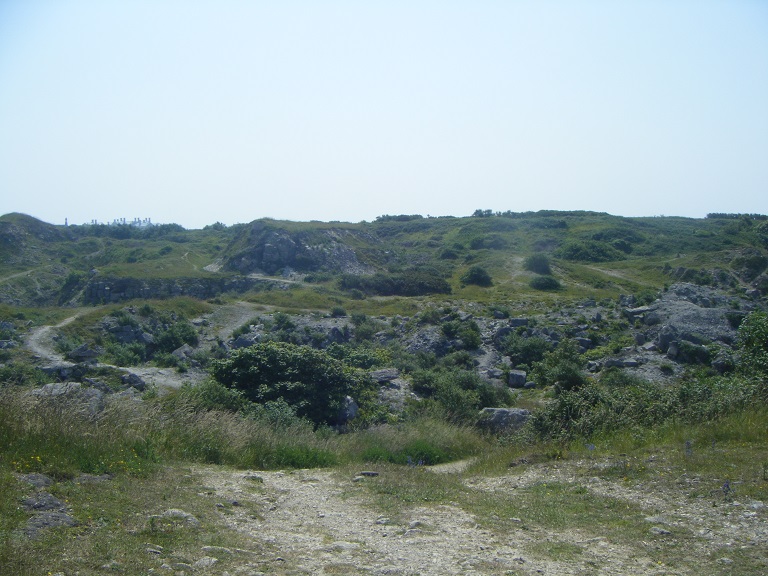
The King Barrow, or Kingsbarrow, quarries lie in the north-east corner of Tophill on the Isle of Portland, south-east of Verne Yeates. They were worked extensively in the nineteenth century as a maze of small, deep excavations walled with backfilled blocks, and Steward's quarry, worked by Messrs Steward and Co. and joined to the main workings by an inclined plane, is usually counted with them. Weston's quarry was another of the group. A horse-drawn tramway with a tunnel carried the stone to the Merchant's Railway. The quarries were described while still working by Strahan in 1898, with the quarrymen's names for the beds, and much of the early description of the Portland Stone comes from them, so the bed names fit this area best.
Opening up the ground uncovered many Roman finds, including stone coffins, which gave rise to the belief that a person of local power had been buried there and to the name King Barrow. Between 1880 and 1886 more than a dozen corbelled stone 'beehive' chambers, mostly about 9 feet across and 8 feet high, were found in Weston's and Steward's quarries; most finds were destroyed by later quarrying and those recovered went to the Dorset County Museum. The quarries were abandoned around the start of the twentieth century and left to regenerate. In more recent years they were used by motorbike riders, until around 2004 the owners handed the 12.2-hectare site to the Dorset Wildlife Trust; with Tout Quarry it forms the Trust's Portland Quarries Nature Park.
Geology
Portland Stone, whose standard bed names were first described here; Strahan's 1898 section runs from the Purbeck 'shifting rubble' and 'hard slate' down through the Portland freestone beds.
Workings
Many small, deep open quarries with backfilled block walls, including Steward's quarry linked by an inclined plane; a horse-drawn tramway and tunnel to the Merchant's Railway.
Closure
Abandoned around the start of the twentieth century; last worked over a hundred years ago.
What remains
A nature reserve of regenerated grassland, bare rock and scree, cleared of invasive cotoneaster and buddleia.
Blocks of cut stone, a quarryman's shelter, and pieces of tramway track and a tunnel from the horse-drawn tramway.
Redevelopment
King Barrow Quarries Nature Reserve (Dorset Wildlife Trust) since about 2004, part of the Portland Quarries Nature Park.
Related mines
- Tout Quarry — Together they make up Dorset Wildlife Trust's Portland Quarries Nature Park.
Nearby mines
- Tout Quarry — 0.4 miles (0.7 km) W
- Jordans Mine — 0.5 miles (0.9 km) SW
- Broadcroft Quarry — 0.7 miles (1.1 km) SE
- Portland Stone Quarries — 0.8 miles (1.3 km) SW
- Yeolands Quarry — 0.8 miles (1.3 km) SE
Straight-line distance, within 9 miles (15 km). Show on the map.
Recorded claims
Individual factual claims, each attached to the source(s) that support it below. Where sources disagree, both are kept.
- The King Barrow quarries were worked extensively in the nineteenth century. 1,2
- The quarries were last worked over a hundred years ago, quarrying ceasing around the start of the twentieth century. 2,3
- Between 1880 and 1886 more than a dozen corbelled beehive chambers were found in Weston's and Steward's quarries at King Barrow. 4
- Quarrying uncovered many Roman finds, including stone coffins. 2
- The 12.2-hectare site became a Dorset Wildlife Trust nature reserve around 2004. 2,5
Photographs & further reading
The reserve and the regenerated quarry landscape.
View sourceThe Iron Age and Roman chambers found during quarrying in the 1880s.
View sourceThe King Barrow quarries and Strahan's 1898 section of their beds.
View sourceSources
- (secondary) Isle of Portland Quarries — Geology by Ian West (University of Southampton)
- (secondary) King Barrow Quarry — Wikipedia
- (secondary) King Barrow Quarries — Dorset Wildlife Trust
- (secondary) MDO6543 - Beehive chambers at King Barrow, Portland — Dorset Heritage Explorer (Dorset HER)
- (observational) Independent and King Barrow Quarries — Portland Museum Picture Archive
Record created: 4 October 2026 · Last researched: 4 October 2026