 MineArchive
Washington F Pit
| Also known as | Washington 'F' Pit, F Pit |
|---|---|
| Location | Albany, Washington, Tyne and Wear — 54.9107, -1.5302 (approximate) |
| Commodity | Coal |
| Type | Coal |
| Worked | 1777–21 June 1968 |
| Maximum depth | 927 feet (about 283 m) to the Busty seam, reached in 1954. |
| Operators | Washington Coal Company Ltd (1900–1927), Matthew Henry Kellett (1927–1947), National Coal Board (1947–1968) |
Overview
A Washington colliery sunk in 1777, abandoned after an explosion in 1796, reopened in 1820 and worked for nearly another century and a half. At its peak in the mid-1960s it raised some 486,000 tons a year; it closed in 1968 and its engine house, with the 1888 winding engine still in place, was given to the town and opened as a museum in 1976.
History
F Pit was sunk in 1777 and raised coal until an explosion led to its abandonment in 1796. A shaft was sunk nearby in 1820 and the pit reopened; it was deepened in 1857 to reach the Hutton seam and remodelled about 1903, and deepened again in 1954 to the Busty seam. The colliery was in the hands of the Washington Coal Company in the 1900s, of Matthew Henry Kellett by 1927 and of the National Coal Board from 1947, working gas, coking, household and steam coal; the returns show 949 people employed in 1902, over 1,100 through the 1910s and 1920s, and the pit at its most productive in the mid-1960s, when it raised some 486,000 tons of saleable coal in a year and employed more than 1,500. It closed on 21 June 1968 under the Coal Board's modernisation programme. The site was cleared soon afterwards, but the engine house was presented to the people of Washington as a monument and opened as a museum in 1976 by the Washington Development Corporation.
Geology
The pit worked the Durham coal measures, reaching the Hutton seam at about 660 feet when it was deepened in 1857 and the Busty seam at about 927 feet in 1954.
Workings
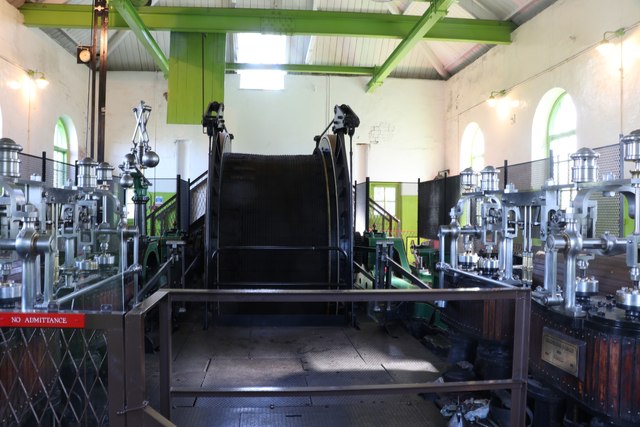
The surviving engine house is of red brick on a rectangular plan with a hipped Welsh slate roof, four bays north and south and three east and west, the upper bays carrying round-headed sash windows. Steel lattice headgear springs from a cross beam above the doorways on the east side, and a blocked square opening below the beam and a dormer in the roof hip once let the twin headgear pulleys be wound by wire rope from a single drum at the east end of the building. Inside stands the engine it was built for: a horizontal twin-cylinder steam winder made by the Grange Iron Company of Durham in 1888 and bought second-hand, later fitted with 1903 patent expansion gear on its Cornish drop valves. Blocked round-headed openings in the west wall carried the exhaust pipes, and a blocked doorway on the east gave access to the boiler.
Closure
The colliery closed on 21 June 1968 as part of the National Coal Board's modernisation programme, only a few years after its most productive period, and the site was cleared soon after.
What remains
The engine house, its engine and the steel lattice headgear are a scheduled monument, the building itself listed Grade II, and the site is run by Sunderland Council as the Washington F Pit Museum. The winding engine is still turned for visitors on open days, driven by electricity rather than steam.
The 1926 engine house with its 1888 winding engine in place, the steel lattice headgear, and the ruined footings of the boiler house; the rest of the colliery was cleared after closure.
Redevelopment
The colliery site was cleared and built over as part of Washington new town; the engine house was kept as a monument and museum.
Nearby mines
- Washington Glebe Colliery — 1.5 km SE
- Usworth Colliery — 1.6 km NE
- Springwell Colliery — 2.1 km NW
- Sheriff Hill Colliery — 3.5 km NW
- Team Colliery — 3.6 km W
Straight-line distance, within 15 km. Show on the map.
Recorded claims
Individual factual claims, each attached to the source(s) that support it below. Where sources disagree, both are kept.
- The pit was sunk in 1777 and raised coal until an explosion led to its abandonment in 1796; it was reopened in 1820, deepened in 1857 and remodelled about 1903. 1
- The official returns record 949 people employed in 1902, 1,146 in 1910 and 1,191 in 1925. 2
- The engine house holds a horizontal twin-cylinder steam winding engine built by the Grange Iron Company of Durham in 1888 and bought second-hand. 1
- The colliery closed on 21 June 1968, the site was cleared, and the engine house was presented to the people of Washington and opened as a museum in 1976. 1,2
Photographs & further reading
Owners, output and year-by-year employment figures from the official lists of mines, with shaft details and maps of the colliery.
View sourceSources
- (primary) Colliery engine house at Washington F Pit, Albany (List entry 1018224) — Historic England
- (primary) Washington 'F' Pit — Durham Mining Museum
Record created: 22 September 2026 · Last researched: 22 September 2026