 MineArchive
Tyne Main Colliery
| Also known as | Friar's Goose Colliery |
|---|---|
| Location | Friar's Goose, Gateshead, Tyne and Wear — 54.9620, -1.5715 (approximate) |
| Commodity | Coal |
| Type | Coal |
| Worked | 1798–1926 |
| Maximum depth | 699 feet (William Pit, 1841, to the Low Main) |
| Operators | Losh & Co., George Elliott & Co. |
Overview
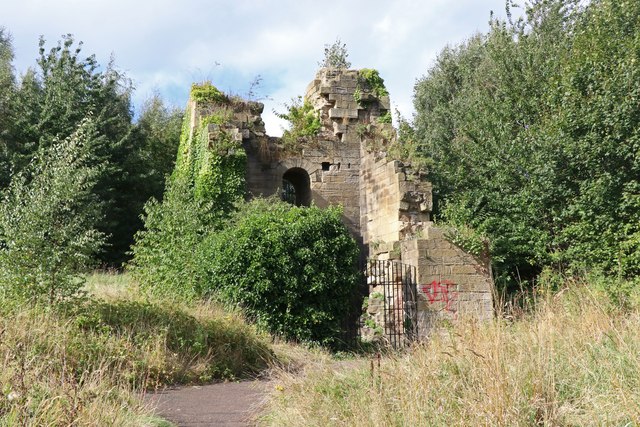
A Gateshead colliery at Friar's Goose, on the south bank of the Tyne, worked from 1798. Its pumping engine, the most powerful on the river, was kept going from 1842 by the owners of five neighbouring collieries, and the ruin of the engine house survives, listed Grade II.
History
Pumping at Friar's Goose began long before the colliery. In 1745 engines were built at Dent's Hole and at Byker because water in the Heaton and Jesmond wastes threatened the barriers of Byker Colliery, and after a report of 1746 a pumping station with two engines was built at Friar's Goose, connected through the workings under the river with Byker's south district; the water beat them, and in 1763 the Friar's Goose engines were drowned out. Tyne Main Colliery itself dates from 1798, when its Engine Pit was bored below the Low Main, proving the Beaumont and Denton Low Main. A new pumping station was working at Friar's Goose by 1823, and the engine house that survives dates from then. The Losh family, who ran the iron works at Walker, owned the colliery; it was Losh and Co. in the 1850s and George Elliott and Co. in the 1860s.
The William Pit was begun on 14 January 1841 and sunk to the Low Main, nearly 700 feet down. In 1842 the High Main was abandoned and tubbed off, and the owners of Felling, Walker, Wallsend, Willington and Heaton collieries agreed to share the cost of keeping the great engine at Friar's Goose at work to stop the water passing to the dip. It was the most powerful engine on the Tyne, of about 180 horsepower and able to pump 1,444,800 gallons a day; in 1849 it was raising 1,170 gallons a minute. The artist T. H. Hair drew the engine house about 1840. The station was laid in in 1851. Two miners, Joseph Charlton and Thomas Heslop, were suffocated by gas on 17 January 1865. The colliery is recorded as closed in 1926.
Geology
Tyne coal basin: the High Main, the Low Main (Tyne Low Main or Hutton), the Beaumont and the Denton Low Main.
Workings
The Engine Pit (1798) and the William Pit (1841); the Friar's Goose pumping engines of 1746 and about 1823, connected with workings under the Tyne.
Closure
Recorded as closed in 1926; the Friar's Goose pumping station was laid in in 1851.
What remains
The ruined Friar's Goose engine house stands in East Gateshead Riverside Park, beside a warehouse estate.
Fragments of the pumping engine house, listed Grade II: a massive beam wall with the beam pivot socket, gantry joist holes and a round-headed opening, and a buttressed pivot wall.
Redevelopment
Riverside park and industrial estate.
Related mines
- Felling Colliery — Felling's owners shared the cost of Tyne Main's Friar's Goose pumping engine from 1842.
- Walker Colliery — Walker's owners shared the cost of Tyne Main's Friar's Goose pumping engine from 1842.
Nearby mines
- Felling Colliery — 0.5 miles (0.7 km) S
- Walker Colliery — 1.5 miles (2.4 km) NE
- Heaton Main Colliery — 1.6 miles (2.6 km) NW
- Heworth Colliery — 1.7 miles (2.7 km) S
- Redheugh Colliery — 1.9 miles (3.1 km) W
Straight-line distance, within 9 miles (15 km). Show on the map.
Recorded claims
Individual factual claims, each attached to the source(s) that support it below. Where sources disagree, both are kept.
- Tyne Main Colliery was begun in 1798, when the Engine Pit was bored below the Low Main. 1,2
- The Tyne Main engine at Friar's Goose was the most powerful on the Tyne, about 180 horsepower, able to pump 1,444,800 gallons a day. 3
- From 1842 the owners of Felling, Walker, Wallsend, Willington and Heaton collieries shared the cost of keeping the Friar's Goose engine at work; in 1849 it raised 1,170 gallons a minute. 1,2
- The surviving engine house dates from the 1820s; the pumping station was laid in in 1851, and the remains are listed Grade II. 4,2
- The colliery was owned by the Losh family, who ran the iron works at Walker. 1,2
Photographs & further reading
The engine house remains and the history of pumping at Friar's Goose.
View sourceThe engine house and the Tyne Main colliery it served.
View sourceOwners, pits, the 1842 pumping agreement and those killed at the colliery.
View sourceSources
- (primary) Tyne Main Colliery — Durham Mining Museum
- (secondary) Friars Goose Pumping Engine House — North East Heritage Library
- (secondary) A Short History of Gateshead: Chapter Six — GENUKI
- (secondary) HER 1012: Friar's Goose Pumping Station — Sitelines (Tyne and Wear HER)
Record created: 4 October 2026 · Last researched: 4 October 2026