 MineArchive
Spital Tongues Colliery
| Also known as | Leazes Main Colliery |
|---|---|
| Location | Spital Tongues, north-west Newcastle upon Tyne, Tyne and Wear — 54.9831, -1.6320 (approximate) |
| Commodity | Coal |
| Type | Coal |
| Worked | 1835 (sinking from 1833)–1858 (some accounts 1860) |
| Maximum depth | About 343 feet (New Winning, 1833, to the Low Main) |
| Operators | Porter and Latimer (1835–?) |
Overview
A Newcastle colliery, also called Leazes Main, whose owners could not get their coal to the Tyne across the town, so they built the Victoria Tunnel under it in 1839-42. The tunnel cut their carriage costs by 88 per cent, but the colliery failed and closed in 1858-60.
History
The New Winning at Spital Tongues, north-west of Newcastle, was sunk to the Low Main, about 340 feet down, by December 1833, and the lease for mining began on 25 March 1835. The colliery, also called Leazes Main, belonged to Porter and Latimer, and it had a problem no other Tyneside pit had: the town lay between it and the river. Coal was carted at first through the narrow streets, slowly and at a cost in road taxes; the freemen would not let a wagonway cross the Town Moor, and a shorter route upstream to Elswick would have meant paying keelmen to carry the coal past the old Tyne Bridge. So the owners had their engineer, William E. Gilhespie, drive an underground wagonway from the colliery beneath the centre of Newcastle to the Tyne near the Ouseburn.
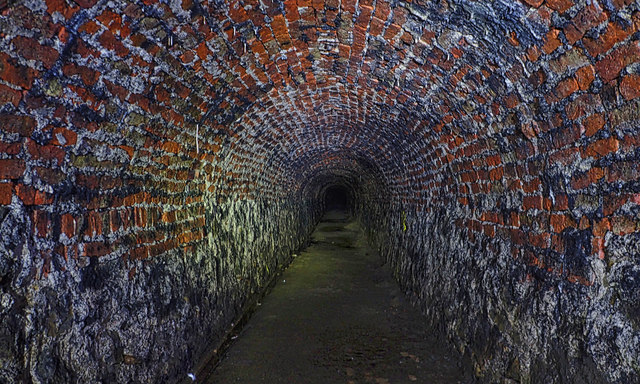
Permission came in 1838 and work began in 1839, managed by John Cherry, a former Yorkshire lead miner who had worked at Leazes Main, with some two hundred men. The Victoria Tunnel, about 7 feet 5 inches high and 6 feet 3 inches wide, was lined in stone with a double brick arch; loaded wagons ran down it by gravity and a stationary engine hauled the empties back. The mayor opened it on 7 April 1842, when a train of eight wagons emerged on the quayside, four of them full of coal. The tunnel cut the cost of getting the coal to the river by 88 per cent, but the colliery, short of money, closed in 1858, or by another account 1860, and the tunnel was in use for only eighteen years. In the 1850s Edward Richardson and Co. are recorded as owners. On 4 June 1852 a boiler explosion killed an engineman, John Campbell Burrell, and a fireman, Edward Moody. In the Second World War the tunnel was converted into an air-raid shelter for 9,000 people.
Geology
Tyne coal basin: the Low Main (about 5 feet 3 inches with bands) and the Main.
Workings
The New Winning (1833); the Victoria Tunnel (1839-42), an underground wagonway about 2¼ miles long from the colliery to the Tyne near the Ouseburn, worked by gravity and a stationary engine.
Closure
Closed through financial difficulties in 1858, or 1860 in other accounts.
What remains
The Victoria Tunnel survives beneath Newcastle.
The Victoria Tunnel, used as an air-raid shelter in the Second World War.
Redevelopment
Unknown.
Nearby mines
- Elswick Colliery — 0.8 miles (1.3 km) S
- Paradise Colliery — 1.4 miles (2.3 km) SW
- Heaton Main Colliery — 1.7 miles (2.8 km) E
- Redheugh Colliery — 1.8 miles (2.9 km) S
- Dunston Colliery — 1.9 miles (3.0 km) S
Straight-line distance, within 9 miles (15 km). Show on the map.
What's uncertain
Points where sources disagree or the record could not be settled; both accounts are kept. All open questions in the archive.
- The colliery closed in 1858 through financial difficulties. (disputed) 3,1
- The colliery closed in 1860, the tunnel having been in use for eighteen years. (disputed) 2
Recorded claims
Individual factual claims, each attached to the source(s) that support it below. Where sources disagree, both are kept.
- The lease for mining at Spital Tongues began on 25 March 1835. 1
- Porter and Latimer built the Victoria Tunnel in 1839-42 to carry the colliery's coal under Newcastle to the Tyne near the Ouseburn. 1,2
- The Victoria Tunnel was opened by the mayor on 7 April 1842 and cut the cost of carrying coal to the river by 88 per cent. 2
- The colliery closed in 1858 through financial difficulties. (disputed) 3,1
- The colliery closed in 1860, the tunnel having been in use for eighteen years. (disputed) 2
Photographs & further reading
The colliery, its lease and why the tunnel was built.
View sourceThe tunnel's building, working and later use as a shelter.
View sourceOwners, shaft section and those killed at the colliery.
View sourceSources
- (secondary) HER 4090: Spital Tongues Colliery (Leazes Main) — Sitelines (Tyne and Wear HER)
- (secondary) Victoria Tunnel (Newcastle) — Wikipedia
- (primary) Spital Tongues Colliery — Durham Mining Museum
Record created: 4 October 2026 · Last researched: 4 October 2026