 MineArchive
Moss Rigg Quarry
| Also known as | Mossrigg Quarry, Moss Rigg (Slate) |
|---|---|
| Location | Tilberthwaite, near Coniston, Cumbria — 54.4127, -3.0617 (approximate) |
| Commodity | Slate |
| Type | Slate |
| Worked | 17th century–1984 |
| Maximum depth | Faces nearly 100 metres high. |
| Operators | Lakeland Green Slate and Stone Company (1948–?) — Took the lease in 1948; about forty men by 1961 Burlington Stone (?–1984) — Took the quarry over in the 1970s, returned as Burlington Slate Ltd. in the 1980s, and closed it in 1984 Tilberthwaite Green Slate Co. Ltd (owner) — Blasted the overhang in July 1902; owners in the 1912 accident return James Stephenson & Co. (owner) — Owners in the 1906 accident return and the 1900s Lists of Mines Buttermere Green Slate Quarries Ltd. (owner) — Took the quarry over and closed it during the First World War; returned as owners in the 1920s |
A green slate quarry in the woods between Tilberthwaite and Little Langdale, worked from the 17th century and closed by Burlington in 1984 after a post-war revival.
Location
Approximate location. The large pin is this mine; the small round markers are the nearest mines on record. Click one for its page. View on full map
History
Moss Rigg is a green slate quarry in the woods above the track from Tilberthwaite to Little Langdale. It was first worked in the 17th century for Westmorland green slate, probably as one or more closeheads, and the workings may have been opened to the sky in the 1880s, once high explosives made that possible. Postlethwaite's account of the Lake District mining field lists the Moss Rigg quarries among the principal slate quarries then being worked.
It employed 56 in 1896 and 64 in 1897, then only four by 1902. That July the Tilberthwaite Green Slate Company blasted away 40,000 tons of rock overhanging the chasm: 21 holes charged with five hundredweight of gelatine, fired electrically by Miss Jeffreys, the principal owner's daughter, who was given a silver casket to remember it by. James Stephenson and Co. were the owners in 1906 and the Tilberthwaite Green Slate Company again by 1912. Within fifteen years of the great blast the Buttermere Green Slate Company, which had taken the quarry over, shut it because the war had killed the building trade, and it was not worked in 1915 or 1927. The accident returns record a powder store explosion in 1898, a stage that gave way 35 yards up the face in 1906 and a fall from a 42-foot ladder in 1912, each of which killed a man.
In 1948 three Tilberthwaite and Coniston quarrymen back from the Second World War, Roly Myers, George Brownlee and Harold Turnbull, took the lease despite local warnings that the quarry was worked out, and formed the Lakeland Green Slate and Stone Company. They sold their first blocks to a monumental mason in Ambleside, then put up an office, cutting and polishing sheds and more than 300 yards of railway. By 1961 about forty men worked there, making steps, cills, copings, flooring, memorials and roofing slate, which rather answered the warnings. After Myers retired in the 1970s Burlington took the quarry over, with Jim Birkett as manager, and Moss Rigg closed in 1984.
Geology
Sea-green slate of the Borrowdale Volcanic rocks, sold as Westmorland green slate.
Workings
A large open pit with its long axis running north-east to south-west, the second largest in Tilberthwaite after Hodge Close and Parrock, with faces rising to nearly 100 metres. Closeheads open off a drainage adit laid with 24-inch gauge track, and its floor lies above the valley so the pit never flooded. A compressed-air winch made in Ulverston before 1866 hauled blocks onto slab wagons; a vehicle ramp later curved into the pit.
Closure
Closed in 1984 with Spout Crag quarry; at the end of working its waste was tipped at Atkinson Ground quarry, and the site was cleared in 2000.
What remains
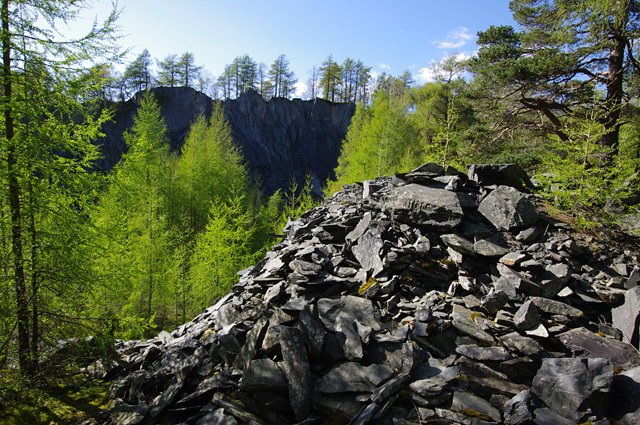
Disused and hidden by woodland, with birch and larch growing on the working floors and regular falls from the north-west wall of the pit.
Slate tips, the walls of older quarry buildings above the 20th-century dressing floors, the collapsed manager's office and rusting machinery and slate wagons.
Nearby mines
- Hodge Close Quarry — 0.5 miles (0.9 km) SE
- Parrock Quarry — 0.6 miles (0.9 km) SE
- Tilberthwaite — 1.2 miles (2.0 km) SW
- Greenburn Mine — 1.3 miles (2.2 km) W
- Lords Quarry — 1.7 miles (2.7 km) NE
Straight-line distance, within 9 miles (15 km).
Further reading
A history of the quarry from its 17th-century start, the 1902 blast and the 1948 revival to its closure in 1984, with notes on the site today.
View sourceThe museum's page: owners from the 1900s to the 1980s, workforce from 1896 to 1927 and the men killed there.
View sourceThe mining history society's account of the pit, its closeheads, adit and winch, and the clearance of the site.
View sourceSources
- (secondary) Moss Rigg Quarry: A Quiet Reclamation (Deborah Walsh, Black Powder Press; first published in Cumbria magazine, 2023) — Black Powder Press
- (secondary) Moss Rigg Quarry Ten Years On (CATMHS Newsletter 129, November 2017) — Cumbria Amenity Trust Mining History Society
- (primary) Moss Rigg (Slate) (Durham Mining Museum) — Durham Mining Museum
- (secondary) NMRS deaths and injuries database: Mossrigg Quarry, 1906 — Northern Mine Research Society
- (secondary) NMRS deaths and injuries database: Mossrigg Quarry, 1912 — Northern Mine Research Society
- (observational) Moss Rigg Quarry (Geograph) — Geograph
- (secondary) Moss Rigg Quarry, Coniston (Old Cumbria Gazetteer) — Lakes Guides
- (secondary) NMRS deaths and injuries database: Moss Rigg Quarry, 1953 — Northern Mine Research Society
- (secondary) Quarries, Cumbria: Postlethwaite 1877 (Old Cumbria Gazetteer) — Lakes Guides
Record created: 20 November 2026 · Last researched: 20 November 2026