 MineArchive
Ingham Colliery
| Also known as | Thornhill Ingham Colliery |
|---|---|
| Location | Ingham, Thornhill, south of Dewsbury, West Yorkshire |
| Commodity | Coal |
| Type | Coal |
| Worked | 1875 (sinking)–1948 (combined into Thornhill Colliery) |
| Maximum depth | The Black Bed seam at 276 to 277 yards, with shaft sumps to 316 yards. |
| Operators | National Coal Board (1947–1948) |
Overview
The Ingham family's colliery at Thornhill, south of Dewsbury, sunk from 1875 and joined underground to Combs, where in 1947 a spark from the relighter of an opened safety lamp caused an explosion that killed 12; it was merged into Thornhill Colliery in 1948.
History
Ingham Colliery was sunk from 3 August 1875 by the Ingham family, who already worked Combs Colliery 1,330 yards to the east and employed 360 men in their Thornhill pits in 1872. NMRS's account of the 1947 explosion says the colliery had been producing coal from about 1860. Its two brick-lined shafts, a 13-foot downcast and a 14-foot upcast, reached the Black Bed seam at 276 yards, with insets at 188 yards; steam winding engines by Pigott and Farrar were fitted in 1876 and a Guibal fan in 1877. The Black Bed was worked from No. 1 shaft and, from 1888, the Beeston from No. 2, and the Guibal fan at Ingham also ventilated the Combs workings. By 1947 Ingham and Combs were connected underground and by a surface tramway, but worked as separate mines. Ingham wound 630 tons a day from the Black Bed, Blocking Bed, Beeston and Wheatley Lime seams, 80 per cent of it for the coke ovens. At 11.15 p.m. on 9 September 1947 an explosion in the No. 2 South District of the Wheatley Lime seam killed 12 (see Disasters, below). The inquiry found that a flame safety lamp had been deliberately opened, by cutting its lead rivet, to adjust a faulty relighter, and that the relighter's spark ignited firedamp in the air passing the meeting station; the flame travelled about 3,000 yards. In 1948 Ingham and Combs were combined as Thornhill Colliery.
Geology
The Black Bed (28 inches, at 276 yards), Blocking Bed, Beeston and Wheatley Lime seams of the West Yorkshire coalfield; the Wheatley Lime had been worked for about 85 years by 1947 and gave off firedamp.
Workings
Two brick-lined shafts 75 yards apart — No. 1 downcast (13 feet) and No. 2 upcast (14 feet) — with insets at 188 yards; steam winding from 1876, a Guibal fan from 1877 and later a steam-driven Walker fan; connected underground with Combs Colliery.
Closure
Combined with Combs as Thornhill Colliery in 1948; the Wheatley Lime seam was abandoned on 20 April 1949.
What remains
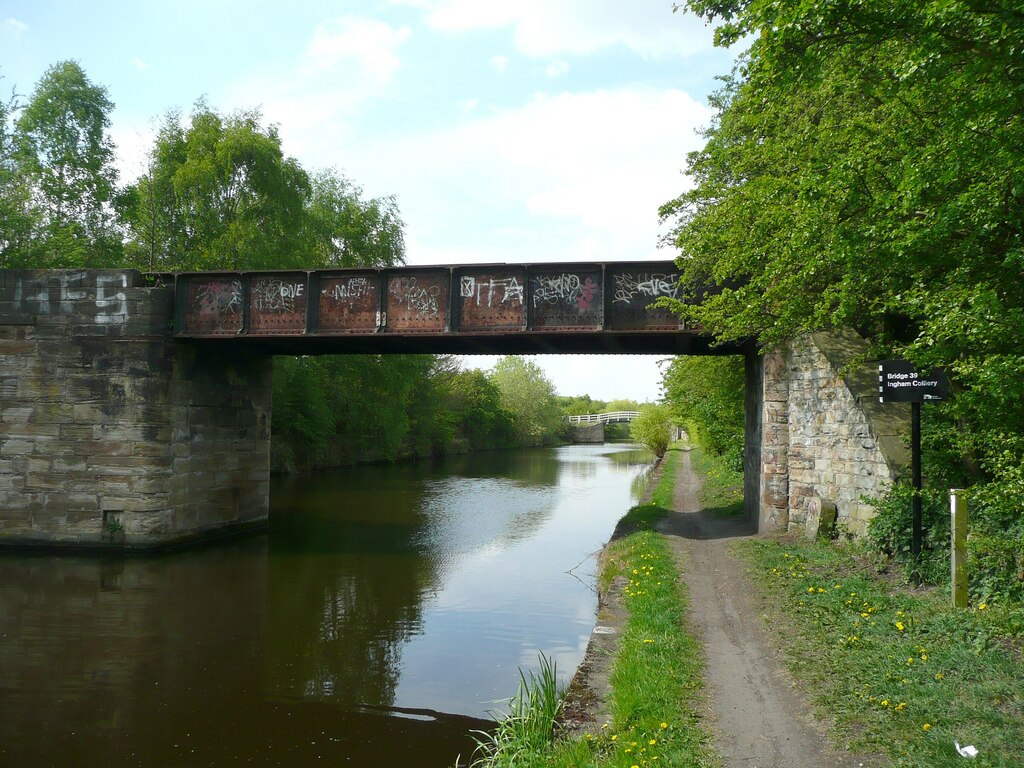
The colliery has gone; a mineral railway bridge over the Calder and Hebble Navigation is still signed 'Bridge 39 Ingham Colliery'.
Bridge No. 39 over the Calder and Hebble Navigation, a redundant mineral railway bridge named after the colliery.
Related mines
- Combs Colliery — Neighbouring Ingham family pits connected underground and by tramway, sharing ventilation; combined as Thornhill Colliery in 1948.
What's uncertain
Points where sources disagree or the record could not be settled; both accounts are kept. All open questions in the archive.
- NMRS's Thornhill Colliery history dates the start of sinking to 3 August 1875; its account of the 1947 explosion says the colliery had produced coal from about 1860. (disputed) 1,2
- NMRS's account of the explosion gives 12 killed and one injured; its Thornhill Colliery history gives 11 killed and one injured. (disputed) 1,2
Recorded claims
Individual factual claims, each attached to the source(s) that support it below. Where sources disagree, both are kept.
- NMRS's Thornhill Colliery history dates the start of sinking to 3 August 1875; its account of the 1947 explosion says the colliery had produced coal from about 1860. (disputed) 1,2
- Two shafts, a 13-foot downcast and 14-foot upcast, were sunk to the Black Bed seam at about 277 yards, with insets at 188 yards. 1,2,3
- In 1947 Ingham wound 630 tons a day, 80 per cent of it for the coke ovens, and was connected underground with Combs Colliery. 1,3
- The inquiry found that a spark from the relighter of a flame safety lamp, opened by cutting its lead rivet, ignited firedamp at the meeting station on 9 September 1947. 1
- NMRS's account of the explosion gives 12 killed and one injured; its Thornhill Colliery history gives 11 killed and one injured. (disputed) 1,2
- In 1948 Combs and Ingham collieries were combined as Thornhill Colliery. 2
- The colliery has long disappeared but its bridge over the canal remains (2011). 4
Photographs & further reading
The history of the Combs, Ingham and Thornhill collieries from 1855 to the combined mine.
View sourceThe 1947 explosion and the inquiry's conclusions on the safety lamp.
View sourceSources
- (secondary) Ingham Colliery Explosion, Dewsbury, 1947 — Northern Mine Research Society
- (secondary) Thornhill Colliery (NMRS Yorkshire coalfield, Leeds) — Northern Mine Research Society
- (secondary) P1 - Thornhill Colliery 1947 — healeyhero.co.uk
- (observational) Bridge No. 39, Ingham Colliery, Thornhill (Geograph photo 2368336, 2011) — Geograph Britain and Ireland
Record created: 17 September 2026 · Last researched: 17 September 2026