 MineArchive
Ffos-y-Fran
| Also known as | Ffos-y-fran Land Reclamation Scheme |
|---|---|
| Location | North-east of Merthyr Tydfil, adjoining Dowlais and Penydarren, Merthyr Tydfil — 51.7300, -3.3600 (approximate) |
| Commodity | Coal |
| Type | Coal |
| Worked | November 2006–30 November 2023 |
| Maximum depth | Around 200 m deep |
| Operators | Merthyr (South Wales) Ltd (2007–2023) |
Overview
Britain's last major opencast coal mine, sold to planners for two decades as a land reclamation scheme for ground scarred by two centuries of deep mining beneath Dowlais and Merthyr — and the site of the country's final tonne of large-scale coal, dug within sight of houses that in places stood less than 40 metres from the pit edge.
History
Ffos-y-Fran grew directly out of the derelict landscape left by two centuries of iron and coal working around Dowlais and Merthyr Tydfil, where deep mines had closed in waves from the 1930s to the 1980s and left the hillsides scarred and unstable. From the mid-1980s the East Merthyr Reclamation Scheme, backed by local councils and the Welsh Development Agency, proposed using profitable opencast coal extraction to fund the restoration of this ground at no cost to the public purse; two earlier phases, Incline Top and the aptly-named Dowlais Great White Tip, were completed in 1993 and 1997. The third and by far the largest phase, Ffos-y-Fran itself, had a tortuous path to approval: first granted consent in 1988, revised in 1994 to claim larger reserves, withdrawn in 1999 over access-rights problems, and only cleared for good in November 2006 after a Welsh Assembly approval, a High Court challenge, and a final Court of Appeal ruling. Operated by Miller Argent, later Merthyr (South Wales) Ltd, the site opened in 2007 with a fifteen-year licence to extract around ten million tonnes of coal from 3,500 acres of ground, eventually producing over eleven million tonnes at a peak of 20,000 tonnes a week and employing around 200 people on site. Local opposition was intense throughout, focused on homes in Dowlais, Mountain Hare and Penydarren standing less than 40 metres from the site boundary in places, and on the mine's contribution to climate change; more than 10,000 people signed a petition against it. The site's planning permission expired in September 2022, and the operator continued digging while contesting the expiry and seeking a nine-month extension; Merthyr Tydfil Council refused that extension in April 2023, and the mine finally closed on 30 November 2023, more than a year after its permission had lapsed — the last major opencast coal mine working anywhere in Britain.
Geology
Ffos-y-Fran worked exposed and near-surface coal seams of the South Wales Coalfield, part of the same coal measures that had earlier fed the Dowlais and Penydarren ironworks by deep mining before those pits closed and left the ground it eventually reclaimed.
Workings
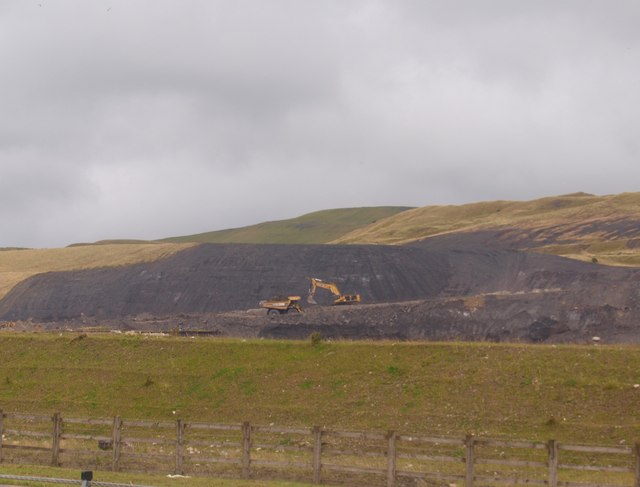
An opencast pit roughly 200 metres deep and, at closure, the size of some 400 football pitches, worked by excavator and dump truck rather than by any underground method. Coal was moved by rail from the site to the Cwmbargoed washery, refurbished in 1992, and from there onward along the former Rhymney Railway route through Cardiff and the Vale of Glamorgan line; the last delivery to Aberthaw Power Station was made in March 2017, after which output went to other markets.
Closure
The mine's fifteen-year planning permission expired in September 2022; after a contested extension request was refused in April 2023, Ffos-y-Fran finally closed on 30 November 2023, having operated more than a year beyond its original licence.
What remains
The site is subject to a legally binding restoration obligation estimated at £120-175 million, which as of 2024 had not begun in earnest; campaigners have raised safety concerns about the unrestored pit and its exposed faces, and one low-lying part of the former workings has since filled naturally with water to form a large reservoir. The dispute over who will fund and carry out restoration remains unresolved.
A vast unrestored opencast void some 200 m deep, exposed pit faces, haul roads and site infrastructure, and a large area of standing water where part of the former workings has flooded.
Redevelopment
None yet — restoration has not begun despite the operator's legal obligation to carry it out, and the site remains a subject of ongoing dispute as of the time of writing.
Nearby mines
- Graig Colliery, Pentrebach — 0.3 miles (0.5 km) SE
- Clynmill Colliery — 0.4 miles (0.7 km) NW
- South Duffryn Colliery — 0.9 miles (1.5 km) S
- Gethin Colliery — 1.0 miles (1.6 km) SW
- Cwm Colliery, Merthyr Tydfil — 1.1 miles (1.7 km) W
Straight-line distance, within 9 miles (15 km). Show on the map.
Recorded claims
Individual factual claims, each attached to the source(s) that support it below. Where sources disagree, both are kept.
- Ffos-y-Fran grew from the mid-1980s East Merthyr Reclamation Scheme, following two earlier phases completed in 1993 and 1997; after a contested planning history from 1988, final approval came in November 2006 and production began in 2007. 1
- The site covered about 3,500 acres, was licensed to extract around 10 million tonnes of coal over 15 years, reached a peak output of 20,000 tonnes a week, and employed about 200 people on site. 1
- Local opposition centred on homes in Dowlais, Mountain Hare and Penydarren standing less than 40 m from the site boundary in places, with more than 10,000 people signing a petition against the mine. 1
- The mine's planning permission expired in September 2022; a nine-month extension request was refused in April 2023, and the mine closed on 30 November 2023, more than a year after its permission had lapsed — the UK's last major opencast coal mine. 1,2
- A legally binding restoration obligation estimated at £120-175 million had not begun in earnest as of 2024, and the dispute over funding and timing of the land's restoration remains unresolved. 2
Sources
- (primary) Ffos-y-fran Land Reclamation Scheme — Wikipedia
- (secondary) Ffos-y-Fran: Merthyr Tydfil opencast mine to close after planning permission controversy — ITV News Wales
Record created: 25 August 2026 · Last researched: 25 August 2026