 MineArchive
Fairplay Iron Mine
| Also known as | Fairplay Pit, Fairplay Mine |
|---|---|
| Location | Edge Hills, near Steam Mills, Cinderford, Forest of Dean — 51.8465, -2.4971 (exact) |
| Commodity | Iron |
| Type | Iron |
| Worked | 1847 (gale granted)–1907 (machinery sold) |
| Maximum depth | About 350 feet (main shaft); workings given at 221 yards |
| Operators | Timothy Bennett (?–1861, owner) — Bought the galees' rights between 1847 and 1857; owner until his death in 1861. Chastan Syndicate Ltd (1907–?, owner) — Gale apparently sold to its director Frederick Jones in 1907; machinery sold by its direction in July 1907. Wigpool Coal and Iron Co. Ltd (1927–1934, owner) — Held the Fairplay gale from 1927 until it returned to Henry Pringle in 1934. |
Fairplay was an iron-ore venture in the Edge Hills near Cinderford, with a deep shaft begun by 1856 and a Cornish engine house that still stands in part. There is no evidence it ever produced any ore.
Location
Recorded location. The large pin is this mine; the small round markers are the nearest mines on record. Click one for its page. View on full map
History
Fairplay was an iron-ore gale lying just west of the Westbury Brook Mine gale, in the Edge Hills of the Forest of Dean. It does not appear in Sopwith's award of 1841 and seems to have been granted first in 1847, to Moses Harris, William Harris, John Roberts and others. Between 1847 and 1857 Timothy Bennett bought up the galees' rights; the ironmaster Henry Crawshay took a sixth share, which Bennett later bought back.
By 1856 the deep pit and a land pit, used as the air shaft, had been begun, and buildings including the Fairplay cottages were up. The date of the engine house over the deep pit is uncertain. Reservoir pools were made by 1860, with a culvert carrying water towards the engine house, and Bennett built a tramway in about 1857. A drainage level driven from Steam Mills towards the shafts failed because it could not be given enough fall. The object was iron ore in the Drybrook Sandstone or the Crease Limestone, but there is no evidence of any significant production, and no spoil heap lies by the main shaft.
Bennett died in 1861 and the mine passed to his son-in-law Osman Barrett and to Richard Yearsley, and by 1895 to James Barrett and Edwin Yearsley. In 1907 the owners appear to have sold the gale to Frederick Jones, a London solicitor and a director of the Chastan Syndicate Ltd, a gold-mining company, and the machinery was sold by the syndicate's direction that July. In September the buildings were being demolished and the 80-foot chimney stack was thrown down.
The gale went on changing hands for decades after its machinery had gone: Fred Brown of Coleford in 1915 and his three sons in 1923, then within the same year the Hon. Marcus Crofton of Roscommon and Gerald Thompson of Regent Street, Henry Pringle of Longhope Manor with John Haines in 1925, the Wigpool Coal and Iron Company in 1927, and Pringle again in 1934. It was surrendered to the Crown in 1944.
Geology
The target was iron ore in the Drybrook Sandstone or the Crease Limestone; there is no evidence of any significant production.
Workings
A main or deep pit of masonry, about 350 feet deep, with a Cornish underbeam (bull) pumping engine of 76-inch cylinder and 12-foot stroke; an air shaft about 100 yards to the east, ventilated by a draught chimney whose hearth connected to it by a flue; the iron workings are given as lying at 221 yards. Reservoir pools supplied the boilers, and a tramway was built in about 1857. A drainage level from Steam Mills failed for want of fall.
Closure
There is no record of significant production. The machinery was sold in July 1907 at the direction of the Chastan Syndicate Ltd, the buildings were demolished that September, and the gale was surrendered to the Crown in 1944.
What remains
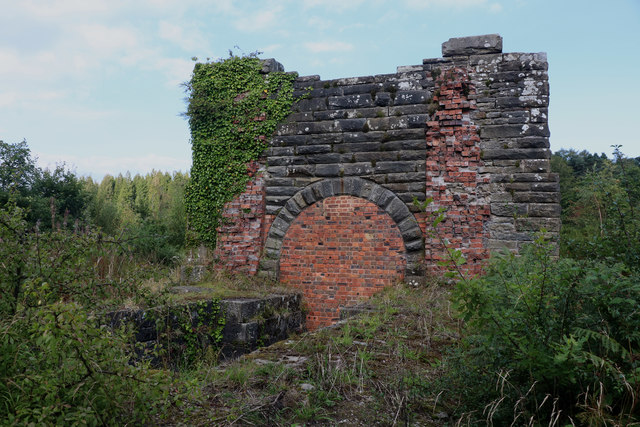
The engine house over the main shaft stands to about 15 feet and is a Grade II listed building. The base of the draught chimney and its hearth at the air shaft were excavated and conserved in 1980. The three reservoir ponds are nature reserves.
Cornish underbeam engine house of squared rubble over a masonry shaft; the conserved base of a draught chimney with its hearth beside the filled air shaft; three reservoir ponds.
Redevelopment
By 1980 the reservoir ponds were a nature reserve leased to the Gloucestershire Trust for Nature Conservation. At the end of the Second World War the air shaft was partly filled with smoke bombs and empty shell cases.
Nearby mines
- Gorbrook Colliery — 0.2 miles (0.3 km) W
- Westbury Brook Ironstone Mine — 0.3 miles (0.4 km) E
- Addis Hill Colliery — 0.4 miles (0.6 km) SW, Gloucestershire
- Plump Hill Dolomite Quarry — 0.4 miles (0.7 km) NE
- Harrow Hill Colliery — 0.8 miles (1.4 km) W
Straight-line distance, within 9 miles (15 km).
Further reading
Brian Cave's account of excavating the draught chimney at the air shaft, with a history of the gale's owners from 1847 to 1944 and a site plan.
View sourceSources
- (secondary) Draught chimney at Fairplay Mine (B. V. Cave), Gloucestershire Society for Industrial Archaeology Journal for 1980, pp. 3-6 — Gloucestershire Society for Industrial Archaeology
- (secondary) Fairplay Iron Mine — Forest of Dean Local History Society
- (secondary) Bull Engine House, Fairplay Pit, Cinderford (Grade II listing text) — British Listed Buildings
Record created: 27 November 2026 · Last researched: 27 November 2026