 MineArchive
Croxdale Colliery
| Also known as | Sunderland Bridge Colliery, Thornton Pit |
|---|---|
| Location | Croxdale, south of Sunderland Bridge, County Durham — 54.7286, -1.5877 (approximate) |
| Commodity | Coal |
| Type | Coal |
| Worked | 1875 (Thornton Pit sunk 1876)–1934 |
| Maximum depth | 596 feet (Thornton Pit; the Victoria seam at 584 feet) |
| Operators | Weardale Iron and Coal Company (1875–1899), Weardale Steel, Coal and Coke Co. Ltd (1899–1934) |
Overview
The Weardale Iron and Coal Company's colliery at Croxdale, south of Durham, opened about 1875 below the Salvins' Croxdale Hall. Its Thornton Pit reached the Victoria seam at 584 feet; it made coke and fireclay, employed over 900 at its peak with Tudhoe, and closed in 1934.
History
Coal had been worked at Croxdale before: the Salvin family of Croxdale Hall opened a pit there in 1845 which lasted only a few decades. About 1875 the Weardale Iron and Coal Company opened Croxdale Colliery, also called Sunderland Bridge Colliery, just south of the village of Sunderland Bridge, and in 1876 its Thornton Pit was sunk to the Victoria seam, reached at 584 feet. In 1894 it was working the Brockwell at 86 fathoms, with the Victoria at 97 fathoms and the Busty and Hutton also met, and when fully employed raised 600 tons a day, giving work to 400 in the pit and at the coke ovens. A railway viaduct and station linked it to the main lines. A colliery village grew up with streets named after the backers who paid for the housing, Salvin Street and Rogerson, Johnson and Foster Terraces, with a Methodist chapel (1877), a school (1878-79), more terraces in 1895 and an enlarged St Bartholomew's church. The colliery did so well that John Rogerson, one of the company's four directors, rented Croxdale Hall from the Salvins for a time.
From 1899 it belonged to the Weardale Steel, Coal and Coke Company. It also raised fireclay and, by the 1920s, clay, and from 1921 its returns included Tudhoe, when the two employed 907 between them. The colliery is recorded as closed in 1934: the Brockwell had been abandoned in July 1931, the Low Main and Hutton followed at the end of 1935 and the Busty and Harvey in May 1936. Most of its dead were killed singly, but two hewers, James Hunter and Charles Robinson, died together under a fall of roof on 19 August 1893. By the 1960s the buildings had been cleared and the land reclaimed, and traces of the colliery's railway spur can still be seen in the fields.
Geology
Durham Coal Measures: the Brockwell at 86 fathoms (3 feet 7 inches), the Victoria at 97 fathoms (2 feet 6 inches), the Busty, the Hutton (1 foot 6 inches), the Harvey (known locally as the Hutton) and the Low Main; fireclay and clay were also raised.
Workings
The Thornton Pit (1876); coke ovens; fireclay and clay working; a railway spur and viaduct to the main lines; returned with Tudhoe from 1921.
Closure
Recorded as closed in 1934; the last seams were abandoned in 1935-36.
What remains
The colliery buildings were cleared and the land reclaimed by the 1960s.
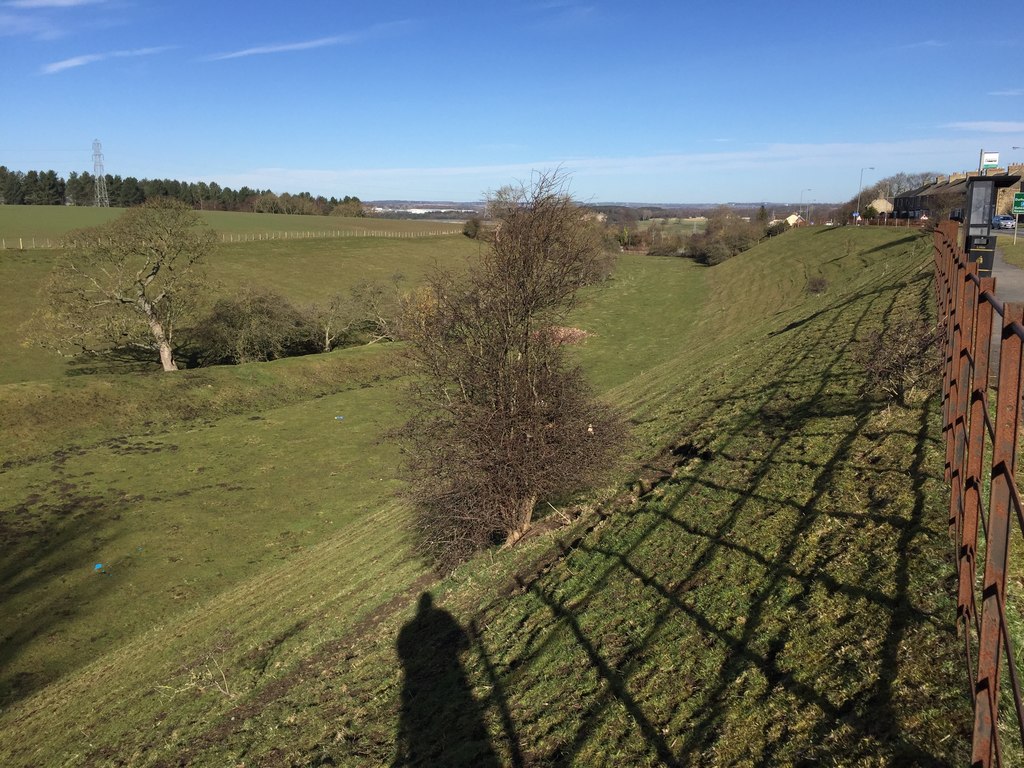
The cutting of the former colliery railway, and traces of its spur in the fields.
Redevelopment
Reclaimed land.
Related mines
- Tudhoe Colliery — Weardale company collieries returned together from 1921 and abandoned as 'Tudhoe and Croxdale'.
Nearby mines
- Tudhoe Whinstone Mine — 0.5 miles (0.9 km) SE
- Tudhoe Colliery — 0.9 miles (1.5 km) S
- Littleburn Colliery — 1.7 miles (2.7 km) NW
- Brandon Colliery — 2.2 miles (3.5 km) NW
- Tursdale Colliery — 2.3 miles (3.7 km) E
Straight-line distance, within 9 miles (15 km). Show on the map.
Recorded claims
Individual factual claims, each attached to the source(s) that support it below. Where sources disagree, both are kept.
- The Weardale Iron and Coal Company opened Croxdale Colliery in 1875; the Thornton Pit was sunk in 1876 to the Victoria seam. 1,2,3
- The Thornton Pit reached the Victoria seam at 584 feet. 4
- In 1894 the colliery raised 600 tons a day when fully employed, with 400 hands in the pit and at the coke ovens. 1
- At its peak the colliery employed over 900. 1,2
- The Salvin family opened an earlier Croxdale pit in 1845 that lasted only a few decades. 2,3
- Croxdale Colliery closed in 1934. 1,2
Photographs & further reading
Owners, employment, seams, abandonments and those killed at the colliery.
View sourceThe village, the Salvins' early pit and the 1875 colliery.
View sourceHow the colliery shaped the village.
View sourceSources
- (primary) Croxdale Colliery — Durham Mining Museum
- (secondary) Croxdale — Wikipedia
- (secondary) Settlement Character Study: Croxdale and Sunderland Bridge — Durham County Council
- (primary) Croxdale Colliery: Thornton Pit shaft details — Durham Mining Museum
Record created: 4 October 2026 · Last researched: 4 October 2026