 MineArchive
Carnock Colliery
| Location | Near Bannockburn, south-east of Stirling — 56.0806, -3.8325 (approximate) |
|---|---|
| Commodity | Coal |
| Type | Coal |
| Worked | c. 1905–c. 1935 |
| Maximum depth | Unknown. |
| Operators | Alloa Coal Company (1905–1935) |
Overview
An Alloa Coal Company colliery near Bannockburn, sunk about 1905, employing up to 500 men in coking, steam and household coal, and abandoned in the early 1930s.
History
Carnock Colliery stood near Bannockburn, south-east of Stirling, one of the Alloa Coal Company's two Stirlingshire collieries alongside Bannockburn Colliery at Cowie. It was being sunk in 1905, when 38 men were at work below ground and 20 at the surface. By 1908 it was in production under the manager James Roberts with 103 men underground and 42 above, and in 1910 it employed 385, working the Coking, Hartley and Hirst seams for coking and manufacturing coal.
As the Main, Steam and Twenty Inch seams were opened, and by 1920 the Knott, Carnock added gas, household and steam coal. In 1918 Neil Corbet was manager with 291 men below ground and 77 above, and in 1920 the colliery employed 501, 405 of them underground. On 7 December 1920 James Paterson, a miner of 28 from St Ninians, was killed at the face when a stone of fifteen hundredweight fell from the roof; he left a widow and family.
Employment was 441 in 1923 and 350 in 1933. Plans of the abandoned Upper and Lower Hirst workings are dated 1930 and those of the Knott, Main and Steam seams 1935.
Geology
The Stirlingshire coalfield: the Coking, Hartley, Hirst (Upper and Lower), Main, Steam, Twenty Inch and Knott seams.
Workings
Unknown.
Closure
Abandonment plans of the Hirst workings are dated 1930 and of the Knott, Main and Steam seams 1935.
What remains
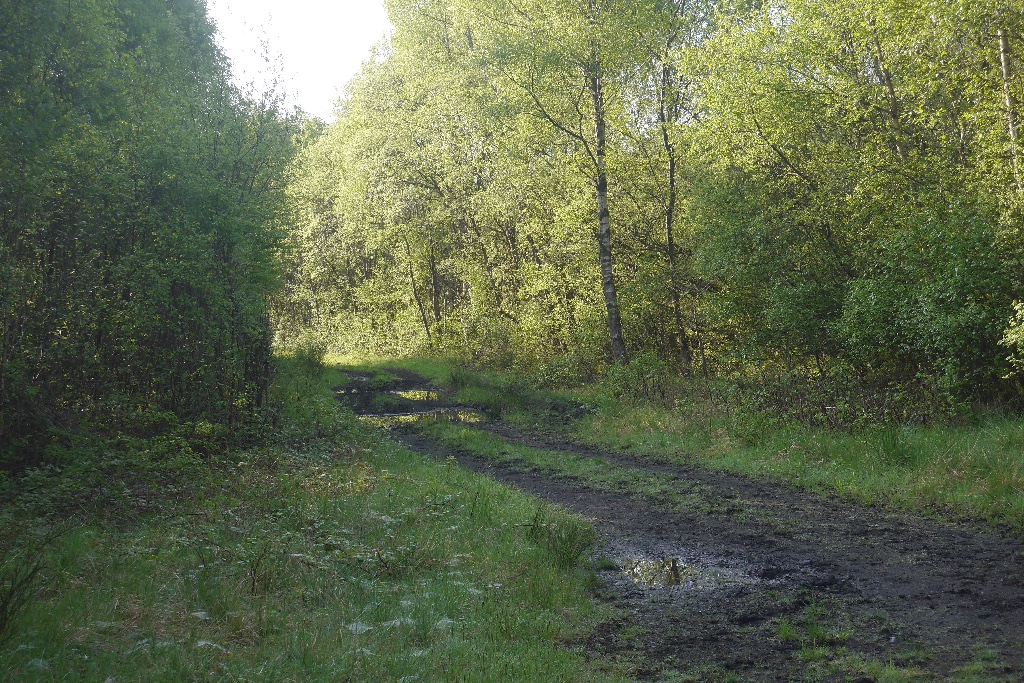
In 2018 the site was young woodland crossed by tracks.
Related mines
- Bannockburn Colliery — The Alloa Coal Company's two Stirlingshire collieries.
- Pirnhall Colliery — Neighbouring collieries near Bannockburn.
Nearby mines
- Bannockburn Colliery — 1.3 miles (2.1 km) W
- Plean Colliery — 2.2 miles (3.5 km) SW
- Forthbank Colliery — 2.4 miles (3.8 km) NE, Clackmannanshire
- Craigrie Colliery — 3.1 miles (5.0 km) NE, Clackmannanshire
- Clackmannan Colliery — 3.2 miles (5.2 km) E, Clackmannanshire
Straight-line distance, within 9 miles (15 km). Show on the map.
Recorded claims
Individual factual claims, each attached to the source(s) that support it below. Where sources disagree, both are kept.
- Carnock Colliery was sinking in 1905, with 38 men below ground and 20 at the surface. 1
- In 1908 Carnock, Bannockburn, belonged to the Alloa Coal Company with James Roberts as manager, 103 men below and 42 above. 2
- The Alloa Coal Company's two Stirlingshire collieries were at Bannockburn and Carnock. 3,1
- Carnock employed 501 men in 1920 (405 below ground) and 350 in 1933. 1
- On 7 December 1920 James Paterson, 28, was killed by a 15-cwt stone falling from the roof at the face in Carnock Colliery near Bannockburn. 4
- Abandonment plans of Carnock's Hirst workings are dated 1930 and of its Knott, Main and Steam seams 1935. 5,6
Sources
- (primary) Carnock Colliery — Durham Mining Museum
- (secondary) Mining in Stirlingshire: list of mines, owners, managers and workers — Tom Paterson
- (secondary) Clackmannan Area Housing (evidence of James Bain, Alloa Coal Company) — Scottish Mining Website
- (secondary) NMRS mining deaths: James Paterson, Carnock, 1920 — Northern Mine Research Society (mining deaths database)
- (primary) BGS / Mining Remediation Authority mine plan 21944830: Carnock, Hirst (Upper and Lower), abandoned 1930 — British Geological Survey
- (primary) BGS / Mining Remediation Authority mine plan 21948541: Carnock, Knott, Main and Steam, abandoned 1935 — British Geological Survey
Record created: 21 October 2026 · Last researched: 21 October 2026