 MineArchive
Blists Hill Colliery
| Location | Blists Hill, Madeley, Shropshire — 52.6420, -2.4560 (approximate) |
|---|---|
| Commodities | Coal, Fireclay, Iron |
| Type | Coal |
| Worked | From 1770s–1941 |
| Maximum depth | Unknown. |
| Operators | Madeley Wood Company (1770–1941) |
Overview
A coal, ironstone and fireclay mine within an integrated Madeley Wood Company ironmaking site, worked from the 1770s to 1941 and preserved today as the Blists Hill Victorian Town museum.
History
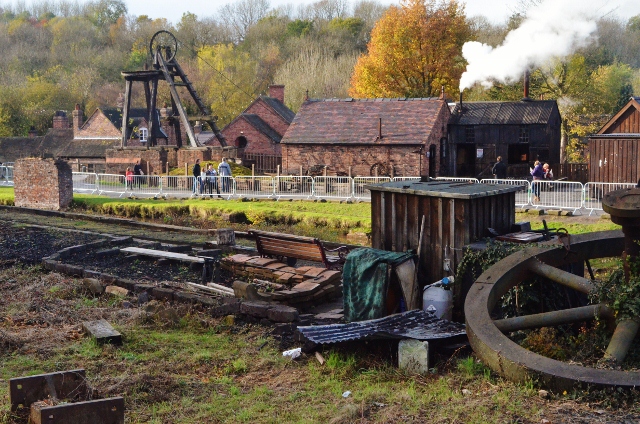
Blists Hill was developed from the 1770s as one of many small mines in the East Shropshire coalfield producing coal, ironstone and fireclay, and by the 18th century mining of all three here was well established under the Madeley Wood Company. The company built its first blast furnace on the site in 1832, adding two more in 1840 and 1844 to make three in total, and ran the works as a genuinely integrated ironmaking operation: coal from its own pits was coked and mixed with ironstone and limestone -- the one raw material not available on site, brought across the Severn Gorge from the far bank -- to produce pig iron. A short branch of the Shropshire Canal crossed the site to reach the Hay Inclined Plane, a 207-foot tramway that lowered loaded tub-boats down to the canal basin at Coalport. Ironmaking here ceased in 1912, but the mines continued in more modest production until Blists Hill finally closed in 1941. The site's completeness -- furnaces, brick and tile works, and mine remains surviving together -- led to its preservation as the open-air Blists Hill Victorian Town museum, part of the Ironbridge Gorge Museums. The red tile clay was abandoned in 1925, sixteen years before the last of the mines; its plan is among eight Blists Hill plans held by the Mining Remediation Authority.
Geology
Coal, ironstone and fireclay of the East Shropshire coalfield, all three worked here from the 1770s and all three feeding the company's own blast furnaces on the same site.
Workings
Coal, ironstone and fireclay worked to feed three on-site blast furnaces (1832, 1840, 1844), with coal coked before mixing with ironstone and imported limestone in the furnace charge.
Closure
Ironmaking ceased in 1912; the mines themselves continued on a more modest scale until final closure in 1941.
What remains
Preserved as the open-air Blists Hill Victorian Town museum, part of the Ironbridge Gorge Museums, with furnace remains, brick and tile works and mine features surviving together on one site.
Related mines
- Lloyds Mines Ironbridge — Both worked by the Madeley Wood Company, which ran the New Hill (Dingle) Pit at the Lloyds as well as the Blists Hill pits.
Nearby mines
- Calcutts Colliery — 1.3 miles (2.0 km) S
- Kemberton Colliery — 1.3 miles (2.0 km) E
- Halesfield Pit — 1.3 miles (2.1 km) SE
- Jackfield Colliery — 1.3 miles (2.1 km) S
- Lloyds Mines Ironbridge — 1.3 miles (2.1 km) SW
Straight-line distance, within 9 miles (15 km). Show on the map.
Recorded claims
Individual factual claims, each attached to the source(s) that support it below. Where sources disagree, both are kept.
- The Madeley Wood Company built three blast furnaces at Blists Hill between 1832 and 1844, coking coal from its own pits and mixing it with ironstone and imported limestone to produce pig iron; ironmaking ceased in 1912. 1,2
- Coal, ironstone and fireclay mining continued at Blists Hill on a more modest scale after the ironworks closed in 1912, until the site finally closed in 1941. 1
- The Mining Remediation Authority holds abandonment plan WM1060 for the Upper and Lower Red Tile clay at Blists Hill, abandoned in 1925, with seven further Blists Hill plans beside it. 3
Photographs & further reading
Grace's Guide's entry for the Madeley Wood Company, owners of the Blists Hill furnaces and pits.
View sourceSources
- (secondary) Blists Hill Victorian Town — Wikipedia
- (secondary) Madeley Wood Co — Graces Guide
- (primary) BLISTS HILL (Mine Remediation Authority abandonment plan WM1060, BGS mine plans catalogue) — British Geological Survey / Mining Remediation Authority
Record created: 31 August 2026 · Last researched: 24 September 2026