 MineArchive
William Pit Explosion, 1823
A firedamp explosion in William Pit's Main Band workings at Whitehaven killed 32 people, including 15 boys and 2 girls, and seventeen pit ponies — one of at least fourteen serious explosions recorded at the pit over its working life.
| Date | 18 October 1823 |
|---|---|
| Mine | William Pit |
| Region | Cumbria |
| Type | Explosion |
| Fatalities | 32 (Thirty-two people died: 15 men, 15 boys and 2 girls, alongside seventeen ponies. Durham Mining Museum's own fatalities record for the colliery names 28 of the 32, by its own admission an incomplete list: Ann Bainbridge, Richard Bainbridge, John Blaylock, John Cartmell, John Corkin, William Cragg, Jonathan Dixon, John Ellwood, Fergus Erail, Thomas Fitzpatrick, Mary Froggat, James Hinde, Thomas Hughes, Thomas Irvine, Joseph Leathers, Peter Macallister, Patrick Mackie, Patrick Mathews, William McCulloch, John McGuire, Archibald McLaughlin, Patrick McLaughlin, John Murray, Christopher Pearson, William Sinclair, William Thompson, John Tweedy and Joseph Usher.) |
| Context | During active mining |
Cause
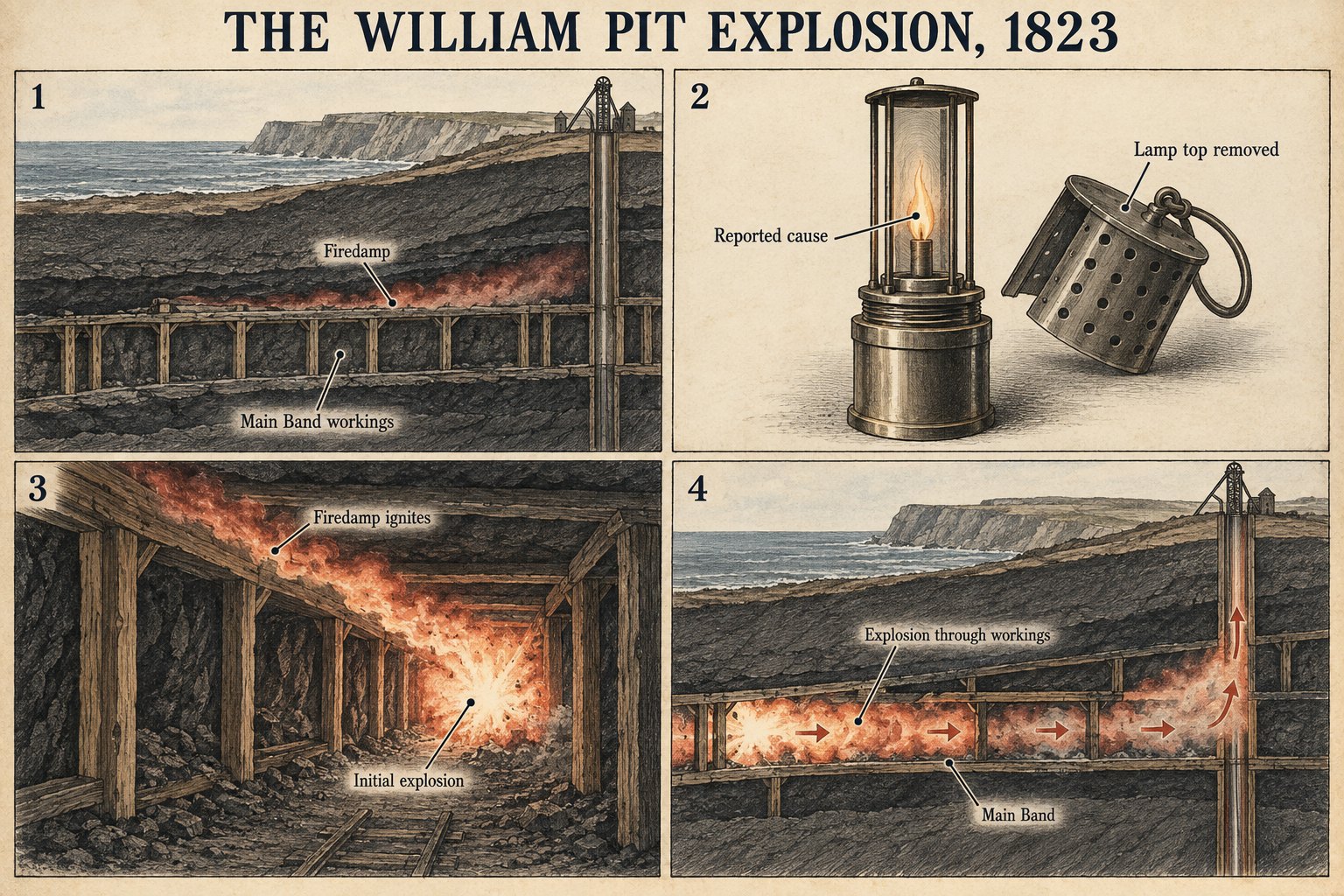
A violent explosion of firedamp in the Main Band workings; general opinion at the time attributed it to someone having removed the top of a safety lamp.
What happened
On 18 October 1823, a violent explosion of firedamp tore through the Main Band workings of William Pit, one of the group of coastal pits at Whitehaven worked for the rich undersea coal seams of the southern Cumberland coalfield. Thirty-two people were killed — fifteen men, fifteen boys and two girls — along with seventeen pit ponies. General opinion at the time held that the explosion had been caused by someone removing the top of a safety lamp, exposing its flame to gas in the workings. This was one of at least fourteen serious explosions recorded at William Pit across its working life, which between them killed more than 200 adults and children before the pit's final closure in 1954.
Memorials & commemoration
The disaster is recorded among the many killed at William Pit across its working life; no dedicated memorial to this specific explosion is known.
Recorded claims
Individual factual claims, each attached to the source(s) that support it below. Where sources disagree, both are kept.
- Thirty-two people died: fifteen men, fifteen boys and two girls, along with seventeen pit ponies. 1
- Durham Mining Museum's own fatalities record names 28 of the 32 victims, by its own admission an incomplete list. 1
- William Pit is recorded as having suffered at least fourteen serious explosions across its working life, killing more than 200 people in total before its 1954 closure. 1
- A CATMHS historical account of the Whitehaven Collieries, read directly, independently confirms the toll (15 men, 15 boys, 2 girls, and seventeen horses) and the general opinion at the time that the explosion was occasioned by someone having had the top of a safety lamp off. 2
Related terminology
Mining terms this disaster is structurally linked to, with the nature of the relationship.
- Coal (contextual relationship)
Named in this record’s narrative: “…the group of coastal pits at Whitehaven worked for the rich undersea coal seams of the southern Cumberland coalfield. Thirty-two people were…” - Coal Seam (contextual relationship)
Named in this record’s narrative: “…the group of coastal pits at Whitehaven worked for the rich undersea coal seams of the southern Cumberland coalfield. Thirty-two people were killed…” - Firedamp (direct cause)
The disaster was a firedamp explosion in the Main Band workings. - Pit Pony (contextual relationship)
Named twice in this record, first in the summary: “…killed 32 people, including 15 boys and 2 girls, and seventeen pit ponies — one of at least fourteen serious explosions recorded at the pit…” - Safety Lamp (contextual relationship)
Named twice in this record, first in the cause: “…at the time attributed it to someone having removed the top of a safety lamp.”
Sources
- (primary) William Colliery, Whitehaven — Durham Mining Museum — Durham Mining Museum
- (primary) William Pit Whitehaven — a history of the Whitehaven Collieries — Cumbria Amenity Trust Mining History Society (CATMHS)
Record created: 25 August 2026 · Last researched: 2 September 2026