 MineArchive
West Cannock No. 5 Colliery Explosion (1933)
An explosion in the Shallow Seam at West Cannock No. 5 Colliery, Hednesford, killed several miners on 16 May 1933 -- sources disagree on the exact toll.
| Date | 16 May 1933 |
|---|---|
| Mine | West Cannock Colliery |
| Region | Staffordshire |
| Primary type | Explosion |
| Associated types | Gas / Asphyxiation |
| Fatalities | 5 (The inquest's own final list names five victims: Samuel Nickles Gwilt, Benjamin Cornwall, Charles Turncock, John Henry Williams and William Thomas Higgins. A House of Commons statement the day after the explosion had given a preliminary count of three killed and three seriously injured; the toll rose to five as some of the injured later died of their wounds (Higgs is recorded as having given evidence before he died). The same source's own account of the inquest verdict separately names both 'J. H. and Joseph Williams' as having died of toxaemia alongside Higgs, which would imply a sixth victim -- a second Williams brother -- not present in its own headline list of five; the source is inconsistent with itself here.) |
| Context | During active mining |
Cause
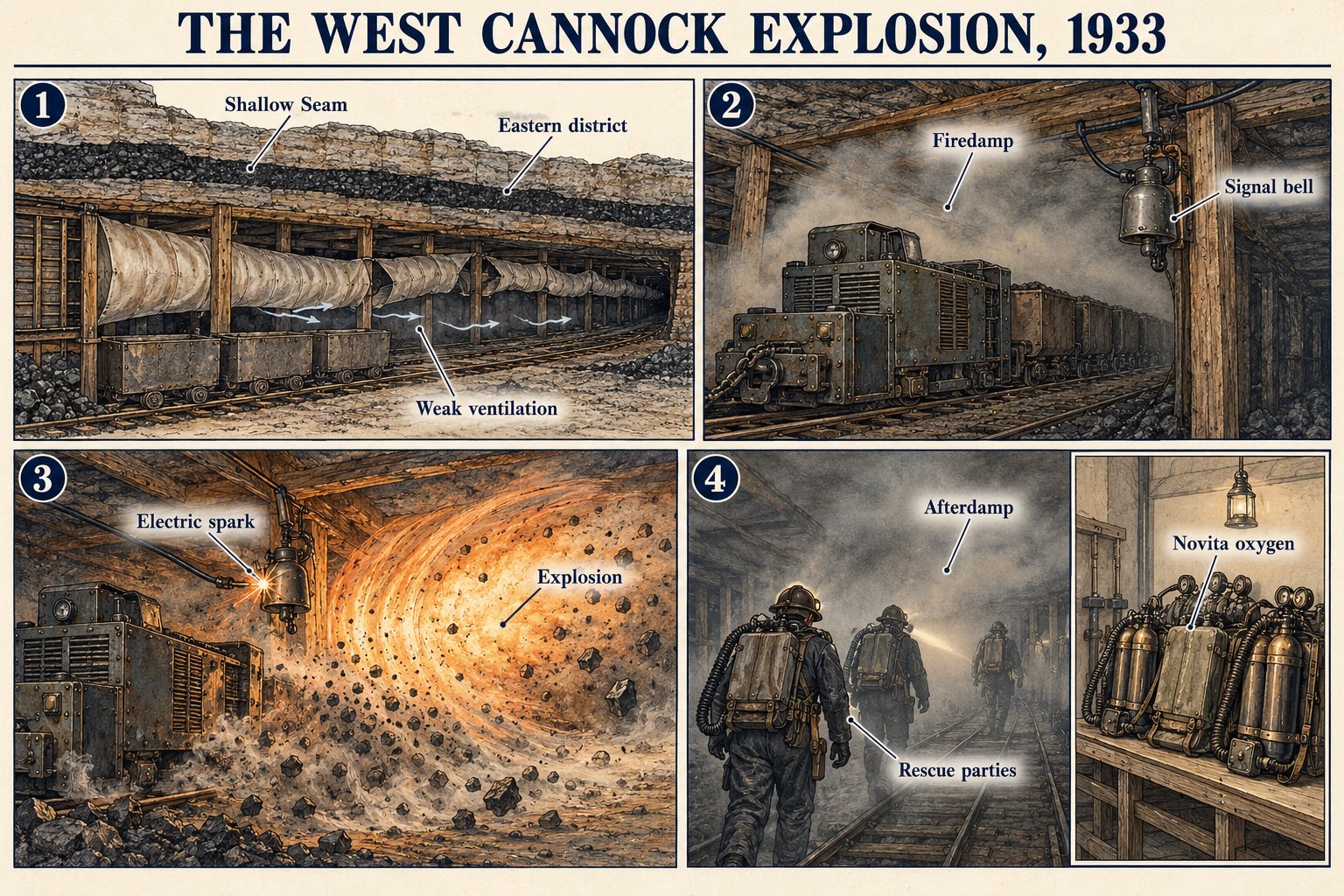
An explosion, consistent with firedamp ignition, occurred in the Shallow Seam at West Cannock No. 5 Colliery.
What happened
Shortly after 8 a.m. on 16 May 1933, an explosion of firedamp tore through the Shallow Seam's Eastern district at West Cannock No. 5 Colliery. The blast is believed to have been ignited by an electric spark from the haulage engine's signal bell -- a bell not of a type certified flameproof by the Mines Department, though colliery officials had believed it incapable of igniting gas, and no evidence emerged of what had caused it to ring at that moment. Firedamp had built up from normal strata bleed and an emission further up the level, and the ventilating current proved too weak to clear it, weakened by leakage and displaced ventilation sheets. Samuel Nickles Gwilt and Charles Turncock were found dead near the coal face; Benjamin Cornwall's body was found by the haulage engine. William Higgs, badly burned, gave evidence before he later died of his injuries. The day fireman, Charles Abner Perks, was knocked down and burned by the explosion's flash but survived, found alive by rescuers some hours later.
Rescue & recovery
The overman, William Challoner, led repeated rescue attempts into the affected district with other men (H. Lyons, F. Gough, then G. Devall), being driven back more than once by afterdamp before finding the missing fireman, Charles Abner Perks, still conscious. The night fireman, Bertie Reynolds, and a man named Parton fought their way to within about 10 yards of the coal face and rescued two ponies from a passbye, though two others further in could not be saved. First-aid personnel gave the injured oxygen from Novita apparatus at the surface ambulance room, supervised by Mr Payton, Superintendent of the Hednesford Rescue Station -- a response Dr S. W. Fisher praised specifically in his report on the men's treatment.
Investigation & inquiry
The inquest, held by W. W. Morgan, HM Coroner for Stafford, ran over three days with all interested parties represented; the Inspector of Mines' report was presented by Mr W. E. T. Hartley. The jury found the deaths of Gwilt and Turncock due to carbon monoxide poisoning, and the other deaths to toxaemia from burns, shock and the after-effects of breathing carbon monoxide. The inquiry attributed the explosion to firedamp (coal dust playing very little part, the roads being well stone-dusted) and could not establish what had caused the signal bell to spark. The incident was also raised in the House of Commons the following day, 17 May, when the Secretary for Mines gave a preliminary casualty count -- see Fatalities.
What's uncertain
Points where sources disagree or the record could not be settled; both accounts are kept. All open questions in the archive.
- A House of Commons statement (17 May 1933) gave three dead and three seriously injured; other records of the same disaster give six dead. (disputed) 1
- The inquest's own final list names five dead (Gwilt, Cornwall, Turncock, John Henry Williams, Higgins), superseding the Commons' next-day preliminary count of three; the same source's own inquest-verdict paragraph separately implies a sixth victim (a second Williams brother, Joseph) not in its own headline list -- an internal inconsistency in the source. (disputed) 2
Recorded claims
Individual factual claims, each attached to the source(s) that support it below. Where sources disagree, both are kept.
- A House of Commons statement (17 May 1933) gave three dead and three seriously injured; other records of the same disaster give six dead. (disputed) 1
- The inquest's own final list names five dead (Gwilt, Cornwall, Turncock, John Henry Williams, Higgins), superseding the Commons' next-day preliminary count of three; the same source's own inquest-verdict paragraph separately implies a sixth victim (a second Williams brother, Joseph) not in its own headline list -- an internal inconsistency in the source. (disputed) 2
Related terminology
Mining terms this disaster is structurally linked to, with the nature of the relationship.
- Afterdamp (contextual relationship)
Named in this record’s rescue and recovery: “…F. Gough, then G. Devall), being driven back more than once by afterdamp before finding the missing fireman, Charles Abner Perks, still…” - Firedamp (contextual relationship)
Named in this record’s cause: “An explosion, consistent with firedamp ignition, occurred in the Shallow Seam at West Cannock No. 5…” - Fireman (contextual relationship)
Named 3 times in this record, first in the narrative: “…burned, gave evidence before he later died of his injuries. The day fireman, Charles Abner Perks, was knocked down and burned by the explosion's…” - Haulage (contextual relationship)
Named twice in this record, first in the narrative: “…blast is believed to have been ignited by an electric spark from the haulage engine's signal bell -- a bell not of a type certified flameproof by…” - Overman (contextual relationship)
Named in this record’s rescue and recovery: “The overman, William Challoner, led repeated rescue attempts into the affected…”
Sources
- (primary) Coal Industry (Accident, Hednesford) — Hansard (House of Commons)
- (primary) West Cannock Colliery Explosion - Hednesford - 1933 — Northern Mine Research Society
Record created: 1 September 2026 · Last researched: 1 September 2026