 MineArchive
Wernbwll Colliery explosion, 1929
| Date | 28 November 1929 |
|---|---|
| Mine | Wernbwll Colliery |
| Region | Swansea |
| Type | Explosion |
| Fatalities | 7 (William Arnold Bennett (29), David Davies (34), Henry Griffiths (34), Edwin Harry (61), Thomas Henry Harry (33), Thomas Luther Hughes (32) and Thomas Jones (54), all of carbon monoxide poisoning; two other men working nearby, Arthur Williams and David John Lewis, survived.) |
| Context | During active mining |
An explosion in the No.13 level of Wernbwll Colliery's West District killed seven men on the evening of 28 November 1929; the official inquiry blamed firedamp ignited at an open acetylene lamp, spread by coal dust the colliery had never stone-dusted against.
Cause
H.M. Deputy Chief Inspector of Mines, F.H. Wynne, concluded the explosion originated in the No.13 level between the No.1 and No.2 topholes, caused by the flame of an open acetylene lamp igniting a pocket of firedamp that had accumulated on the level's rise side; the initially small explosion was then extended along the level and into the No.2 tophole by fine, dry coal dust, no stone dust having been applied anywhere in the mine. The owners' own expert witnesses disputed this, maintaining the explosion was caused by coal dust alone with no firedamp involved (see the disputed claim, below).
What happened
At about 7pm on Thursday 28 November 1929, close to the time many of the 29 men then working the West District would normally have stopped to eat, an explosion tore through the No.13 level. Of eight men in or near the level, six were killed outright or died soon after from carbon monoxide poisoning; a seventh, Thomas Jones, who had come from the main west slant face in search of timber, was fatally burned and gassed some distance further along; and two men, Arthur Williams and David John Lewis, survived — Williams burned on the back and shoulders by the flame and rescued by collier John Sambrook, Lewis blown over but otherwise unhurt. The colliery's only official then underground, fireman Henry Rees, felt the blast while working in the East District and made repeated attempts to reach the West District workings, twice turned back by gas and bad air; the ventilating fan was meanwhile found to have stopped, its motor obstructed. Once the fan was restarted and the manager, J. Phillips, had reached the scene, a party recovered the bodies of two men lying in the parting at the foot of the slant; afterdamp then held up further recovery until the Rescue Brigade, wearing breathing apparatus, brought out the remaining five bodies.
Investigation & inquiry
An inquest held by the Swansea County Coroner, C.J. Wilson, at Penclawdd on 14 and 15 January 1930, returned a verdict of death by carbon monoxide poisoning, placed the explosion 'in the vicinity of the No.1 tophole', and found its precise nature unknown and no one negligent. A fuller inquiry, held by H.M. Deputy Chief Inspector of Mines F.H. Wynne over four days in February and March 1930 at the Llewellyn Hall, Swansea, heard from 25 witnesses. Wynne rejected the suggestion that a damaged acetylene generator found on the body of one victim, Thomas Luther Hughes, had itself set off the explosion, concluding instead that firedamp accumulated at the level's rise side had been ignited by an open lamp flame and spread by coal dust (see Cause, above). He was critical of the mine's own quarterly coal-dust sampling, which had returned 80 per cent or more incombustible matter and so was treated as safe; systematic resampling of No.13 level by the Inspectorate after the explosion found an average of only 25 per cent, and Wynne concluded the natural conditions of the mine did not make stone-dusting unnecessary, as the owners had assumed, and that had it been applied the explosion would probably have been confined to a narrower area with fewer lives lost.
Memorials & commemoration
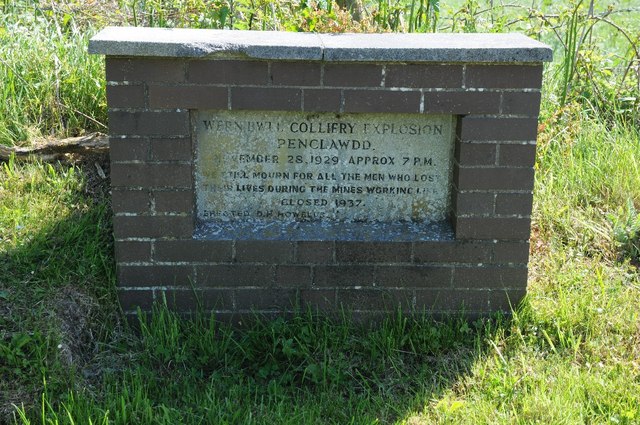
A brick memorial plaque near the colliery site, erected by D.H. Howells, records the explosion, its date and approximate time, and the colliery's 1937 closure.
Recorded claims
Individual factual claims, each attached to the source(s) that support it below. Where sources disagree, both are kept.
- The owners' expert witnesses, mining engineers J. Dyer Lewis and John Kane, maintained the explosion was caused solely by coal dust ignited at an acetylene lamp flame in the No.1 tophole, with no firedamp involved; the Miners' Agent, D.L. Davies, thought coal dust the main agent but could not rule out firedamp; H.M. Inspectors of Mines Lea, Waldin and Finney, and the reporting Inspector, F.H. Wynne, concluded firedamp accumulated in the level was the primary ignition source, subsequently extended by coal dust. (disputed) 1
Related terminology
Mining terms this disaster is structurally linked to, with the nature of the relationship.
- Acetylene Lamp (direct cause)
The official inquiry concluded the flame of an open acetylene lamp ignited the firedamp that caused the explosion. - Bad Air (contextual relationship)
Named in this record’s narrative: “…to reach the West District workings, twice turned back by gas and bad air; the ventilating fan was meanwhile found to have stopped, its motor…” - Breathing Apparatus (contextual relationship)
Named in this record’s narrative: “…then held up further recovery until the Rescue Brigade, wearing breathing apparatus, brought out the remaining five bodies.” - Deputy (contextual relationship)
Named twice in this record, first in the cause: “H.M. Deputy Chief Inspector of Mines, F.H. Wynne, concluded the explosion…” - HM Chief Inspector of Mines (contextual relationship)
Named twice in this record, first in the cause: “H.M. Deputy Chief Inspector of Mines, F.H. Wynne, concluded the explosion originated in the No.13 level…” - Slant (contextual relationship)
Named twice in this record, first in the narrative: “…poisoning; a seventh, Thomas Jones, who had come from the main west slant face in search of timber, was fatally burned and gassed some…” - Tophole System (contributing factor)
The official inquiry blamed untreated coal dust in the topholes for spreading the explosion beyond its initial small ignition.
Sources
- (secondary) Wernbwll Colliery Explosion - Penclawdd - 1929 — Northern Mine Research Society
- (primary) Wernbwll Colliery Disaster Report (H.M. Inspector of Mines) — Durham Mining Museum (official inquiry report)
- (secondary) Wernbwll Colliery (Welsh Coal Mines) — Welsh Coal Mines
Record created: 14 September 2026 · Last researched: 14 September 2026