 MineArchive
Wath Main Colliery explosions, 1930
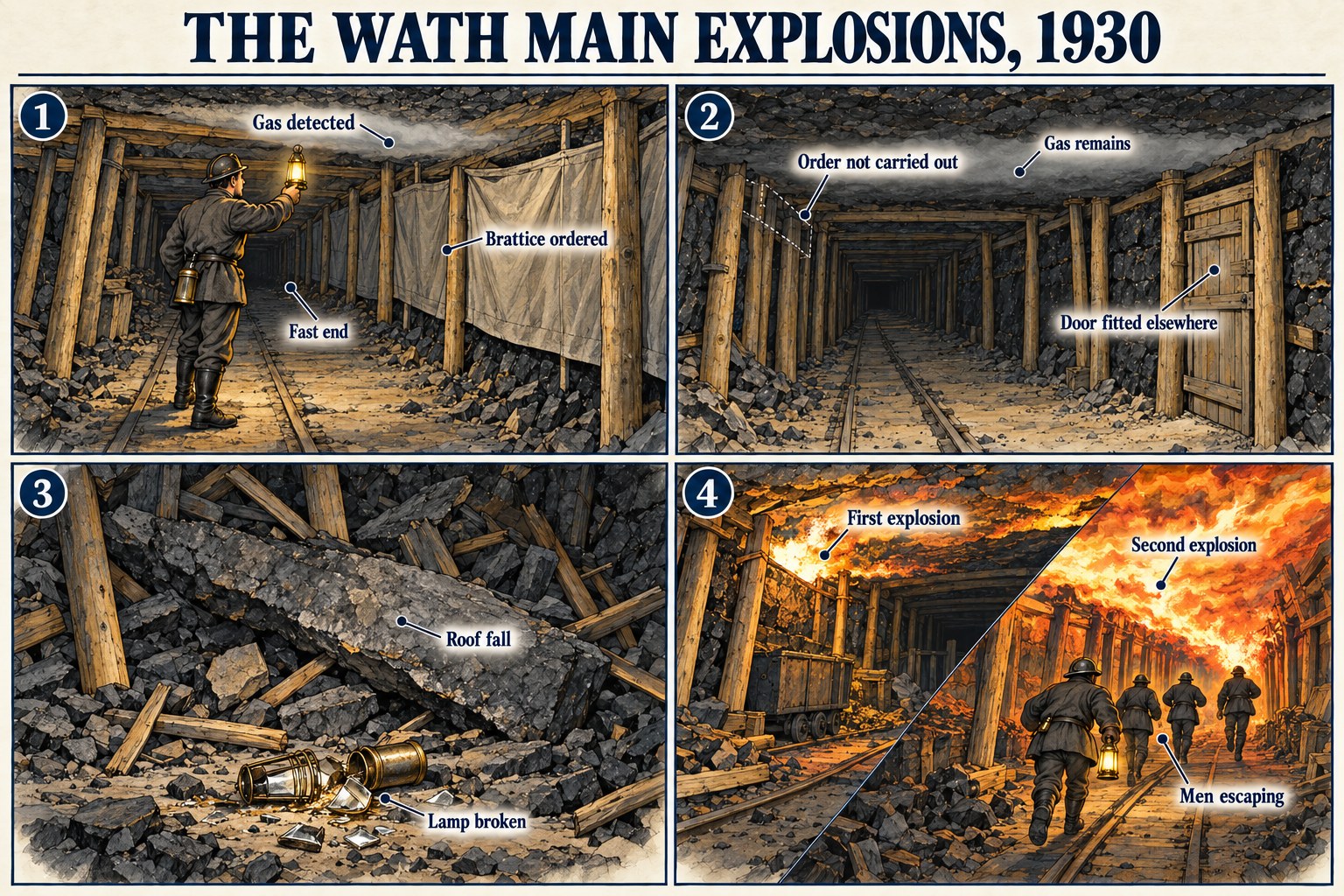
Two explosions in the Billingley Drift District of Wath Main Colliery on 24 February 1930 killed seven men and injured three more, after a fall of roof broke a miner's flame lamp in an area an inspector's ventilation order had not, in fact, been carried out.
| Date | 24 February 1930 |
|---|---|
| Mine | Wath Main Colliery |
| Region | South Yorkshire |
| Type | Explosion |
| Fatalities | 7 (An initial statement to Parliament the day after the disaster reported three dead, four badly burned and three less severely burned; the final toll, as further injured men died of their burns, reached seven dead and three injured.) |
| Injuries | Three men, seriously burned in the explosions, survived. |
| Context | During active mining |
Cause
A fall of roof broke a miner's flame safety lamp in the '30's' working place, igniting firedamp that had been repeatedly reported present in the area over the preceding weeks; a second, more violent explosion followed as the men were making their way out.
Contributing factors
H.M. Sub-Inspector of Mines T. Gawthorpe had inspected the district on 7 February, found 1% firedamp in an unventilated section, and instructed the manager to have a brattice sheet erected to carry ventilating air into it. The order was not in fact carried out — a wooden door was fitted elsewhere instead — and gas continued to be reported in the area up to the day of the explosion. Pre-shift gas inspections were also found not to have been carried out within the required two hours before each shift began, a breach of the mining regulations the manager acknowledged had persisted since working hours were altered after the 1926 stoppage.
What happened
The explosions occurred in the Billingley Drift District of the Barnsley Seam, an area of workings around two miles from the shafts, between six and seven in the evening. Samuel Walton and William Hart were working normally in the '30's' gate road when a section of unsupported roof fell; the fall broke Hart's flame safety lamp, igniting gas that had built up in the unventilated fast end of the workings. A second, more violent explosion followed shortly afterward, catching men as they made their way toward the pit bottom.
Investigation & inquiry
The divisional inspector of mines and colleagues investigated immediately; the case was raised in the House of Commons the day after the disaster, where the Secretary for Mines confirmed the sequence of the two explosions and fielded questions about the lack of automatic gas detectors at the colliery. The subsequent inquiry established that a specific ventilation order given by the sub-inspector two and a half weeks earlier had not been carried out as instructed, and that pre-shift gas inspections had been performed outside the required time window in breach of the regulations.
Legal & regulatory aftermath
The disaster was raised in Parliament the day after it occurred, with MPs pressing the Secretary for Mines on the case for mandatory automatic gas detectors.
Related terminology
Mining terms this disaster is structurally linked to, with the nature of the relationship.
- Brattice (contextual relationship)
Named in this record’s contributing factors: “…in an unventilated section, and instructed the manager to have a brattice sheet erected to carry ventilating air into it. The order was not in…” - Gate Road (contextual relationship)
Named in this record’s narrative: “…Samuel Walton and William Hart were working normally in the '30's' gate road when a section of unsupported roof fell; the fall broke Hart's flame…” - HM Chief Inspector of Mines (contextual relationship)
Named in this record’s investigation: “The divisional inspector of mines and colleagues investigated immediately; the case was raised in the…” - Roof Fall (contextual relationship)
Named twice in this record, first in the summary: “…on 24 February 1930 killed seven men and injured three more, after a fall of roof broke a miner's flame lamp in an area an inspector's ventilation…” - Safety Lamp (contextual relationship)
Named twice in this record, first in the cause: “A fall of roof broke a miner's flame safety lamp in the '30's' working place, igniting firedamp that had been…”
Sources
- (primary) WATH MAIN COLLIERY (EXPLOSION) — Hansard, 25 February 1930 — UK Parliament (Historic Hansard)
- (secondary) Wath Main Colliery Explosions - Wath-on-Dearne - 1930 — Northern Mine Research Society
Record created: 28 August 2026 · Last researched: 28 August 2026