 MineArchive
Tylorstown Colliery explosion, 1896
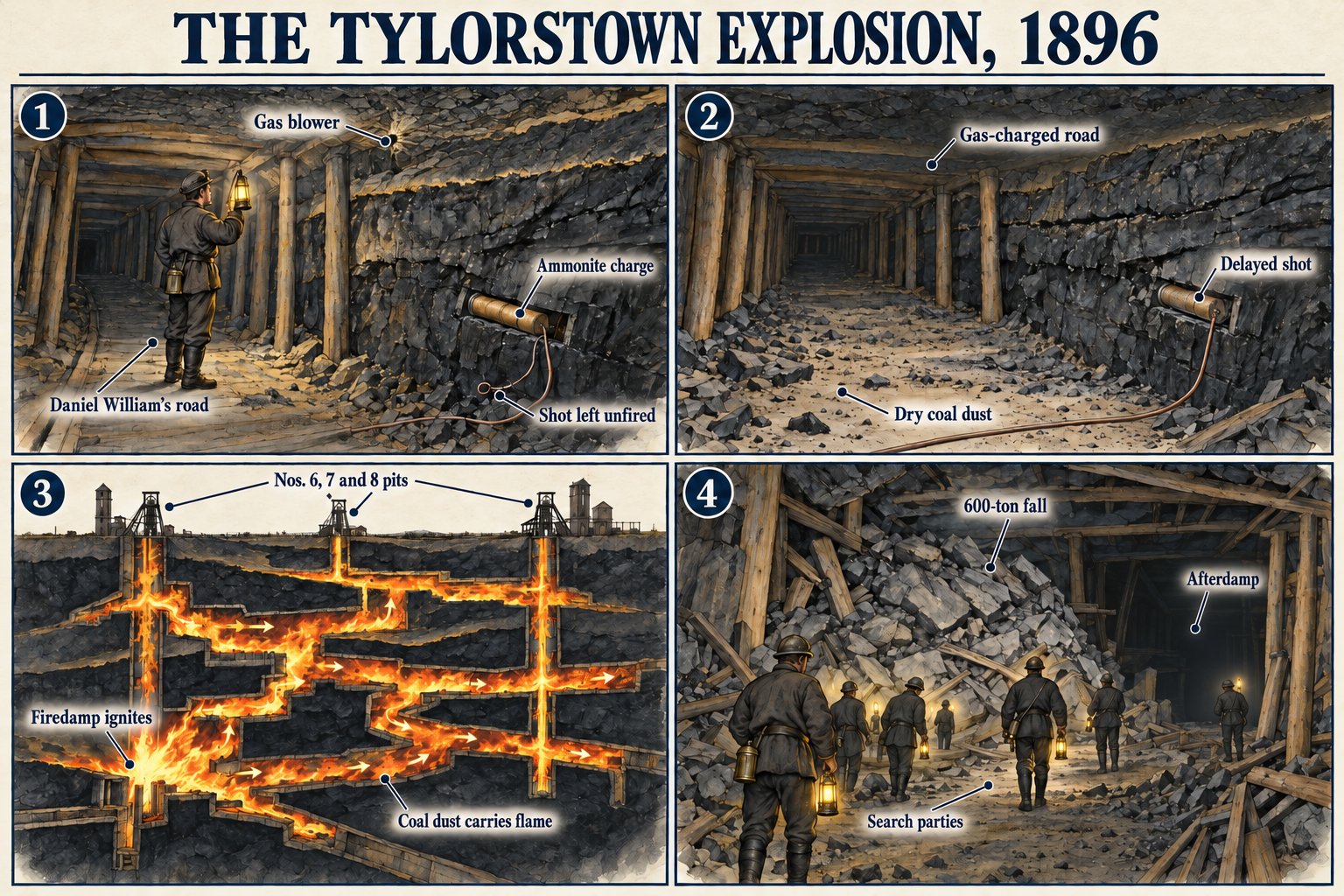
An explosion swept Tylorstown's Nos. 6, 7 and 8 pits as the day shift descended on 28 January 1896, killing 57 men and boys, after a delayed shot fired into a gas-charged road ignited firedamp and coal dust through the dry workings.
| Date | 28 January 1896 |
|---|---|
| Mines involved | Tylorstown Colliery, Ferndale Collieries (related workings) |
| Region | Rhondda Cynon Taf |
| Type | Explosion |
| Fatalities | 57 (Of around 90 men in the pits at the time, 30 escaped uninjured (mainly from the east side of No.7, where the explosion travelled only 270 yards before dying out) and 3 were found injured; the remaining 57 died. All 12 men working the Five Feet seam in No.6 pit died, as did every man in No.8 pit. The Durham Mining Museum's archive lists all 57 victims by name.) |
| Injuries | Three men were found injured: two enginemen burned near the No.7 shaft bottom, and collier Griffith Phillips (24), found 1,200 yards from the shaft at Canon's heading. |
| Context | During active mining |
Cause
A shot had been prepared on the Friday afternoon in Daniel William's road in No.8 pit, using a cartridge of Ammonite, but was left unfired after the night fireman detected an active gas blower there; the day fireman, Richard Evans, said he was unaware the shot existed. When it was eventually fired, on the Monday morning, it ignited gas that had accumulated in the meantime, and the resulting flame propagated through coal dust suspended throughout the dry workings.
Contributing factors
The inquest jury found that air passing through the working faces was charged with gas, probably meeting a film of gas near the shot itself, with coal dust accelerating the resulting blast; the inspector separately criticised inadequate watering of the roof and sides against dust.
What happened
The repairing shift descended around 10:30pm on Sunday 26 January after an inspection by night firemen; the explosion occurred around 5:37am on Monday 27-28 January as day firemen were descending, sending dust-laden clouds up all three shafts without visible flame. A fall of over 600 tons blocked the Six Feet level, hampering the search that followed; nine of the No.6 pit dead were found from carbon monoxide poisoning with their lamps still burning beside them. Day foreman Roderick Williams was noted for finding his way through afterdamp to fresher air with what the inquiry called considerable judgement and coolness.
Rescue & recovery
General manager David Hannah descended shortly after 6:30am to begin the search; recovery was made difficult by afterdamp and by structural collapse, including the more-than-600-ton fall in the Six Feet level.
Investigation & inquiry
An inquest opened on 18 February 1896 and sat for six days with all interested parties represented; the jury concluded the explosion was caused by the delayed shot in Daniel William's road meeting gas-charged air, accelerated by coal dust, and found no one then living responsible. Inspector J.T. Robson recommended that no shot be fired where the slightest trace of gas showed on a safety lamp, that shots not proceed in districts with firedamp accumulation, and that firemen act as dedicated shotfirers using electric batteries rather than fuses.
Changes to practice & legislation
Inspector Robson's recommendations targeted shotfiring practice directly — dedicated shotfirers, electric ignition in place of fuses, and a stricter rule against firing anywhere gas was detectable — alongside better watering of dust-prone roof and sides.
Recorded claims
Individual factual claims, each attached to the source(s) that support it below. Where sources disagree, both are kept.
- A shot prepared on the Friday in Daniel William's road, No.8 pit, was left unfired after a night fireman detected an active gas blower; fired anyway on the Monday, apparently in ignorance of that history, it ignited accumulated gas and, through coal dust, the wider explosion. 1
- 57 men and boys died; the Durham Mining Museum's archive lists all 57 victims by name. 2
- Inspector J.T. Robson recommended dedicated shotfirers using electric batteries rather than fuses, a stricter rule against firing shots wherever gas was detectable, and better watering of dust-prone roof and sides. 1
Related terminology
Mining terms this disaster is structurally linked to, with the nature of the relationship.
- Afterdamp (contextual relationship)
Named twice in this record, first in the narrative: “…Day foreman Roderick Williams was noted for finding his way through afterdamp to fresher air with what the inquiry called considerable judgement…” - Blower (contextual relationship)
Named in this record’s cause: “…but was left unfired after the night fireman detected an active gas blower there; the day fireman, Richard Evans, said he was unaware the shot…” - Fireman (contextual relationship)
Named twice in this record, first in the cause: “…using a cartridge of Ammonite, but was left unfired after the night fireman detected an active gas blower there; the day fireman, Richard Evans,…” - Safety Lamp (contextual relationship)
Named in this record’s investigation: “…that no shot be fired where the slightest trace of gas showed on a safety lamp, that shots not proceed in districts with firedamp accumulation, and…” - Shot-firing (contextual relationship)
Named twice in this record, first in the investigation: “…with firedamp accumulation, and that firemen act as dedicated shotfirers using electric batteries rather than fuses.”
Sources
- (secondary) Ferndale Colliery Tylorstown Pit Explosion - Rhondda Fach - 1896 — Northern Mine Research Society
- (primary) Tylorstown Colliery Disaster, 28th January 1896 — Durham Mining Museum
Record created: 27 August 2026 · Last researched: 27 August 2026