 MineArchive
Trimdon Grange Colliery Explosion, 1882
An explosion in the Harvey seam of Trimdon Grange Colliery on the afternoon of 16 February 1882 killed 74 men and boys, among them rescuers overcome by afterdamp that travelled through the underground connection into the neighbouring East Hetton (Kelloe) colliery.
| Date | 16 February 1882 |
|---|---|
| Mine | Trimdon Grange Colliery |
| Region | County Durham |
| Primary type | Explosion |
| Associated types | Gas / Asphyxiation, Rescue |
| Fatalities | 74 (74 is the figure given by the official report, by the Durham Mining Museum's disaster record and by the memorial inscription at Kelloe. Contemporary and later accounts also give 71 and 69; see the disputed claim below.) |
| Injuries | Not separately recorded in the official report. |
| Context | During active mining |
Cause
A sudden 'squeeze' or outburst of gas, forced towards the working face together with coal dust by a heavy fall of roof over the northern edge of the Pit Narrow Board goaf, and driven out with enough velocity to send flame through a miner's safety lamp.
Contributing factors
Trimdon Grange was admittedly a dusty mine; the trolley ways were watered daily, but only 'where it was absolutely necessary'. The only lamp in use was the old Davy pattern with a sliding shield, which the coroner concluded afforded no security against a disaster of this kind. Naked lights called 'midgies' were permitted as far as caution boards placed at a distance from the working places, though the report found no evidence they caused the explosion. The mine was not thought more than ordinarily gassy.
What happened
The explosion took place at about 2.40 p.m. on Thursday 16 February 1882, during the back shift. There were 94 people in the Harvey seam at the time — 64 hewers, 5 deputies and 25 boys. Every man and boy at work in the Pit Narrow Board and Headways districts was killed. Men in the Cross-cut district felt a sudden shock and compression of the air and, with those working south of the shaft, made their way through the advancing afterdamp to the shaft bottom and were brought out. The afterdamp also travelled through the underground connection into the East Hetton (Kelloe) workings two miles away, killing men who had gone in from that side to help; among them was Thomas Blenkinsop, a master shifter, who left a wife and four children.
Rescue & recovery
No time was lost in beginning rescue work, and exploring parties went in as soon as ventilation could be restored. Of those killed, 44 were buried in a mass grave at Old Trimdon, 26 at Kelloe, two at Shadforth, one at Croxdale and one at Cassop.
Investigation & inquiry
A coroner's inquest on two of the bodies was opened by Crofton Maynard the following day and continued on 29, 30 and 31 March and 1 April. T. W. Snagge, barrister-at-law, reported to both Houses of Parliament by command of Her Majesty later that year. The inquest itself failed to reach a definite conclusion as to the cause, though Snagge's report found no room for doubt that the explosion originated in the Pit Narrow Board district.
Legal & regulatory aftermath
The coroner observed that the inquiry was 'a further proof, if further proof were needed, that the Davy lamp affords no security whatever against the occurrence of grave disasters of a similar kind'. The jury recommended that no shots be fired during the day or while men were in the pit within forty yards of standing or fallen goaf, and that more deputies be employed.
Memorials & commemoration
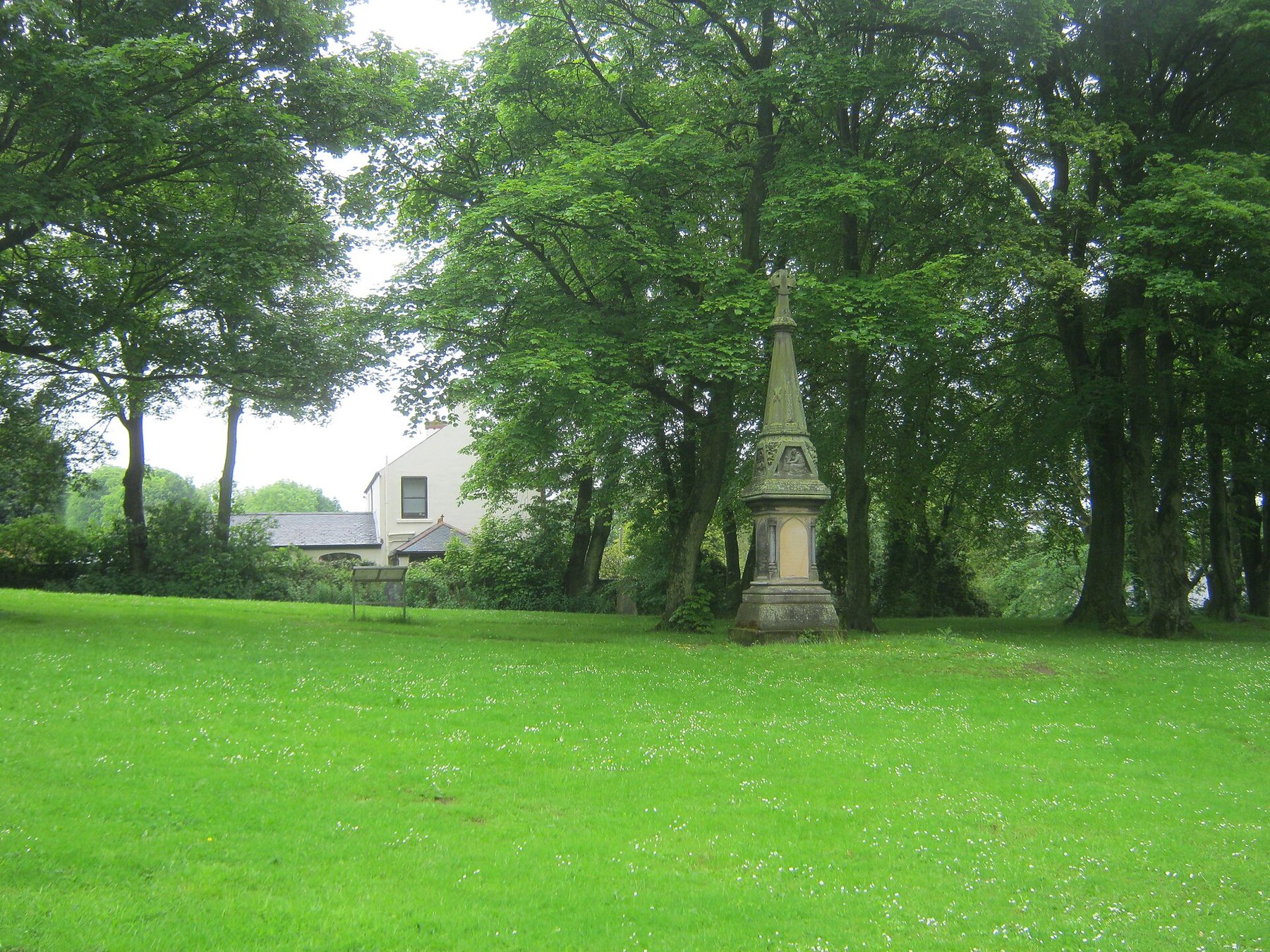
A Grade II listed sandstone memorial in Gothic Revival style, by C. Ryder and Sons of Bishop Auckland, stands near St Helen's Church at Kelloe. Raised by fellow workmen and friends, it names the 26 victims buried there and records the total of 74. A further memorial marks the mass grave at Trimdon. The disaster is also commemorated in Tommy Armstrong's ballad, written within days of the event.
What's uncertain
Points where sources disagree or the record could not be settled; both accounts are kept. All open questions in the archive.
- Lower figures are also in circulation: a contemporary description of the colliery reproduced by the Durham Mining Museum gives 71 killed, and 69 appears in other accounts. No source explains how the smaller totals were arrived at; the disaster killed men on both sides of the underground connection with East Hetton, which may account for some of the variation. (disputed) 4
Recorded claims
Individual factual claims, each attached to the source(s) that support it below. Where sources disagree, both are kept.
- The official report by T. W. Snagge, the Durham Mining Museum's disaster record and the Kelloe memorial inscription all give 74 deaths. 1,2,3
- Lower figures are also in circulation: a contemporary description of the colliery reproduced by the Durham Mining Museum gives 71 killed, and 69 appears in other accounts. No source explains how the smaller totals were arrived at; the disaster killed men on both sides of the underground connection with East Hetton, which may account for some of the variation. (disputed) 4
- 94 people were in the Harvey seam when the explosion occurred: 64 hewers, 5 deputies and 25 boys. Everyone at work in the Pit Narrow Board and Headways districts was killed. 1
- The explosion originated in the Pit Narrow Board district and was caused by a sudden outburst of gas and dust driven towards the face by a heavy roof fall over the goaf, at a velocity that sent flame through a safety lamp. 1
- 44 of the victims were buried in a mass grave at Old Trimdon, 26 at Kelloe, two at Shadforth, one at Croxdale and one at Cassop. 3
Related terminology
Mining terms this disaster is structurally linked to, with the nature of the relationship.
- Afterdamp (contextual relationship)
Named 3 times in this record, first in the summary: “…1882 killed 74 men and boys, among them rescuers overcome by afterdamp that travelled through the underground connection into the…” - Deputy (contextual relationship)
Named twice in this record, first in the narrative: “…There were 94 people in the Harvey seam at the time — 64 hewers, 5 deputies and 25 boys. Every man and boy at work in the Pit Narrow Board and…” - Goaf (contextual relationship)
Named twice in this record, first in the cause: “…a heavy fall of roof over the northern edge of the Pit Narrow Board goaf, and driven out with enough velocity to send flame through a miner's…” - Hewer (contextual relationship)
Named in this record’s narrative: “…back shift. There were 94 people in the Harvey seam at the time — 64 hewers, 5 deputies and 25 boys. Every man and boy at work in the Pit Narrow…” - Outburst (contextual relationship)
Named in this record’s cause: “A sudden 'squeeze' or outburst of gas, forced towards the working face together with coal dust by a…”
Photographs & further reading
This page doesn't try to reproduce everything — these are the best original sources found for this disaster.
Names, ages, occupations and burial places of the 1882 victims, with the circumstances recorded for each — including the rescuers who died of afterdamp in the East Hetton workings.
View sourceThe Durham Mining Museum's transcription of the report presented to both Houses of Parliament, covering the state of the mine, the lamps in use and the sequence of the explosion.
View sourceSources
- (primary) Report of T. W. Snagge on the Explosion at Trimdon Grange Colliery, 16 February 1882 — The National Archives
- (primary) Report on the Explosion which occurred at the Trimdon Grange Colliery on the 16th February 1882 — Durham Mining Museum
- (secondary) Trimdon Grange Colliery Memorial — Co-Curate, Newcastle University
- (primary) Trimdon Grange Colliery — Durham Mining Museum
Record created: 3 September 2026 · Last researched: 3 September 2026