 MineArchive
Tilmanstone Colliery shaft accident, 1909
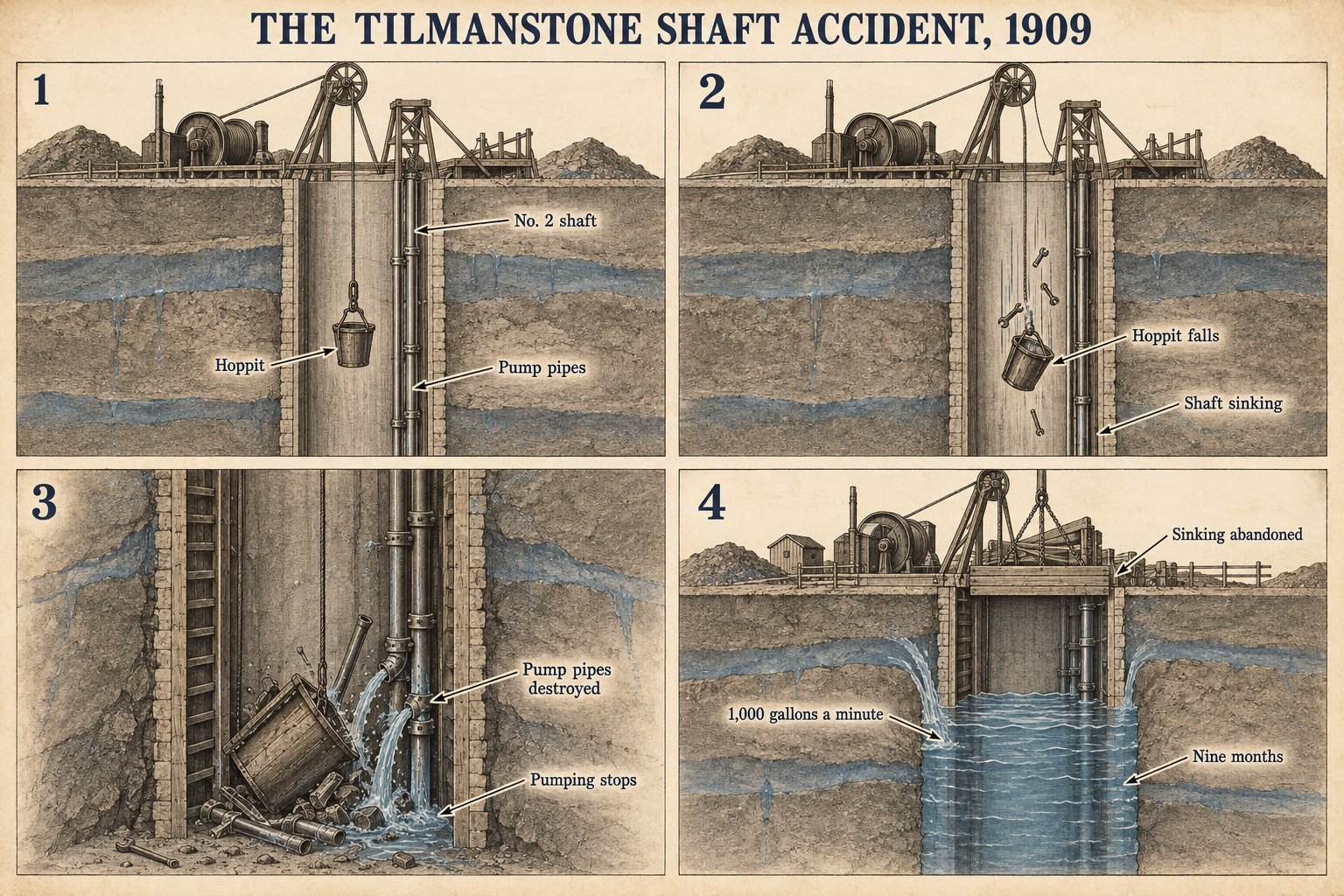
Tilmanstone's No. 2 shaft was still being sunk in 1909 when a hoisting bucket, or hoppit, fell down it, killing three men and wrecking the pumping equipment that was keeping the workings dry. A thousand gallons of water a minute poured in, and sinking was abandoned for nine months.
| Date | 1909 |
|---|---|
| Mine | Tilmanstone Colliery |
| Region | Kent |
| Type | Winding / Shaft Accident |
| Fatalities | 3 (Three men working on the No. 2 shaft sinking were killed; individual names are not recorded.) |
| Context | During active mining (An accident during the sinking of No. 2 shaft, years before the colliery ever reached coal.) |
Cause
A hoisting bucket (hoppit) fell down the shaft during sinking operations.
What happened
Tilmanstone's shafts were difficult from the start, driven through water-bearing ground years before any coal was found. In 1909, while No. 2 shaft was still being sunk, a hoppit — the bucket used to raise spoil and lower men and materials during sinking — fell down the shaft. Three men were killed, and the fall destroyed the pump pipes that were keeping the sinking dry. With the pumps gone, water poured into the pit at a thousand gallons a minute, and sinking was abandoned for nine months while the damage was made good.
Investigation & inquiry
No formal inquiry report is recorded; the account rests on the colliery's documented history rather than a surviving inquest record.
Recorded claims
Individual factual claims, each attached to the source(s) that support it below. Where sources disagree, both are kept.
- A hoisting bucket fell down No. 2 shaft during sinking in 1909, killing three men and destroying the pump pipes. 1
- The loss of pumping let water into the pit at a thousand gallons a minute, and shaft sinking was abandoned for nine months. 1
Related terminology
Mining terms this disaster is structurally linked to, with the nature of the relationship.
- Coal (contextual relationship)
Tilmanstone's shafts were driven through water-bearing ground for years before any coal was found — this accident happened during that sinking, not in a working colliery. - Colliery (contextual relationship)
Named in this record’s investigation: “…report has been located in this pass; the account rests on the colliery's documented history rather than a surviving inquest record.” - Kibble (contextual relationship)
Named 3 times in this record, first in the summary: “…No. 2 shaft was still being sunk in 1909 when a hoisting bucket, or hoppit, fell down it, killing three men and wrecking the pumping equipment…” - Shaft (contextual relationship)
The falling hoppit wrecked the pumping equipment keeping the shaft dry, and a thousand gallons a minute poured in behind it, stopping the sinking for nine months. - Shaft Sinking (contextual relationship)
A sinking accident: the hoppit that fell was the bucket used to raise spoil and lower men and materials while the shaft was being driven.
Sources
- (secondary) Tilmanstone Colliery — Dover Museum — Dover Museum
- (primary) Tilmanstone Colliery — Subterranea Britannica — Subterranea Britannica
Record created: 24 August 2026 · Last researched: 24 August 2026