 MineArchive
Strafford Colliery explosion, 1857
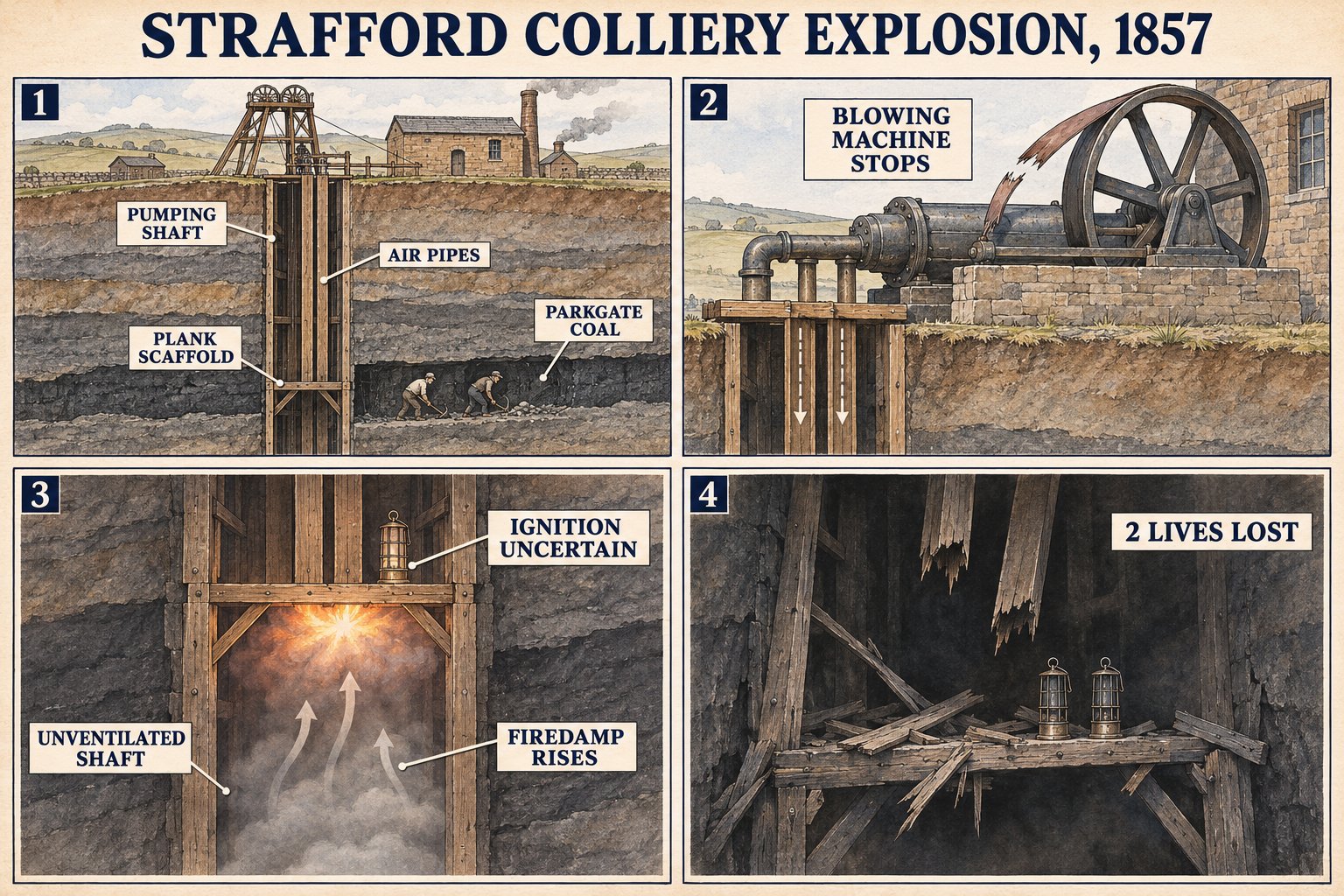
On 18 December 1857 two miners driving a drift from a scaffold in a pumping shaft at Strafford Colliery, near Barnsley, were killed when gas that had gathered in the unventilated shaft below them exploded, after the fan blowing air down to them had broken down for the second time in a day.
| Date | 18 December 1857 |
|---|---|
| Mine | Strafford Colliery |
| Region | South Yorkshire |
| Type | Explosion |
| Fatalities | 2 (R. Turner and G. Chappel (Chapel in the inspector's text), miners.) |
| Context | During active mining |
Location
Plotted at Strafford Colliery. Approximate location. The large pin is the mine; the small round markers are the nearest mines on record. Click one for its page. View on full map
Cause
Firedamp that had collected in the unventilated lower part of the shaft rose to the scaffold and was probably fired by a defective Davy lamp; the exact origin could not be established.
Contributing factors
The 101 yards of shaft between the Parkgate and Silkstone coals were not ventilated at all, and gas had been flashing in the lamps at the scaffold for several days. The drift depended on a single blowing machine whose strap failed twice.
What happened
The pumping pit went down 235 yards to the Silkstone coal, which gave off abundant gas. At 134 yards a plank scaffold crossed the shaft, and from it Turner and Chappel were driving a 20-yard drift in the Parkgate coal with locked Davy lamps. Air reached them through wooden pipes of a square foot from a blowing machine at the surface.
On the afternoon before, the machine's strap broke and the men had to leave because of gas. About twelve hours later it failed again. A hurried attempt to draw them out failed. Within minutes, as they waited at the scaffold, an explosion tore away the air pipes, water pipes and sheeting boards. Their burnt bodies were recovered hours later from under the wreckage.
Rescue & recovery
The bodies were extracted with difficulty, several hours later, from beneath the shattered fittings.
Investigation & inquiry
The inspector, Charles Morton, thought a defective Davy lamp at or near the scaffold the most likely cause. The fourteen jurors divided: ten wanted a verdict of manslaughter against the under-viewer, Samuel Steer. They compromised on death by an explosion of unknown cause, adding that the evidence proved gross want of care in the management and ventilation of the pit and incompetency on Steer's part.
Changes to practice & legislation
Control of the Strafford mines, all very fiery, passed to abler hands. The pumping shaft was bratticed and aired down to the Silkstone with a fall of water, and Stephenson safety lamps replaced the Davy lamps.
Recorded claims
Individual factual claims, each attached to the source(s) that support it below. Where sources disagree, both are kept.
- On 18 December 1857 an explosion of firedamp in a pumping shaft at Smith and Co.'s Strafford Colliery, near Barnsley, killed the miners Turner and Chappel. 1,2
- The men were driving a drift in the Parkgate coal from a scaffold 134 yards down a 235-yard pumping shaft, with air blown down wooden pipes by a fan. 2
- The fan's strap broke twice; on the second stoppage the men were caught at the scaffold before they could be drawn out. 2
- Ten of the fourteen jurors wanted a manslaughter verdict against the under-viewer, Samuel Steer; they agreed instead that the cause was unknown, citing gross want of care and his incompetency. 2
- Afterwards the management changed, the pumping shaft was bratticed and ventilated to the Silkstone, and Stephenson lamps replaced Davy lamps. 2
Related terminology
Mining terms this disaster is structurally linked to, with the nature of the relationship.
- Drift (contextual relationship)
Named 3 times in this record, first in the summary: “On 18 December 1857 two miners driving a drift from a scaffold in a pumping shaft at Strafford Colliery, near…” - Firedamp (contextual relationship)
Named in this record’s cause: “Firedamp that had collected in the unventilated lower part of the shaft rose…” - Safety Lamp (contextual relationship)
Named 5 times in this record, first in the cause: “…the shaft rose to the scaffold and was probably fired by a defective Davy lamp; the exact origin could not be established.” - Shaft (contextual relationship)
Named 6 times in this record, first in the summary: “…1857 two miners driving a drift from a scaffold in a pumping shaft at Strafford Colliery, near Barnsley, were killed when gas that had…” - Viewer (contextual relationship)
Named in this record’s investigation: “…jurors divided: ten wanted a verdict of manslaughter against the under-viewer, Samuel Steer. They compromised on death by an explosion of unknown…”
Sources
- (primary) Strafford Colliery (Durham Mining Museum) — Durham Mining Museum
- (primary) Strafford, 18 December 1857: explosion of firedamp (Mines Inspectors Report 1857) (Durham Mining Museum) — Durham Mining Museum
Record created: 4 November 2026 · Last researched: 6 November 2026