 MineArchive
Park Slip Colliery explosion, 1892
An explosion of firedamp, its violence multiplied by coal dust, tore through Park Slip Colliery near Tondu on 26 August 1892, killing 112 of the men and boys underground — one of the worst single mining disasters in Welsh history.
| Date | 26 August 1892 |
|---|---|
| Mine | Park Slip Colliery |
| Region | Bridgend |
| Type | Explosion |
| Fatalities | 112 (108 men and boys were killed outright in the blast; a further four were brought out alive but died of their injuries within days, giving a final toll of 112. Sixty women were widowed and 153 children left fatherless; the youngest victim was 13. All 16 pit ponies underground also died. Sources differ slightly on how many were underground at the time — 146 (Wikipedia) or 151 (NMRS) — both given here honestly rather than silently reconciled; 39 men escaped.) |
| Context | During active mining |
Cause
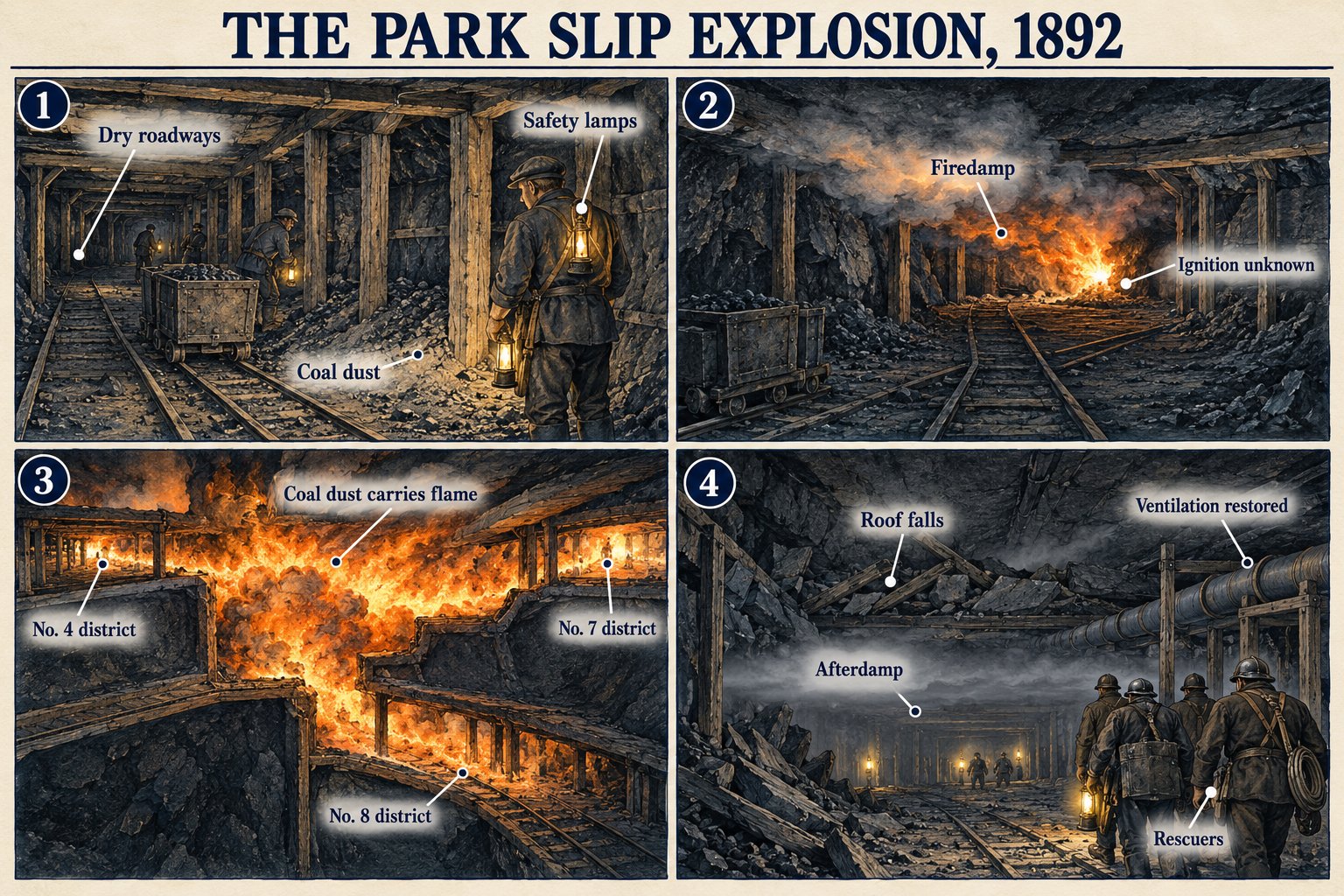
An explosion of gas (firedamp), greatly worsened in its spread and violence by coal dust; the coroner's inquest could not establish the specific point or source of ignition, though the Inspector of Mines suspected it originated on the east side of the workings.
What happened
At around 8:20-8:30am on 26 August 1892, with roughly 150 men and boys underground, an explosion of firedamp tore through Park Slip Colliery, its force and reach multiplied by coal dust in the roadways. Losses were concentrated in the colliery's No.4, No.7 and No.8 districts. Rescue operations began immediately: two pumpmen were brought out alive within hours, though explorers faced extensive roof falls in the main intake and dangerous accumulations of afterdamp (irrespirable gas left after an explosion). Once ventilation was restored, rescuers pulled 18 survivors from the North Fawr section and a further 25 from the No.7 West heading. Recovery of the dead continued until 20 September 1892. In total, 108 died in the blast itself, with four more of the rescued later dying of their injuries, for a final toll of 112 — 60 women widowed, 153 children left fatherless, and all 16 pit ponies underground killed alongside the men and boys.
Investigation & inquiry
The coroner's inquest, described at the time as extensive and searching, ran from 4 October to 9 November 1892. Its verdict found the mine's ventilation 'fairly good' but criticised the practice of leaving safety-lamp keys at unlocking stations and allowing miners to take lamps home unsupervised. The jury recommended mandatory watering of dry or dusty roadways, restricting shot-firing to between shifts, requiring the colliery to own and strictly supervise all safety lamps, and searching workers for matches and other unauthorised items. The Inspector of Mines' own report went further, calling for an end to torchlight use, a ban on gunpowder and dynamite, firemen on night shifts, and systematic watering of roadways.
Changes to practice & legislation
The inquest jury and the Inspector of Mines both issued detailed recommendations on safety-lamp discipline and coal-dust suppression by watering, reflecting the same concerns with dust-propagated explosions that were reshaping mine-safety practice across Britain through the 1890s.
Memorials & commemoration
A memorial of 112 stones, one for each victim, and a commemorative wooden statue stand at what is now Parc Slip Nature Reserve, on the site of the former colliery.
Recorded claims
Individual factual claims, each attached to the source(s) that support it below. Where sources disagree, both are kept.
- An explosion of firedamp, worsened by coal dust, killed 112 men and boys at Park Slip Colliery on 26 August 1892 — 108 immediately and 4 more of their injuries within days. 1,2
- Rescuers freed 18 survivors from the North Fawr section and 25 from the No.7 West heading after restoring ventilation; body recovery continued until 20 September 1892. 2
- The coroner's inquest (4 October-9 November 1892) criticised safety-lamp handling practices and recommended roadway watering, restricted shot-firing and stricter lamp supervision; the Inspector of Mines' own report went further still. 2
Related terminology
Mining terms this disaster is structurally linked to, with the nature of the relationship.
- Afterdamp (contextual relationship)
Named in this record’s narrative: “…roof falls in the main intake and dangerous accumulations of afterdamp (irrespirable gas left after an explosion). Once ventilation was…” - HM Chief Inspector of Mines (contextual relationship)
Named 3 times in this record, first in the cause: “…not establish the specific point or source of ignition, though the Inspector of Mines suspected it originated on the east side of the workings.” - Pit Pony (contextual relationship)
Named in this record’s narrative: “…of 112 — 60 women widowed, 153 children left fatherless, and all 16 pit ponies underground killed alongside the men and boys.” - Return Airway (contextual relationship)
Named in this record’s narrative: “…hours, though explorers faced extensive roof falls in the main intake and dangerous accumulations of afterdamp (irrespirable gas left…” - Safety Lamp (contextual relationship)
Named 3 times in this record, first in the investigation: “…ventilation 'fairly good' but criticised the practice of leaving safety-lamp keys at unlocking stations and allowing miners to take lamps home…”
Sources
- (secondary) Parc Slip Colliery — Wikipedia
- (secondary) Park Slip Colliery Explosion - Tondu - 1892 — Northern Mine Research Society
- (secondary) Park Slip Colliery - Tondu - Bridgend — Northern Mine Research Society
Record created: 27 August 2026 · Last researched: 27 August 2026