 MineArchive
Mill Close Mine firedamp explosion
Five miners died when a shot-firer's naked flame ignited firedamp gas that had already been detected and flagged as dangerous in the days before the blast.
| Date | 3 November 1887 |
|---|---|
| Mine | Millclose Mine |
| Region | Derbyshire |
| Type | Explosion |
| Fatalities | 5 (The five men killed were Job Stone, miner, aged 56; George Stone, miner, 31; George William Allen, miner, 31; George Needham, miner, 25; and Benjamin Boam, miner, 23.) |
| Context | During active mining |
Cause
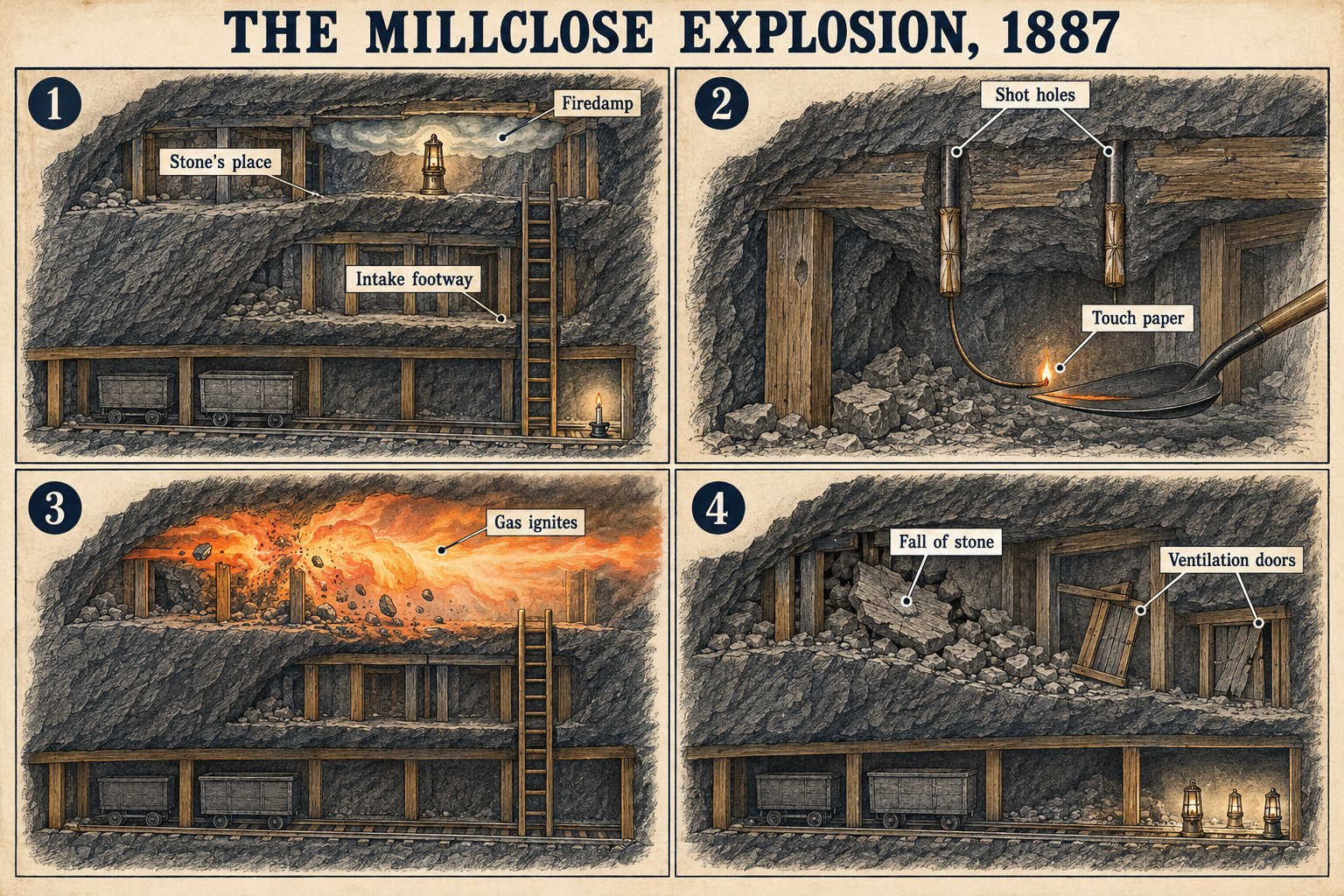
Firedamp (methane) had built up in a working known as Stone's place; despite warnings issued after gas was detected on 1-2 November, shot-firing went ahead using a candle flame to light the fuses.
What happened
Mill Close belonged to Wass and Son's Trustees, with A. M. Wirksworth as agent and Joseph Greatorex as manager. The miners worked by safety lamp, but the wagoners who moved the ore carried naked lights, which were allowed to be brought within ten yards of the end of the forefield. The working place was about 18 feet from floor to roof and 20 feet wide, with a timbered roadway above the wagon way that served as air intake and footway, reached by a ladder through about two yards of stone.
The gas was known about. The report book carried John Heathcote's entries for 1 November — 'I find a great deal of gas in Stone's place' — and for 2 November, 'I find gas in Stone's place but not as much as yesterday'. The deputy William Webster visited a little after six in the evening and again at midnight, wrote that Stone's place 'was full by 12 o'clock', told Robert Marsden to be very careful, and told Job Stone not to let the wagoners come near with their naked lights.
Marsden and Job Stone went down at midnight on 3 November 1887 and climbed the ladder into the forefield. Marsden found gas half way between the top of the ladder and the forefield end, and at the end itself gas fired in his lamp. They went on working, got some ore loose, and bored a shot hole, which Stone charged and fired without incident. They cleared the stuff away and bored two more, each charged with a packet of dynamite. The fuses were lit from a touch paper, itself lit at a candle at the bottom of the wagon way and carried up on a shovel and handed through the hole. Job Stone and George Allen stayed to fire the shots; the others went down the ladder and took cover about fifty yards back, two wagoners with them. About a minute later they heard one shot go off. There was a rush of wind and no flame that the survivors saw. Marsden was knocked over and lay unconscious for some time; when he came round he felt the edge of a fall of stone and saw George Bateman coming towards him with a candle. Five men were killed.
John Heathcote went back down about two hours later and found gas in the mine. A door twelve yards from the forefield, near Allen's body, had been blown out and another sixty yards beyond it blown to pieces. Seventeen to twenty charges were lying about the place, with pieces of burnt fuse but no detonators — it appeared the box had caught fire.
Investigation & inquiry
The inquest was held at the Stag's Head Inn, Darley Dale, before Mr A. O. Brookes of Bakewell, the deputy coroner. Mr Stokes, the Inspector of Mines, questioned John Heathcote closely about having found gas and yet allowing shots to be fired; the witness had no explanation for his actions. It emerged that there had been several small explosions in the previous twelve months, all connected with the firing of shots. After twenty minutes' deliberation the jury returned a verdict that the deaths were accidental and caused by an explosion of gas ignited by the firing of a shot.
Recorded claims
Individual factual claims, each attached to the source(s) that support it below. Where sources disagree, both are kept.
- Five miners — Benjamin Boam (23), George William Allen (31), George Stone (31), Job Stone (56) and George Needham (25) — died when firedamp ignited during shot-firing on 3 November 1887. 1
- The coroner's jury found the deaths accidental; smaller gas ignitions linked to shot-firing in the same working had reportedly occurred over the preceding year. 1
- The five men killed were Job Stone, aged 56, George Stone, 31, George William Allen, 31, George Needham, 25, and Benjamin Boam, 23, all miners. 2
- The report book carried John Heathcote's entries for 1 November 1887 — 'I find a great deal of gas in Stone's place' — and for 2 November, 'I find gas in Stone's place but not as much as yesterday'; the deputy William Webster recorded at midnight that Stone's place 'was full by 12 o'clock' and told Job Stone not to let the wagoners near with their naked lights. 2
- The mine was the property of Wass and Son's Trustees, with A. M. Wirksworth as agent and Joseph Greatorex as manager; the miners worked by safety lamp while the wagoners carried naked lights, permitted to within ten yards of the end of the forefield. 2
- The inquest at the Stag's Head Inn, Darley Dale, before deputy coroner A. O. Brookes, heard the Inspector question John Heathcote about allowing shots to be fired where gas had been found, and returned a verdict after twenty minutes that the deaths were accidental and caused by an explosion of gas ignited by the firing of a shot. 2
Related terminology
Mining terms this disaster is structurally linked to, with the nature of the relationship.
- Deputy (contextual relationship)
Named twice in this record, first in the narrative: “…'I find gas in Stone's place but not as much as yesterday'. The deputy William Webster visited a little after six in the evening and again…” - Naked Light (contextual relationship)
Named in this record’s summary: “Five miners died when a shot-firer's naked flame ignited firedamp gas that had already been detected and flagged as…” - Return Airway (contextual relationship)
Named in this record’s narrative: “…wide, with a timbered roadway above the wagon way that served as air intake and footway, reached by a ladder through about two yards of…” - Safety Lamp (contextual relationship)
Named in this record’s narrative: “…as agent and Joseph Greatorex as manager. The miners worked by safety lamp, but the wagoners who moved the ore carried naked lights, which were…” - Shot-firing (contextual relationship)
Shot-firing went ahead with a candle flame used to light the fuses, in a working where gas had been detected and flagged as dangerous days earlier.
Sources
- (secondary) Mill Close Lead Mine Explosion - Darley Dale - 1887 — Northern Mine Research Society
- (secondary) Mining Disasters in Great Britain, 1886-88: Hill Close [Mill Close] Lead Mine, Darley Dale, Derbyshire, 3rd November 1887 — Coalmining History Resource Centre
Record created: 20 August 2026 · Last researched: 5 September 2026