 MineArchive
Maltby Main Colliery explosion, 1923
An explosion tore through Maltby Main Colliery at 9.15am on Saturday 28 July 1923, a mile from the pit bottom, while men were working to seal off a stubborn underground gob fire. Twenty-seven died; only one body was recovered at the time. The disaster became known locally as 'Black Saturday'.
| Date | 28 July 1923 |
|---|---|
| Mine | Maltby Colliery |
| Region | South Yorkshire |
| Type | Explosion |
| Fatalities | 27 (The average age of the dead was 29.9; several were still in their teens, one just 15. Only one body, that of roadlayer Original 'Reg' Renshaw, was recovered in the immediate aftermath, found around 130 yards from where the explosion occurred; the remaining 26 could not be reached and the affected workings were sealed. A further unidentified body, believed to be one of the missing men, was found in the same seam on 13 November 1947 and formally ruled at a Rotherham inquest that December to be a victim of the 1923 disaster; it was buried locally as 'The Unknown Miner'.) |
| Context | During active mining |
Cause
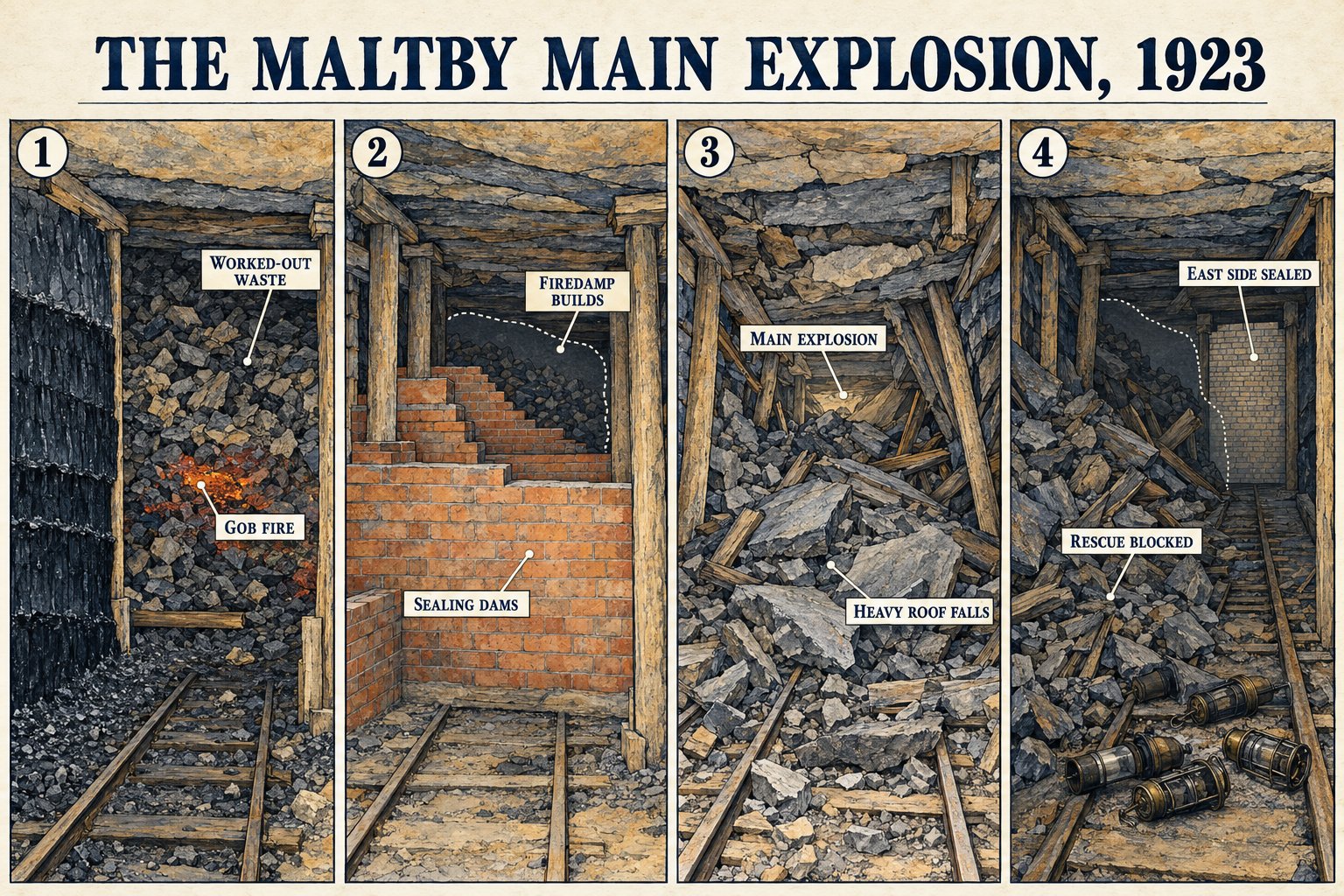
An underground gob fire — spontaneous combustion in worked-out waste — had already caused several minor explosions in the weeks beforehand, most recently on 16-17 July, and had forced a halt to coal-getting; men were instead building sealing dams to starve the fire of air. On the morning of 28 July, firedamp gas that had built up behind the new stoppings ignited, causing the main explosion, which brought down heavy falls of roof, coal and stone and filled the workings with noxious gases, blocking any further rescue attempt.
Contributing factors
HM Chief Inspector of Mines Sir Thomas Mottram's official report found the management's handling of the fire, up to the repeated minor explosions of 16-17 July, to have followed recognised practice; he concluded the final disaster came about because some of those left to fight the fire on 27-28 July let 'zeal... overrule discretion,' risking their own lives in the process.
What happened
News reached the surface as families gathered in growing numbers at the pithead through a day of heavy rain; some kept vigil through the following night. The disaster was, at the time, the worst in South Yorkshire since the Cadeby Main explosions of 1912, in which more than 80 had died.
Rescue & recovery
Rescue efforts were abandoned in the face of heavy roof falls and noxious gas, and the affected East side workings were sealed off rather than risk further loss of life; the 26 men whose bodies could not be recovered remained entombed, aside from the one identified in 1947.
Investigation & inquiry
A formal inquiry under Sir Thomas Mottram, HM Chief Inspector of Mines, sat at Sheffield City Hall for seven days, concluding on 27 September 1923; his report was published on 25 February 1924. A coroner's jury returned a verdict of accidental death.
Memorials & commemoration
A stained-glass window commemorating the disaster was placed in the Church of the Ascension in Maltby's model village; a memorial stands at Grange Lane, Maltby, where Renshaw and the unidentified 1947 victim are buried, and a centenary memorial service was held there in 2008.
Recorded claims
Individual factual claims, each attached to the source(s) that support it below. Where sources disagree, both are kept.
- An underground gob fire had caused several minor explosions in the weeks before, most recently on 16-17 July 1923; men were building sealing dams to starve it of air when firedamp trapped behind the new stoppings ignited on 28 July, causing the main explosion. 1,2
- Twenty-seven men died; their average age was 29.9, several were still in their teens, and one was just 15 years old. 2
- Only one body, roadlayer Original Renshaw's, was recovered in the immediate aftermath; the remaining 26 could not be reached and the workings were sealed. 1,2
- Human remains found in the same seam on 13 November 1947 were ruled at a Rotherham inquest that December to be those of a further, previously unrecovered victim of the 1923 disaster; he was buried locally as 'The Unknown Miner'. 2
- Sir Thomas Mottram's official inquiry, sitting for seven days at Sheffield City Hall and concluding 27 September 1923, found the fire had been fought according to recognised practice up to the minor explosions of 16-17 July, but concluded the final disaster arose because some of those left to fight the fire let zeal override discretion. 2
Related terminology
Mining terms this disaster is structurally linked to, with the nature of the relationship.
- Firedamp (contextual relationship)
Named in this record’s cause: “…sealing dams to starve the fire of air. On the morning of 28 July, firedamp gas that had built up behind the new stoppings ignited, causing the…” - HM Chief Inspector of Mines (contextual relationship)
Named twice in this record, first in the contributing factors: “HM Chief Inspector of Mines Sir Thomas Mottram's official report found the management's handling…” - Pithead (contextual relationship)
Named in this record’s narrative: “…reached the surface as families gathered in growing numbers at the pithead through a day of heavy rain; some kept vigil through the following…” - Roof Fall (contextual relationship)
Named twice in this record, first in the cause: “…ignited, causing the main explosion, which brought down heavy falls of roof, coal and stone and filled the workings with noxious gases, blocking…” - Spontaneous Combustion (contextual relationship)
Named 3 times in this record, first in the summary: “…bottom, while men were working to seal off a stubborn underground gob fire. Twenty-seven died; only one body was recovered at the time. The…”
Sources
- (secondary) Maltby Main Colliery Explosion - Maltby - 1923 — Northern Mine Research Society
- (secondary) Maltby Colliery: The Yorkshire coal mine tainted by a 1923 disaster — Yorkshire Post
Record created: 27 August 2026 · Last researched: 27 August 2026