 MineArchive
Kilnhurst Colliery cage accident, 1937
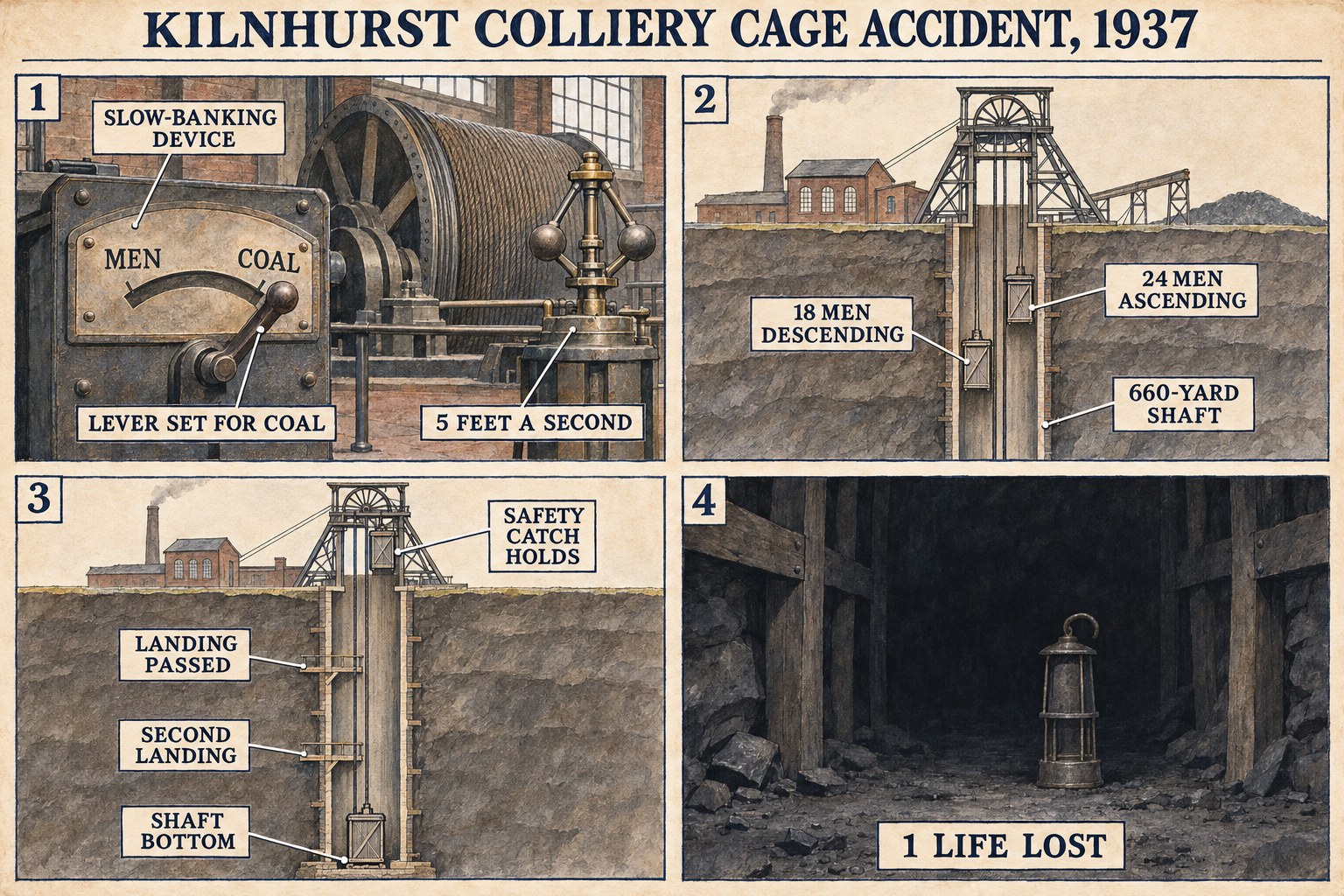
At 2.45 pm on 28 July 1937, as the day and afternoon shifts changed over, the cages in the No. 2 shaft at Kilnhurst Colliery near Rotherham were overwound. The ascending cage was caught and held, but the descending one, carrying 18 men, struck the bottom of the shaft. Joe Sales, a 54-year-old miner of Rawmarsh, died and sixteen men were taken to hospital with broken legs.
| Date | 28 July 1937 |
|---|---|
| Mine | Kilnhurst Colliery |
| Region | South Yorkshire |
| Type | Winding / Shaft Accident |
| Fatalities | 1 (One: Joe Sales, 54, miner, of Apollo Street, Rawmarsh, married with a family of five.) |
| Injuries | Sixteen of the 18 men in the descending cage suffered fractured legs and were taken to hospital; the remaining man escaped with shock. Some of the injured later had limbs amputated. |
| Context | During active mining |
Location
Plotted at Kilnhurst Colliery. Recorded location. The large pin is the mine; the small round markers are the nearest mines on record. Click one for its page. View on full map
Cause
An overwind. The slow-banking device, which held the cages to 5 feet a second when its lever was set for winding men, had been left in the position for winding coal.
What happened
The No. 2 shaft, the Silkstone shaft, was about 660 yards deep; the local paper put it at some 2,000 feet. The shifts were changing over, and men were riding both cages at once: 24 coming up in one, according to the Secretary for Mines, or about twenty by the local paper's count, and 18 going down on the two decks of the other.
It was the third wind of men since the winding engineman, William Henry Hudson, had taken over at about 1.50 pm. One of the riders, John Rix, said his cage ran normally until about 20 yards below the landing, then gathered speed, passed the landing and came to rest at the second landing, where it dropped about a yard and shook violently. The overwind gear applied the brakes and the ascending cage was held safely in the headgear, where the safety catch kept it from falling back. The descending cage went on to strike the bottom of the shaft.
Sales had been gassed in a rush of gas at the colliery in January 1936.
Rescue & recovery
A deputy, Ernest Cottrell, heard shouts and groans from the shaft bottom and found Sales among the injured, bleeding heavily from one leg. A doctor who saw him at the pithead found that he had died of shock and loss of blood.
Investigation & inquiry
The Secretary for Mines, Captain Crookshank, answered a private notice question from E. Dunn in the Commons the next day. The inquest, opened by the Sheffield District Coroner and resumed at Rotherham before J. Kenyon Parker, heard that the slow-banking lever was in the coal position; the winder (named once in the report as Watson) admitted his mistake in not setting it for men. H.M. Inspector John Edward Henshaw said the device at Kilnhurst was three and a half years ahead of the regulations, and the coroner said no question of criminal negligence arose. The jury found that death was due to an accident caused by overwinding, with an error of judgement by the engine winder.
What's uncertain
Points where sources disagree or the record could not be settled; both accounts are kept. All open questions in the archive.
- The ascending cage carried 24 men by the Secretary for Mines' account and about twenty by the local paper's. (disputed) 2,3
Recorded claims
Individual factual claims, each attached to the source(s) that support it below. Where sources disagree, both are kept.
- On 28 July 1937 an overwind in the No. 2 shaft at Kilnhurst Colliery killed one man and injured seventeen. 1,2,3
- Sixteen of the 18 men in the descending cage suffered fractured legs; the remaining man escaped with shock. 2
- The ascending cage carried 24 men by the Secretary for Mines' account and about twenty by the local paper's. (disputed) 2,3
- The slow-banking device's lever was in the coal position, not the men position, when the cages overwound. 4
- The inquest jury found death due to an accident caused by overwinding, with an error of judgement by the engine winder. 4
- Joe Sales, 54, miner, of Rawmarsh, died of shock and loss of blood. 1,5,4
Related terminology
Mining terms this disaster is structurally linked to, with the nature of the relationship.
- Cage (contextual relationship)
Named 7 times in this record, first in the summary: “…on 28 July 1937, as the day and afternoon shifts changed over, the cages in the No. 2 shaft at Kilnhurst Colliery near Rotherham were…” - Engineman (contextual relationship)
Named in this record’s narrative: “…the two decks of the other. It was the third wind of men since the winding engineman, William Henry Hudson, had taken over at about 1.50 pm. One of the…” - Overwind (contextual relationship)
Named twice in this record, first in the cause: “An overwind. The slow-banking device, which held the cages to 5 feet a second…” - Pithead (contextual relationship)
Named in this record’s rescue and recovery: “…injured, bleeding heavily from one leg. A doctor who saw him at the pithead found that he had died of shock and loss of blood.” - Winding Engine (contextual relationship)
Named twice in this record, first in the investigation: “…heard that the slow-banking lever was in the coal position; the winder (named once in the report as Watson) admitted his mistake in not…”
Further reading
This page doesn't try to reproduce everything — these are the best original sources found for this disaster.
The Secretary for Mines' statement to the Commons the day after the accident, with the shaft depth and the numbers in each cage.
View sourceReport of the resumed inquest, with the winder's and chief engineer's evidence and the verdict, transcribed by the Kilnhurst local history site.
View sourceSources
- (primary) Kilnhurst Colliery (Durham Mining Museum) — Durham Mining Museum
- (primary) Colliery Accident, Rotherham (HC Deb 29 July 1937 vol 326 cc3312-3) — Hansard (UK Parliament)
- (secondary) Kilnhurst Colliery Accident: The Dead and Injured (Mexborough and Swinton Times, 30 July 1937) — Kilnhurst, Dearne Valley History
- (secondary) Kilnhurst Pit Cage Crash: Winder's Admission (South Yorkshire Times, 31 August 1937) — Kilnhurst, Dearne Valley History
- (secondary) Kilnhurst Colliery Accident: The Inquest (Mexborough and Swinton Times, 30 July 1937) — Kilnhurst, Dearne Valley History
Record created: 19 November 2026 · Last researched: 19 November 2026