 MineArchive
Hapton Valley Colliery explosion, 1962
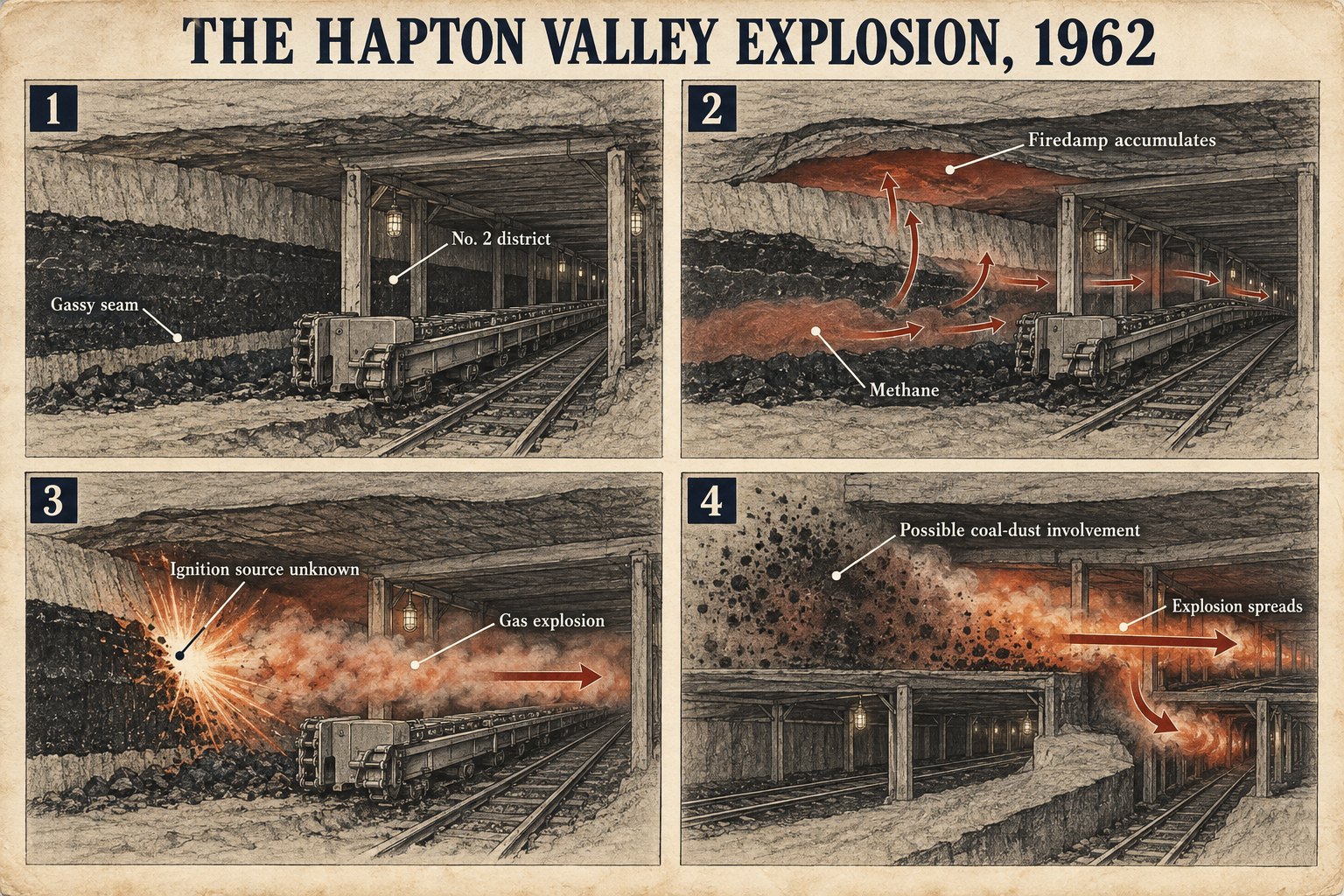
A gas explosion at Hapton Valley Colliery just after 9.45am on 22 March 1962 killed 16 men outright, with three more later dying of their injuries, in a mine whose seams were already known to carry unusually high levels of firedamp.
| Date | 22 March 1962 |
|---|---|
| Mine | Hapton Valley Colliery |
| Region | Lancashire |
| Type | Explosion |
| Fatalities | 19 (16 men were killed outright, with a further 3 dying later of injuries sustained in the explosion.) |
| Context | During active mining |
Cause
An official investigation concluded the explosion was most likely caused by firedamp ignition, possibly combined with coal dust, though the exact source of gas and point of ignition could not be conclusively identified.
Contributing factors
The seams at Hapton Valley were known to carry high levels of firedamp; two gas ignitions in summer 1960 and a further ignition on 4 April 1961 had already established a pattern of hazardous conditions in the same workings before the fatal explosion.
What happened
Just after 9.45am on 22 March 1962, an explosion occurred in the number two district of Hapton Valley Colliery, near Burnley. Sixteen men were killed outright, and three more subsequently died of their injuries, bringing the total death toll to 19.
Investigation & inquiry
H.M. Chief Inspector of Mines, H.S. Stephenson, prepared an official report on the causes and circumstances of the explosion; despite a meticulous examination of the evidence, investigators were unable to pinpoint a specific ignition source, though firedamp ignition, possibly involving coal dust, was considered the most likely cause. The disaster was also raised in the House of Commons on 23 March 1962.
Memorials & commemoration
The victims are remembered with memorial plaques at St Mark's Church, Rossendale Road, and at Burnley Miners Club, which holds an annual reunion in their memory.
Related terminology
Mining terms this disaster is structurally linked to, with the nature of the relationship.
- Coal (contextual relationship)
The official investigation thought firedamp the likely cause, possibly with coal dust adding to it, though neither the gas source nor the ignition point could be pinned down. - Colliery (contextual relationship)
Named twice in this record, first in the summary: “A gas explosion at Hapton Valley Colliery just after 9.45am on 22 March 1962 killed 16 men outright, with…” - Firedamp (contextual relationship)
Hapton Valley's seams were already known to carry unusually high firedamp levels before the 1962 explosion killed nineteen men. - HM Chief Inspector of Mines (contextual relationship)
Named in this record’s investigation: “H.M. Chief Inspector of Mines, H.S. Stephenson, prepared an official report on the causes and…” - Level (contextual relationship)
Named twice in this record, first in the summary: “…in a mine whose seams were already known to carry unusually high levels of firedamp.”
Sources
- (primary) Hapton Colliery, Burnley (Explosion) (Hansard, 23 March 1962) — UK Parliament (Hansard)
- (primary) The Official Report on the causes and circumstances of the Explosion at the Hapton Valley Colliery on the 22nd March 1962 — Hapton Heritage
- (secondary) Hapton Valley Colliery — Wikipedia
- (secondary) Hapton Valley Colliery Explosion - Burnley - 1962 — Northern Mine Research Society
Record created: 21 August 2026 · Last researched: 21 August 2026