 MineArchive
Donibristle Colliery Moss Inrush
At about twenty to two on the afternoon of 26 August 1901, soft peat began to flow into a heading in the East section of the Mynheer seam workings at Donibristle Colliery in west Fife. Most of the colliery ran beneath Mossmorran, a square mile of moss 450 feet above sea level, and two men probing upward with a rod to form an air shaft brought it down on themselves. Eight men died, smothered rather than drowned. Six were brought out alive, and the rescue was extraordinary in its own right: some three hundred volunteers came forward, and two of the rescuers were themselves trapped the following day and had to be got out in turn.
| Date | 26 August 1901 |
|---|---|
| Mine | Donibristle Colliery |
| Region | Fife |
| Primary type | Flooding / Inundation |
| Associated types | Entrapment, Rescue |
| Fatalities | 8 (The eight killed were Thomas Rattray, 54, overman; David Campbell, 54, pit inspector; Alexander Smith, 48, oncostman; George Herd Hutchison, 50, miner; William Hynd, 52, pit bottomer; James Bowman McDonald, 32, incline bottomer; Andrew Paterson, 40, ostler; and William Forsyth, 20, wheeler. Six men were rescued alive: John Farquhar, John Colville, Thomas Bauld, Andrew Love, John Beveridge and Alexander Bauld. Two rescuers, John Jones and John Sheddon, were trapped on 27 August and rescued in turn.) |
| Context | During active mining |
Cause
An inflow of soft peat or moss from the ground overlying the workings. Two men, David Campbell and Alexander Smith, were at the heading probing upwards with a rod as part of operations to form an air shaft when the moss burst in, killing both of them and two more men working at the lower levels.
Contributing factors
The colliery's exposure was structural rather than momentary: most of its workings lay under a square mile of peat moss at 450 feet above sea level, and the field was cut by several large faults with an irregular inclination. Boring upward from a heading beneath that cover is what let the moss in.
What happened
The flow began at about 1.40 p.m. in a heading in the East section of the Mynheer Coal Seam workings of the Nos. 12 and 15 pits. Campbell and Smith were killed at the heading itself and two men in the lower levels died as the moss swept down. Contemporary description has a large mass of mineral giving way followed by a torrent of moss that swept down the brae and through the workings, carrying everything before it.
Rescue & recovery
Three hundred volunteers were prepared to go underground after the trapped men. Six were brought out alive. The rescue then produced a second emergency: on 27 August two of the rescuers, John Jones and John Sheddon, were themselves trapped and had to be rescued.
Investigation & inquiry
A formal inquiry was held in the Dunfermline Sheriff Court on 25 September 1901, presided over by Sheriff Substitute Gillespie with Honorary Sheriff Substitute Walker also on the bench. Appearing were the Acting Procurator Fiscal J. S. Soutar; John Ross for the Donibristle Colliery Company; James Currie Macbeth for the Fife and Kinross Miners' Association and the relatives of the dead; W. G. Campbell for the agents of the Ocean Insurance Company, with which the company was insured against liability for accidents to workmen; H.M. Inspector of Mines J. B. Atkinson with Inspectors McLaren and Johnstone; and James Innes and John Weir, president and secretary of the miners' association. Atkinson's account of the accident was published in his report.
Memorials & commemoration
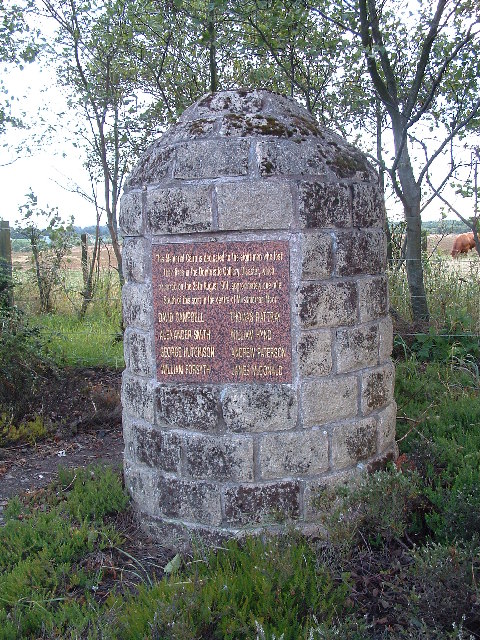
A memorial to the eight men stands at Cowdenbeath. A separate cairn was raised on Bridge Street in the town, overlooking Mossmorran, by Donald McArthur, a grandson of James Bowman McDonald, one of the dead. The 125th anniversary of the disaster was marked locally in 2026.
Recorded claims
Individual factual claims, each attached to the source(s) that support it below. Where sources disagree, both are kept.
- At about 1.40 p.m. soft peat or moss started to flow into a heading in the East section of the Mynheer Coal Seam workings of the Nos. 12 and 15 pits. 1
- David Campbell and Alexander Smith were working at the heading, probing upwards with a rod as part of operations to form an air shaft, when the moss burst in and killed them both, along with two more men working in the lower levels. 2
- Eight men were killed: Thomas Rattray, 54, overman; David Campbell, 54; Alexander Smith, 48, oncostman; George Herd Hutchison, 50, miner; William Hynd, 52, pit bottomer; James Bowman McDonald, 32, incline bottomer; Andrew Paterson, 40, ostler; and William Forsyth, 20, wheeler. 1
- Six men were brought out alive, and two of the rescuers, John Jones and John Sheddon, were themselves trapped on 27 August and had to be rescued in turn. Three hundred volunteers were prepared to go in after the trapped men. 1,2
- An inquiry was held in the Dunfermline Sheriff Court on 25 September 1901 before Sheriff Substitute Gillespie, with the Procurator Fiscal, the colliery company, the Fife and Kinross Miners' Association, the relatives of the dead, the company's insurers and three Inspectors of Mines all represented. 1
Related terminology
Mining terms this disaster is structurally linked to, with the nature of the relationship.
- Colliery (contextual relationship)
Named 3 times in this record, first in the summary: “…in the East section of the Mynheer seam workings at Donibristle Colliery in west Fife. Most of the colliery ran beneath Mossmorran, a square…” - Fault (contextual relationship)
Named in this record’s contributing factors: “…at 450 feet above sea level, and the field was cut by several large faults with an irregular inclination. Boring upward from a heading beneath…” - HM Chief Inspector of Mines (contextual relationship)
Named in this record’s investigation: “…company was insured against liability for accidents to workmen; H.M. Inspector of Mines J. B. Atkinson with Inspectors McLaren and Johnstone; and James…” - Level (contextual relationship)
Named twice in this record, first in the cause: “…burst in, killing both of them and two more men working at the lower levels.” - Shaft (contextual relationship)
Named twice in this record, first in the summary: “…sea level, and two men probing upward with a rod to form an air shaft brought it down on themselves. Eight men died, smothered rather than…”
Photographs & further reading
This page doesn't try to reproduce everything — these are the best original sources found for this disaster.
Contemporary reporting and record gathered by the Scottish Mining Website, including the men at the heading, the scale of the volunteer rescue effort and the later commemoration of the disaster.
View sourceExtracts from H.M. Inspector of Mines J. B. Atkinson's report, with the description of the coalfield and its cover of moss, the narrative of the inrush, the names and ages of the eight dead and the six rescued, the two rescuers trapped the following day, and the parties represented at the Dunfermline inquiry.
View sourceSources
- (primary) Donibristle Colliery Disaster, 26 August 1901: extracts from the report of J. B. Atkinson, H.M. Inspector of Mines — Durham Mining Museum, transcribing the Inspector of Mines report
- (secondary) Donibristle Disaster, 26th August 1901 — Scottish Mining Website
- (primary) Donibristle Colliery — Durham Mining Museum
Record created: 10 September 2026 · Last researched: 10 September 2026