 MineArchive
Congo Pit flooding, 1895
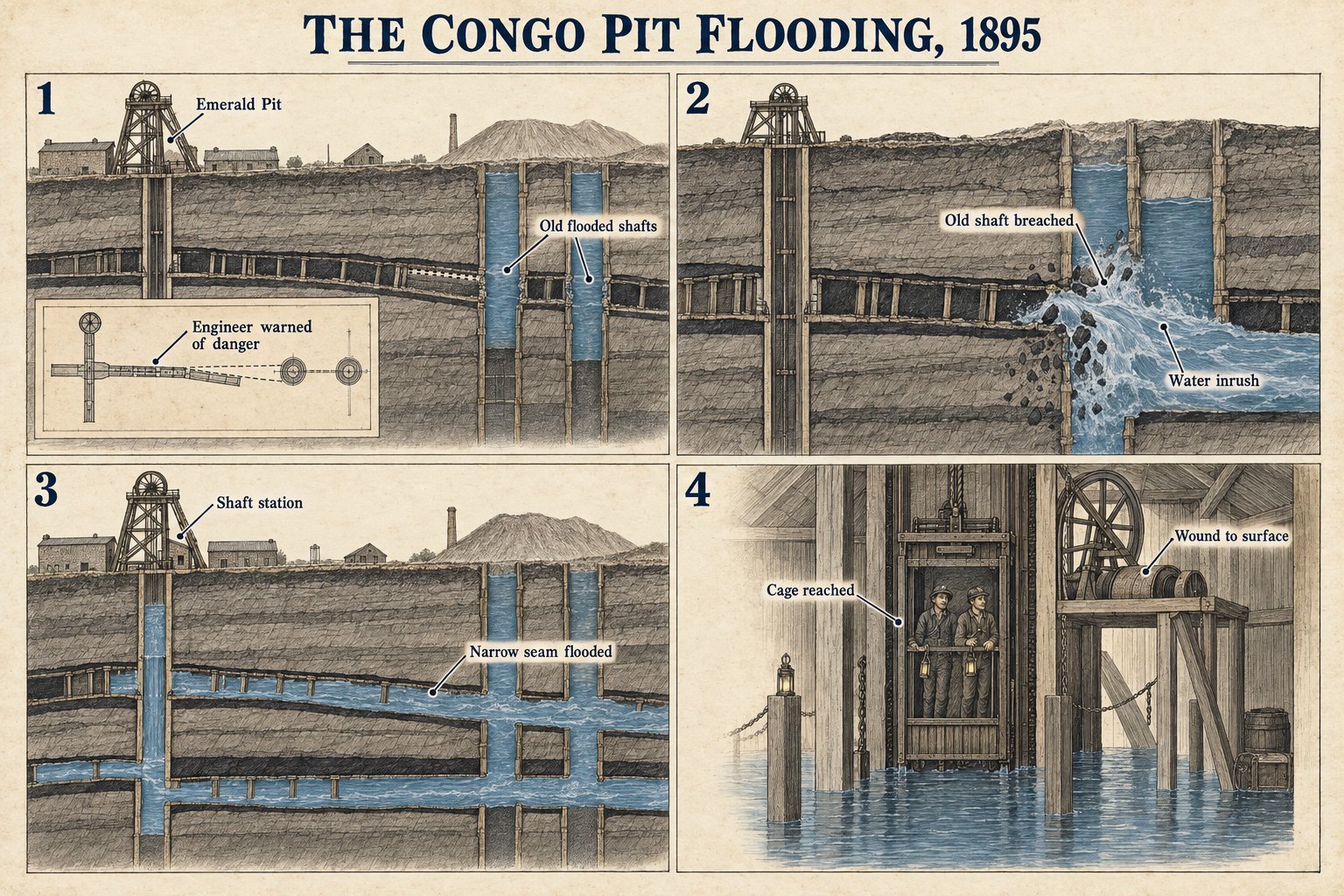
At ten past one in the morning of 10 December 1895 the Emerald Pit in the townland of Congo flooded catastrophically and six men were killed. The colliery's head engineer had warned that old water-filled shafts lay nearby and that breaching one would be disastrous. That is exactly what happened.
| Date | 10 December 1895 |
|---|---|
| Mine | Coalisland Collieries |
| Region | County Tyrone |
| Type | Flooding / Inundation |
| Fatalities | 6 (William Bretland and his nephew David, both of Ashton-under-Lyne; Frederick Mitchell of Manchester; John Cooper of Ashton-under-Lyne; John McMullen of Killybrackey; and Edward Rafferty of Rossbeg.) |
| Context | During active mining (A night-time inrush at a working pit in the East Tyrone coalfield.) |
Cause
An inrush from old, abandoned water-filled shafts into the narrow coal seam the men were working.
Contributing factors
The head engineer at the colliery had raised concerns about the safety of the mine beforehand, warning specifically that there would be old shafts filled with water and that breaching one accidentally would be disastrous.
What happened
Coal had been worked at Congo, a townland west of Coalisland and north of Dungannon, throughout the nineteenth century, including a large pit that closed in 1888 because it kept flooding and had become too dangerous. In 1891 a syndicate from Manchester calling itself the Dungannon Colliery Company sank a new shaft nearby and named it the Emerald Pit.
At ten past one on the morning of 10 December 1895 the men digging the narrow seam breached a shaft of the earlier workings, and huge volumes of water broke in and drowned the six of them. What makes it a hard story is that it had been foreseen: the colliery's own head engineer had warned that the ground held old shafts standing full of water, and that accidentally breaching one would be catastrophic. Four of the six were Englishmen who had come over for the work — two from Ashton-under-Lyne who were uncle and nephew, another from Ashton and one from Manchester. Frederick Mitchell, the Manchester man, was not a miner at all: he was a 21-year-old clerk at the company, and it was curiosity about the workings that had taken him down the shaft that night.
Two men got out. Thomas Ward and Edward McMahon reached the cage with the water round their waists and were wound to the surface.
Rescue & recovery
Thomas Ward and Edward McMahon escaped by reaching the cage as the water gathered around their waists and being wound to the surface; the six men at the face did not get out. Lord and Lady Ranfurly led a relief fund for the families, and money collected at concerts, variety shows, church services and a banquet raised £940, which was shared among the relatives.
Investigation & inquiry
No formal inquiry report is recorded; the account rests on the coalfield's own documented history.
Memorials & commemoration
At least one more man died in the Congo mine afterwards — Peter Hart, crushed by a boulder in November 1899 — and the pit was closed about 1900, five years after the disaster.
Recorded claims
Individual factual claims, each attached to the source(s) that support it below. Where sources disagree, both are kept.
- Water broke in from old abandoned water-filled shafts at 1.10 a.m. on 10 December 1895, killing the six men working the narrow seam. 1
- The dead were William Bretland and his nephew David, Frederick Mitchell, John Cooper, John McMullen and Edward Rafferty. 1
- The colliery's head engineer had warned beforehand that old water-filled shafts lay in the ground and that breaching one would be disastrous. 1
- A relief fund raised £940 for the families; the Congo Pit closed in 1900. 1
- The Emerald Pit was opened in 1891 by a syndicate from Manchester calling themselves the Dungannon Colliery Company, on ground where an earlier large Congo pit had closed in 1888 because it kept flooding and had become too dangerous. 2
- Frederick Mitchell, one of the six killed, was a 21-year-old clerk at the company rather than a miner; it was curiosity about the workings that had taken him down the shaft that night. 2
- Thomas Ward and Edward McMahon reached the cage as the water gathered around their waists and were wound to the surface. 2
- Lord and Lady Ranfurly led a relief fund for the bereaved families; money collected at concerts, variety shows, church services and a banquet raised £940, shared among the relatives. 2
- At least one further death followed at the Congo mine, Peter Hart being crushed by a boulder in November 1899, and the pit closed about 1900. 2
Related terminology
Mining terms this disaster is structurally linked to, with the nature of the relationship.
- Cage (contextual relationship)
Named twice in this record, first in the narrative: “…night. Two men got out. Thomas Ward and Edward McMahon reached the cage with the water round their waists and were wound to the surface.” - Coal (contextual relationship)
The men were working a narrow coal seam when water burst in from old, abandoned water-filled shafts nearby — a hazard the colliery's head engineer had warned about. - Colliery (contextual relationship)
Named 3 times in this record, first in the summary: “…of Congo flooded catastrophically and six men were killed. The colliery's head engineer had warned that old water-filled shafts lay nearby…” - Inrush (direct cause)
Water standing in abandoned shafts released into a working face — the hazard the colliery's engineer had named in advance. - Shaft (contextual relationship)
Named 4 times in this record, first in the summary: “…The colliery's head engineer had warned that old water-filled shafts lay nearby and that breaching one would be disastrous. That is…”
Sources
- (primary) Digging Deep: A History of the East Tyrone Coalfields — Lough Neagh Partnership
- (secondary) The Story of Coal Mining in Coalisland & District — resource notes — Lough Neagh Partnership
Record created: 24 August 2026 · Last researched: 5 September 2026