 MineArchive
Chanters Colliery Explosion, 1957
Gas that had accumulated in Chanters Colliery's No. 2 drift after a roof fall five days earlier was ignited by an electrical arc when an electrician twisted a switch's cover plate onto a live busbar, killing eight men.
| Date | 6 March 1957 |
|---|---|
| Mine | Chanters Colliery |
| Region | Greater Manchester |
| Type | Explosion |
| Fatalities | 8 (Eight men died: Leslie Inman (40, electrician) and Thomas Morris (23, mechanic's mate), Kenneth Tryner (31, electrician's mate) and Fred Woodward (45, engine driver) killed in the explosion itself; Wilfred Beckett (29, repairer), Eric Nutter (21, repairer), Walter Pearson (36, mechanic) and Pawel Socha (46, contractor) died of their injuries. Three more men — Taras Dzundza, Jack Howcroft and Ernest Williams — were injured but survived.) |
| Context | During active mining |
Cause
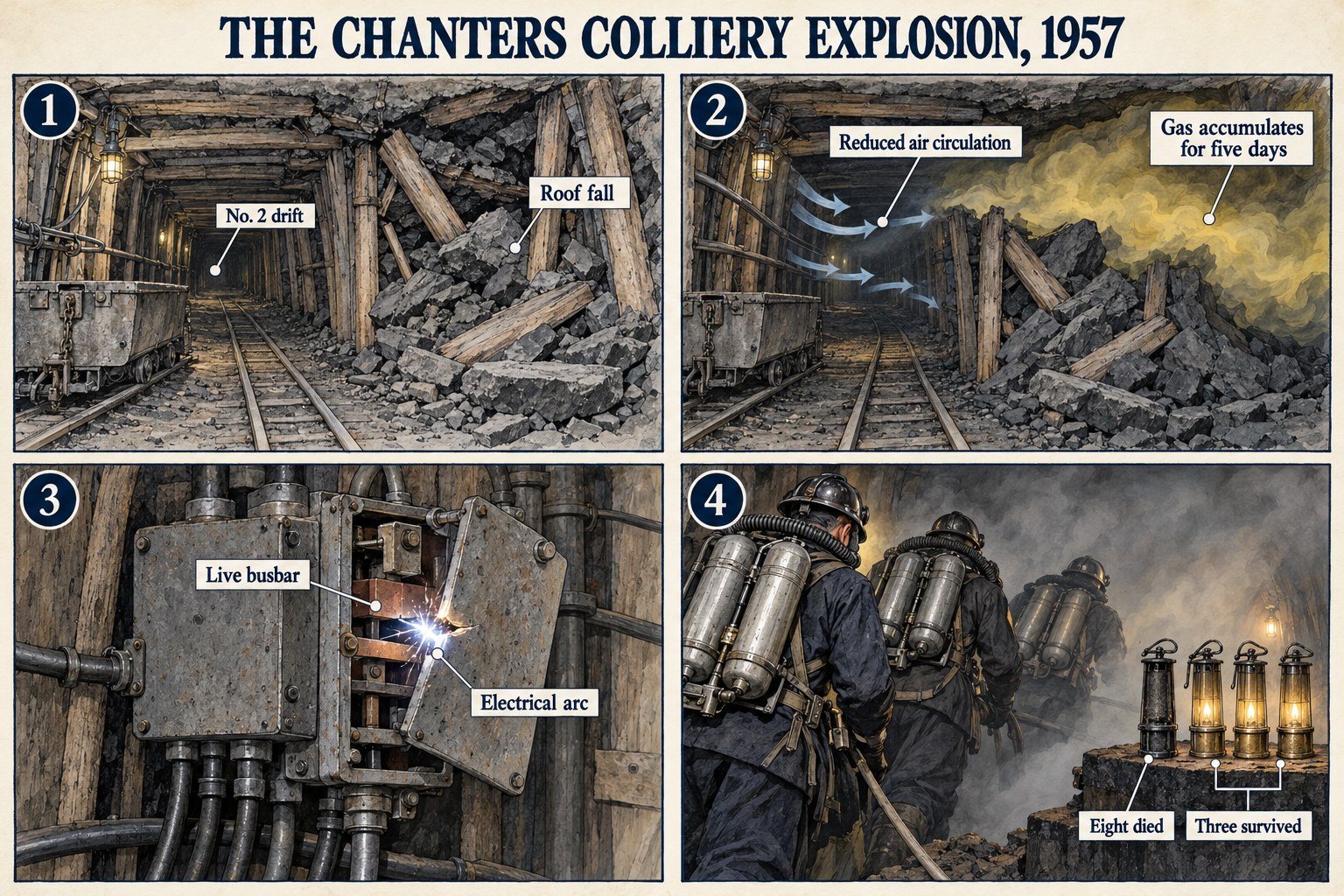
Gas had been accumulating progressively in the No. 2 drift for five days following a roof fall on the development face there, aggravated by reduced air circulation. It was ignited when an electrician twisted the cover plate of a switch, which came into contact with a live busbar and produced an electrical arc.
What happened
A roof fall on the development face of Chanters Colliery's No. 2 drift, five days before the disaster, allowed gas to begin accumulating in the drift as air circulation there was reduced. On 6 March 1957, an electrician twisted the cover plate of a switch, which came into contact with a live busbar; the resulting electrical arc ignited the accumulated gas. Eight men died — four in the explosion itself and four more from their injuries afterward — and three more were injured but survived. Recovery teams working in self-contained breathing apparatus began locating bodies from around 4pm, with four recovered by 6:40pm; survivors either made their own way out or were guided to safety.
Rescue & recovery
Recovery teams in self-contained breathing apparatus began locating the dead from around 4pm, with four bodies recovered by 6:40pm; the survivors either self-evacuated or were guided to safety by rescuers.
Investigation & inquiry
HM Divisional Inspector G. Hoyle investigated the explosion and concluded that electricians had been working on live apparatus without proper safety protocols — a practice he identified as a recurring danger across the industry, not unique to Chanters.
Recorded claims
Individual factual claims, each attached to the source(s) that support it below. Where sources disagree, both are kept.
- Eight men died: Leslie Inman, Thomas Morris, Kenneth Tryner and Fred Woodward killed in the explosion itself, and Wilfred Beckett, Eric Nutter, Walter Pearson and Pawel Socha from their injuries; three more men were injured but survived. 1
- Gas that had accumulated in the No. 2 drift for five days following a roof fall was ignited when an electrician twisted a switch's cover plate onto a live busbar, producing an electrical arc. 1
- HM Divisional Inspector G. Hoyle concluded that electricians had been working on live apparatus without proper safety protocols, identifying this as a recurring danger across the mining industry generally. 1
- Chanters Colliery continued working for almost another decade after the disaster before finally closing in 1966. 2
Related terminology
Mining terms this disaster is structurally linked to, with the nature of the relationship.
- Breathing Apparatus (contextual relationship)
Named twice in this record, first in the narrative: “…were injured but survived. Recovery teams working in self-contained breathing apparatus began locating bodies from around 4pm, with four recovered by…” - Colliery (contextual relationship)
Named twice in this record, first in the summary: “Gas that had accumulated in Chanters Colliery's No. 2 drift after a roof fall five days earlier was ignited by an…” - Drift (contextual relationship)
Named 4 times in this record, first in the summary: “Gas that had accumulated in Chanters Colliery's No. 2 drift after a roof fall five days earlier was ignited by an electrical arc…” - Firedamp (direct cause)
The disaster was a firedamp explosion, the gas having accumulated in an unventilated drift after a roof fall. - Roof Fall (contributing factor)
A roof fall five days before the explosion reduced air circulation in the No. 2 drift, allowing gas to accumulate there undetected.
Sources
- (primary) Chanters Colliery Explosion — Atherton — 1957 — Northern Mine Research Society
- (secondary) Chanters Colliery — Wikipedia — Wikipedia
Record created: 2 September 2026 · Last researched: 2 September 2026