 MineArchive
Cannock Chase No. 9 Pit fire, 1911
On 14 December 1911 fire broke out at the bottom of the downcast shaft of No. 9 Pit, the Hednesford Mine of the Cannock Chase Colliery Company, where oil for the lamps was kept. Most of the 161 men below were brought out, but four men working far inbye died in the smoke, and so did Thomas Stokes, one of the two men who went in to fetch them.
| Date | 14 December 1911 |
|---|---|
| Mine | Cannock Chase No. 9 Pit |
| Region | Staffordshire |
| Primary type | Fire |
| Associated types | Gas / Asphyxiation |
| Fatalities | 5 (Five: William Reeves, 48, stallman; Thomas Stokes, 41, stallman; Jacob Ward, 49, holer; William Baugh, 28, loader; William E. Bradbury, 19, loader.) |
| Context | During active mining |
Location
Plotted at Cannock Chase No. 9 Pit. Approximate location. The large pin is the mine; the small round markers are the nearest mines on record. Click one for its page. View on full map
Cause
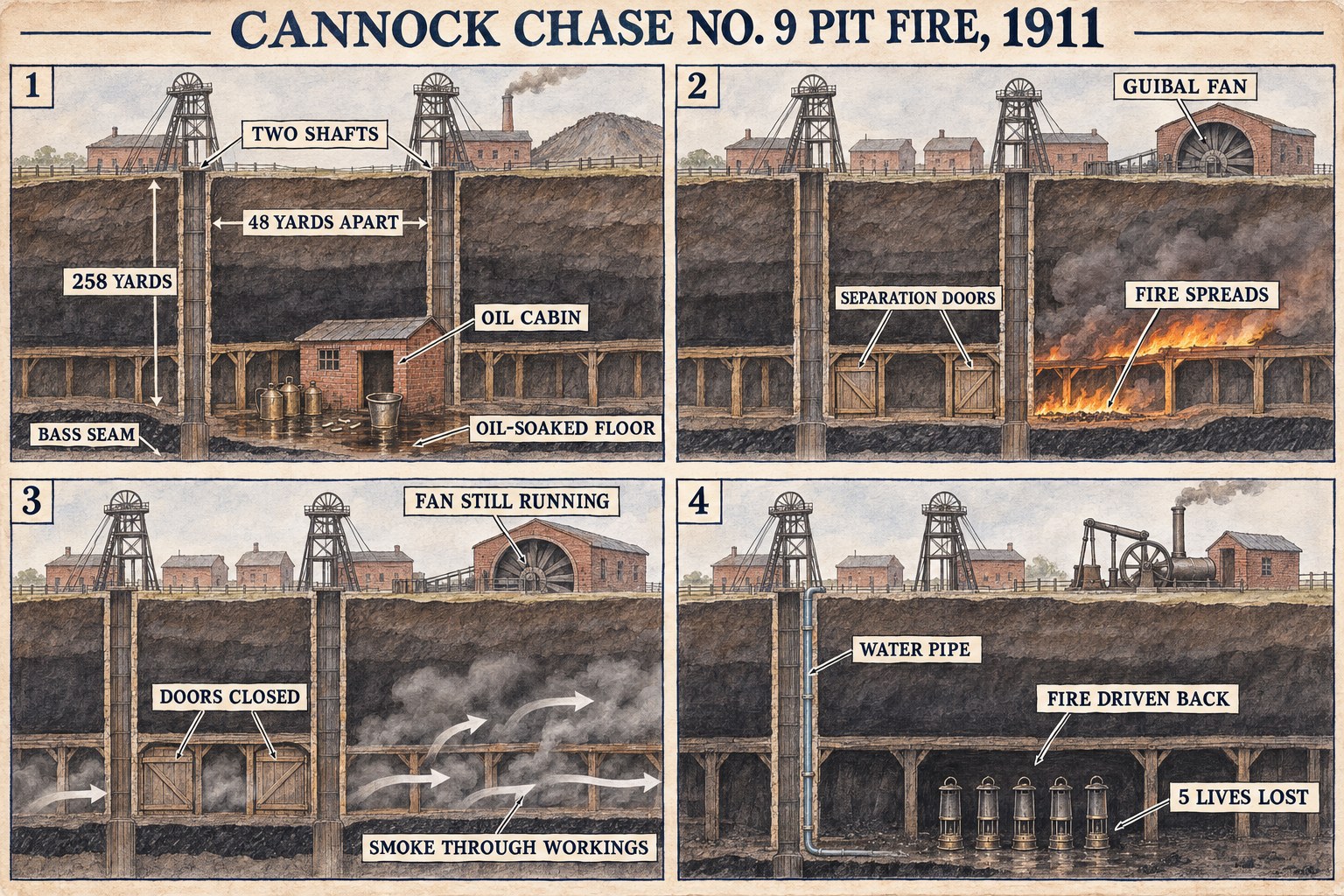
What lit the fire was never established. It was thought that a smouldering lamp wick or snuff from the lamp of one of the lads at the pit bottom had fallen on a floor saturated with oil beside the cabin where the lamp oil was kept. The boys usually filled their lamps by dipping them in a pail under the cans, and wick ends were sometimes thrown about.
What happened
No. 9 had two shafts about 48 yards apart, 258 yards deep to the Bass seam, where the fire began at about 12.10 in the afternoon. The workings were ventilated by a Guibal fan 24 feet across, running at 55 revolutions a minute. A man sent to clean up at the shaft bottom came back after his meal break to find flames spreading along the floor into the woodwork; he tried to stamp them out and could not overturn the tubs, which were buffered too closely.
The overman reached the shaft bottom about 12.30 and began withdrawing the men. He had the separation doors between the shafts opened to short-circuit the air, but did not think to stop the fan. Henry Merritt, an examiner who had been firing shots in No. 1 stall, came out by the return airway and was asked to go in for four men still working in Nos. 2 and 3 stalls. Tom Stokes, a stallman, volunteered to go with him, and the two went more than 800 yards up an incline to reach them.
Meanwhile the undermanager, finding the fire creeping along the roof against the air towards the shafts and fearing it would cut off the upcast, ordered the separation doors closed, which drove the smoke through the workings. On the way back the return airway was badly fouled. Payne followed Merritt out holding on to his waistcoat and Bradbury came behind; the others appear to have stayed where they were. Merritt sent Payne on, went back through the double doors and called, and then tried again with other men from the upcast side, but the smoke was too dense, and he reached the surface exhausted.
Rescue & recovery
A donkey pump at the surface was connected to a pipe down the shaft and the fire was gradually driven back and put out. The local fire brigade did valuable work, and a rescue team from North Staffordshire led by Professor Cadman came with breathing apparatus, though it could only help fight the fire. Bradbury's body was brought up three days later and the others after six days.
Investigation & inquiry
The inspector, Hugh Johnstone, thought the brick-built oil cabin had been put up with care but was badly placed, and that had the fan been stopped and the separation doors opened as soon as the alarm was raised, the fire could have been dealt with before it reached either shaft and the men brought out alive.
Legal & regulatory aftermath
In April 1912 the King awarded the Edward Medal of the first class to Henry Merritt, a fireman, and to the widow of Thomas Stokes, for going 800 yards along the smoke-filled return airway to rescue the men.
Recorded claims
Individual factual claims, each attached to the source(s) that support it below. Where sources disagree, both are kept.
- Five men died in an underground fire at No. 9 Pit, Cannock Chase Colliery, Hednesford, on 14 December 1911. 1,2,3
- Henry Merritt and Thomas Stokes went about 800 yards along the return airway into the smoke to fetch the men; one got out holding on to Merritt, the other four and Stokes died. 1,2
- The fire started near the lamp-oil cabin at the bottom of the downcast shaft; the cause of ignition was not determined. 1
- Henry Merritt and the widow of Thomas Stokes were awarded the Edward Medal of the first class in April 1912. 2
- The inspector held that stopping the fan and opening the separation doors at once would have saved the men. 1
Related terminology
Mining terms this disaster is structurally linked to, with the nature of the relationship.
- Breathing Apparatus (contextual relationship)
Named in this record’s rescue and recovery: “…team from North Staffordshire led by Professor Cadman came with breathing apparatus, though it could only help fight the fire. Bradbury's body was…” - Guibal Fan (contextual relationship)
Named in this record’s narrative: “…at about 12.10 in the afternoon. The workings were ventilated by a Guibal fan 24 feet across, running at 55 revolutions a minute. A man sent to…” - Rescue Brigade (contextual relationship)
Named in this record’s rescue and recovery: “…back and put out. The local fire brigade did valuable work, and a rescue team from North Staffordshire led by Professor Cadman came with breathing…” - Return Airway (contextual relationship)
Named 3 times in this record, first in the narrative: “…examiner who had been firing shots in No. 1 stall, came out by the return airway and was asked to go in for four men still working in Nos. 2 and 3…” - Stall (contextual relationship)
Named twice in this record, first in the narrative: “…fan. Henry Merritt, an examiner who had been firing shots in No. 1 stall, came out by the return airway and was asked to go in for four men…”
Further reading
This page doesn't try to reproduce everything — these are the best original sources found for this disaster.
An account drawn from the inspector's report and the Colliery Guardian, with the escape, the rescue attempts and the names of the dead.
View sourceThe Edward Medal citation for Henry Merritt and Thomas Stokes.
View sourceSources
- (secondary) Hednesford Colliery Fire, Cannock Chase, 1911 (Northern Mine Research Society) — Northern Mine Research Society
- (primary) The London Gazette, 19 April 1912, p. 2789: Edward Medals to Henry Merritt and the widow of Thomas Stokes — The London Gazette
- (secondary) Coal Mining Accidents and Deaths: Thomas Stokes, 1911 (NMRS record 73697) — Northern Mine Research Society
Record created: 19 November 2026 · Last researched: 19 November 2026